
TypeSpec
TypeSpec is a language for defining APIs and data models, then producing schemas, API specifications, code, and documentation.
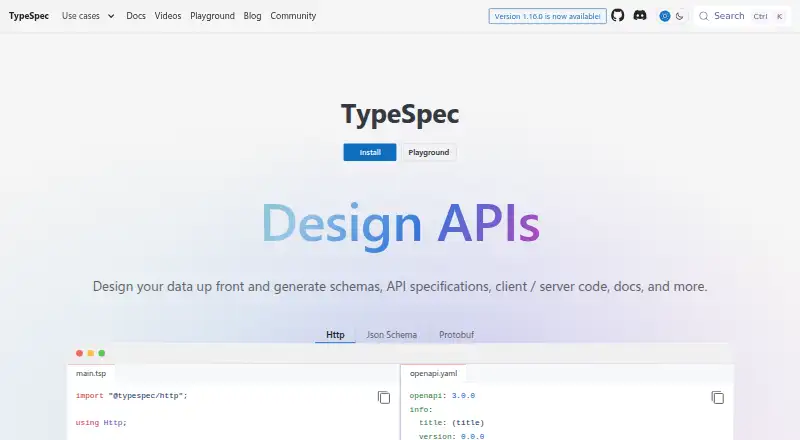
What TypeSpec is
TypeSpec is a language for defining APIs and data models, then producing schemas, API specifications, code, and documentation. Inspired by TypeScript, it offers a lightweight way to describe API shapes. Its standard library supports OpenAPI 3.0, JSON Schema 2020-12, and Protobuf. OpenAPI output can feed tools for API gateways, code generation, and validation; JSON Schema output can validate data against shared models. TypeSpec provides editor support for Visual Studio Code and Visual Studio. The VS Code extension includes syntax highlighting, completion, formatting, diagnostics, quick fixes, refactoring, and API documentation preview. Developers can extend it with custom emitters and decorators. The CLI is available as an npm package for Node.js or as an experimental standalone executable, and the site provides a browser playground. TypeSpec is an open-source project listed as free. The emitter framework remains experimental and under active development, with documentation saying only TypeScript is well supported for that framework at the time described. Client emitters for JavaScript, Python, Java, and C# are in preview and may change.
Good
- Supports OpenAPI 3.0, JSON Schema 2020-12, and Protobuf.
- VS Code extension includes diagnostics, formatting, and refactoring.
- Custom emitters and decorators allow extension.
- Browser playground is available.
- Open-source project listed as free.
Watch out
- Emitter framework is experimental and under active development.
- Client emitters are in preview and subject to change.
- Standalone CLI executable is marked experimental.
- AsyncAPI support is listed as unavailable.
Who it suits
TypeSpec suits developers defining API contracts and shared data models, especially those who want generated specifications or validation schemas. It also offers editor tooling and a browser playground for trying the language.
Verdict
TypeSpec provides a language and tooling for defining API shapes and generating standard outputs. Its editor features and playground are useful entry points, while emitter maturity and preview client generators remain important limitations.
Plans and prices
From TypeSpec's own pricing page, checked 3 Oct 2026.
| Plan | Price | What it gives you |
|---|---|---|
| TypeSpec | Free | Open-source project; TypeSpec CLI and online playground |
The facts
Each one read from TypeSpec's own pages, with the date it was checked.
What it does
- Authentication modeling
- The HTTP library's @useAuth decorator supports applying authentication schemes to a service namespace, sub-namespace, interface, or operation.checked 3 Oct 2026
- Built-in formats
- Its standard library supports OpenAPI 3.0, JSON Schema 2020-12, and Protocol Buffers (Protobuf).checked 3 Oct 2026
- Client generation
- The client emitter guide lists JavaScript, Python, Java, and C# client emitters and says they are in preview and subject to change.checked 3 Oct 2026
- Data validation
- The JSON Schema emitter can produce schemas from shared models for validating data.checked 3 Oct 2026
- Editor integrations
- TypeSpec provides language support for VS Code and Visual Studio, including syntax highlighting and code completion.checked 3 Oct 2026
- Editor support
- TypeSpec provides extensions for Visual Studio Code and Visual Studio.checked 3 Oct 2026
- Emitter status
- The emitter framework is experimental and under active development, and the documentation says only TypeScript is well supported at the time of that page.checked 3 Oct 2026
- Extensibility
- Developers can write custom emitters or add metadata with custom decorators.checked 3 Oct 2026
- Installation
- The CLI is available as an npm package for Node.js or as a standalone executable marked experimental; installation instructions cover macOS, Windows, and Linux.checked 3 Oct 2026
- Integrations
- The VS Code extension can import TypeSpec from existing OpenAPI 3 definitions and emit code from TypeSpec.checked 3 Oct 2026
- Language
- TypeSpec is inspired by TypeScript and is described as a lightweight language for defining API shapes.checked 3 Oct 2026
- Online access
- The site provides an online playground for trying TypeSpec.checked 3 Oct 2026
- OpenAPI workflow
- TypeSpec can generate OpenAPI specifications for use with tools for API gateways, code generation, and data validation.checked 3 Oct 2026
- Output formats
- The standard library supports OpenAPI 3.0, JSON Schema 2020-12, and Protobuf.checked 3 Oct 2026
- Pricing
- The official homepage and documentation pages reviewed present TypeSpec as an installable project and do not list paid plans or prices.checked 3 Oct 2026
- Publisher and support
- TypeSpec is described as a Microsoft-built, community-supported project.checked 3 Oct 2026
- Purpose
- TypeSpec is a language for designing APIs and data models, then generating schemas, API specifications, code, and documentation.checked 3 Oct 2026
- Supported auth schemes
- Documented security scheme options include HTTP authentication, API keys, OAuth2, and OpenID Connect.checked 3 Oct 2026
- Telemetry
- The VS Code extension collects usage data and sends it to Microsoft; the page says it respects the telemetry.telemetryLevel setting.checked 3 Oct 2026
- Telemetry privacy
- The VS Code extension documentation says unknown customer emitters are masked and compiler location telemetry does not store the actual compiler path.checked 3 Oct 2026
- VS Code features
- The VS Code extension provides IntelliSense, syntax highlighting, completion, formatting, diagnostics, quick fixes, refactoring, and API documentation preview.checked 3 Oct 2026
Where it runs
- Browser playground
- The official site links to a TypeSpec Playground for trying TypeSpec in a browser.checked 3 Oct 2026
The company
- Maker
- TypeSpec describes itself as a Microsoft-built, community-supported project.checked 3 Oct 2026
The full review of TypeSpec
Overview
TypeSpec is a programming language for describing APIs and data models and producing reusable outputs from them. It suits developers and teams who want one structured model behind specifications, schemas, code, and documentation. Its breadth of built-in formats and capable editor support make it useful for API design, though its emitter ecosystem is not yet mature enough to treat every generation path as stable.
Key features
TypeSpec uses a lightweight, TypeScript-inspired syntax to define API shapes. Its standard library supports OpenAPI 3.0, JSON Schema 2020-12, and Protocol Buffers (Protobuf), giving a shared model several practical destinations. OpenAPI output can feed API gateways, code-generation tools, and validation workflows; JSON Schema output can validate data against shared models.
Authentication can be modeled with the HTTP library’s @useAuth decorator at service, sub-namespace, interface, or operation level. Supported schemes include HTTP authentication, API keys, OAuth2, and OpenID Connect. Keeping these declarations alongside the API model is useful for teams that want their security requirements represented in the same design artifact.
Extensions for Visual Studio Code and Visual Studio bring TypeSpec into familiar development environments. The VS Code extension includes IntelliSense, syntax highlighting, completion, formatting, diagnostics, quick fixes, refactoring, and API documentation preview. It can import existing OpenAPI 3 definitions and emit code from TypeSpec, which helps teams incorporate existing specifications or connect the language to code workflows.
The language is extensible: developers can create custom emitters or add metadata through custom decorators. That flexibility is valuable when built-in outputs do not cover a team’s needs, but the emitter framework itself is experimental and under active development. Documentation describes TypeScript as the only well-supported emitter at the time of that page; JavaScript, Python, Java, and C# client emitters are in preview and subject to change. Teams depending on those preview clients should account for that uncertainty before making TypeSpec central to production generation.
Getting started is possible through an npm package for Node.js or a standalone executable marked experimental, with installation instructions for macOS, Windows, and Linux. The browser playground offers a way to try the language without beginning with a local installation. TypeSpec is built by Microsoft and supported by its community.
The VS Code extension collects usage data and sends it to Microsoft, while respecting the telemetry.telemetryLevel setting. Its documentation says unknown customer emitters are masked and compiler-location telemetry does not store the actual compiler path. That is useful context for organizations reviewing developer-tool telemetry policies.
Pricing
TypeSpec is free and open source. The TypeSpec plan costs nothing and includes the CLI and online playground. There are no paid tiers to weigh against a cheaper edition, and no seat or usage caps are stated for this plan. It is a straightforward choice for individual developers and teams that want an API modeling tool without a software subscription.
Platforms
TypeSpec supports extension, Linux, macOS, web, and Windows. Editor integrations are available for Visual Studio Code and Visual Studio; the web option is the online playground. The CLI is installable through npm or as an experimental standalone executable, with instructions covering the desktop operating systems.
Who it's for
TypeSpec is a strong fit for API teams that want to define a service once and generate multiple standard outputs, especially where OpenAPI and JSON Schema serve different parts of the workflow. Its editor tooling also makes it appealing to developers who prefer working in an IDE and want diagnostics, refactoring, and documentation preview close to the model.
It is less suitable as a firm foundation for teams whose critical deliverable depends on a preview client emitter or broad, stable support across custom emitters. Those teams should be comfortable with an evolving toolchain or choose a generator centered on their specific output.
Pros and cons
- Pros: One TypeSpec model can produce OpenAPI 3.0, JSON Schema 2020-12, and Protobuf, reducing the need to maintain separate representations for those outputs.
- Pros: The VS Code extension combines rich language tooling with OpenAPI import and code emission, supporting both new design work and some existing specification workflows.
- Pros: Authentication schemes can be attached at several API levels, keeping security modeling close to service definitions.
- Cons: The emitter framework remains experimental, with TypeScript described as the only well-supported emitter in the cited documentation.
- Cons: JavaScript, Python, Java, and C# client emitters are previews subject to change, making them a less dependable basis for production client generation.
- Cons: The VS Code extension sends usage data to Microsoft, a consideration for teams with stricter telemetry policies.
Alternatives
For a broader directory of tools in this space, browse API Design Tools or Code Generators.
- quicktype is a free, open-source option with a web app and CLI; choose it when that combination better matches the workflow than TypeSpec’s API-modeling language.
- SQLDelight is a free, open-source Kotlin SQL code-generation library, making it the more relevant choice for Kotlin SQL generation.
- JHipster is a free, open-source development platform; choose it when a broader development platform is the priority rather than TypeSpec’s focused API modeling.
- Nx offers a free Hobby plan with 50,000 monthly-reset credits, five contributors, and ten concurrent CI connections. It is a better match for readers seeking a development platform with those CI limits and community support.
- OpenAPI Generator is a free open-source generator for API clients, server stubs, documentation, and configurations; choose it when generation from OpenAPI is the primary need.
- Backstage is a free open-source framework and an alternative for readers looking for a framework rather than a language for API definitions.
- sqlc provides a free CLI, while hosted sqlc Cloud features require a cloud project; it is the alternative to consider when its CLI-and-cloud split better suits the intended workflow.
- Stainless has a free plan capped at five generators, five seats, 25 endpoints, and 100 preview builds per month, with a rate limit of 25 per day. It may suit readers who prefer a generator service with explicit free-plan limits.
Verdict
Choose TypeSpec if you want a free, extensible language for maintaining an API model that can generate OpenAPI, JSON Schema, and Protobuf, with strong VS Code support. Look elsewhere if production work depends on stable client emitters beyond the well-supported TypeScript path: several client generators remain previews, and the emitter framework is still evolving.
Alternatives to TypeSpec
- 1
SQLDelight
Free planOpen sourceAndroidiOSWebAPI7.9Free plan - 2
Fern
Free planOpen sourceWebAPILinuxmacOS7.8Free plan - 3
Swagger Codegen
Free planOpen sourceWebAPILinuxmacOS7.6Free plan - 4
APIMatic
Free planWebAPIExtensionLinux7.4From $99 a month - 5
Symfony MakerBundle
Free planOpen sourceAPILinuxmacOSSelf-hosted7.4Free plan - 6

quicktype
Free planWebAPILinuxmacOS7.3From $19 a month