
Jamulus
Jamulus is free, open-source software for playing, rehearsing, and jamming together remotely in real time.
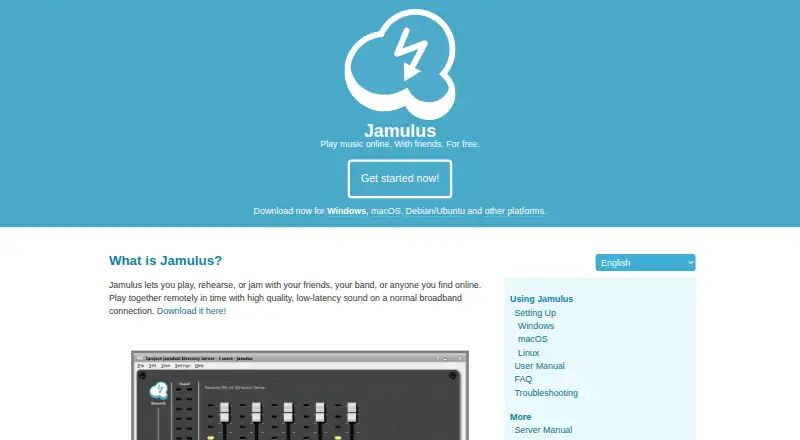
What Jamulus is
Jamulus is free, open-source software for playing, rehearsing, and jamming together remotely in real time. It sends audio over a broadband connection with low latency. The site describes use by choirs, bands, folk and classical musicians, as well as music lessons, schools, and universities. In the client mixer, you can adjust how loudly each connected musician sounds, then mute, solo, pan, or group channels. Clients connected to the same server can also exchange text messages visible to everyone there. A MIDI controller can operate mixer volume, pan, mute, and solo controls, with availability depending on platform and version. You can run your own server, but this is optional: clients can connect to listed or unlisted servers. Network conditions affect server quality; the manual says fewer than five players is usually fine on a slower home connection. Communications are unencrypted, and normal use shares your Jamulus name, city, country, instrument, and skill level with connected servers, peers, and protocol-using third parties. When recording is enabled, unmodified servers show a notice; the operator controls recordings.
Good
- Free and open-source under the GPL.
- Mixer includes mute, solo, pan, and grouping.
- Text chat is visible to everyone on the server.
- Self-hosting a server is optional.
Watch out
- Communications are sent without encryption.
- Normal use shares profile details with connected parties.
- Network conditions affect audio quality.
Who it suits
Jamulus suits musicians, ensembles, and music educators who want to play or rehearse remotely. It is also suitable for users who want free, open-source software and are comfortable with the stated network and privacy conditions.
Verdict
Jamulus offers remote real-time music sessions with useful mixer controls and text chat, without requiring users to host a server. Before using it, consider its unencrypted communications and the profile information shared during normal use.
Plans and prices
From Jamulus's own pricing page, checked 15 Oct 2026.
| Plan | Price | What it gives you |
|---|---|---|
| Free and open-source Jamulus | Free | Real-time online music collaboration · client and server software · GPL-licensed source code |
| Jamulus | Free | Free and open-source software; no usage limits stated |
The facts
Each one read from Jamulus's own pages, with the date it was checked.
What it does
- Authentication limit
- Jamulus has no built-in password protection or other user-authentication mechanism.checked 15 Oct 2026
- Chat
- Clients connected to the same server can exchange text messages that are visible to everyone on that server.checked 3 Oct 2026
- Client-server audio
- Each client sends audio to a Jamulus server, which mixes it and returns an individual mix to every client.checked 15 Oct 2026
- Documentation and support
- The project provides manuals, FAQs, troubleshooting pages, a community knowledge base, GitHub discussions and issue tracking.checked 15 Oct 2026
- Documentation licence
- The Jamulus documentation is published under Creative Commons Attribution-ShareAlike.checked 15 Oct 2026
- Independent rating
- Produce Like A Pro rated Jamulus 3 out of 5, describing it as a strong free client that is easy to start with.checked 15 Oct 2026
- Latest release
- GitHub lists Jamulus 3.12.5, released 31 August 2026, with fixes including a recording-related server crash and a client startup crash.checked 15 Oct 2026
- Licence
- Jamulus is free and open-source software released under the GPL.checked 15 Oct 2026
- Limit: audio instability
- A GitHub issue reports buffering, popping and crackling that made sessions difficult, while noting the technology was promising.checked 15 Oct 2026
- Limit: latency
- The independent review reported that latency can remain a major problem, with distant connections sometimes exceeding 300 ms ping.checked 15 Oct 2026
- Limit: missing video
- The independent review deducted points because Jamulus has no video capability.checked 15 Oct 2026
- Limit: network dependence
- A TalkBass user reported 60–100 ms latency despite wired high-speed connections and considered the result unusable.checked 15 Oct 2026
- Limit: private-server setup
- The independent review found configuring a genuinely private server somewhat difficult because firewall port forwarding is required.checked 15 Oct 2026
- Limit: technical expertise
- Hacker News users said successful sessions may require fiber, Ethernet, wired headphones, suitable audio interfaces and substantial adaptation to delay.checked 15 Oct 2026
- Low-latency focus
- The product is designed for real-time musical performance over ordinary broadband connections.checked 15 Oct 2026
- MIDI control
- A connected MIDI controller can control mixer volume faders, pan, mute, and solo, with platform and version availability documented in the manual.checked 3 Oct 2026
- Mixer
- The client mixer lets users adjust the level they hear from each connected musician, with mute, solo, pan, and grouping controls.checked 3 Oct 2026
- Network guidance
- The FAQ says low ping matters more than high bandwidth and that standard broadband is usually sufficient for clients.checked 15 Oct 2026
- Network requirements
- The manual says server quality depends on network conditions and that fewer than five players is usually fine on a slower home connection such as 10 Mbit/s down and 1 Mbit/s up.checked 3 Oct 2026
- No built-in metronome
- The FAQ says Jamulus has no metronome or synchronization signal.checked 15 Oct 2026
Money
- Free and open source
- Jamulus is free and open-source software licensed under the GPL.checked 3 Oct 2026
Where it runs
- iOS compatibility
- The App Store listing requires iOS 12 or later and supports iPhone and iPad.checked 15 Oct 2026
- iOS hardware guidance
- The iOS documentation strongly recommends a wired audio interface and USB-Ethernet adapter, and says Bluetooth headphones work poorly.checked 15 Oct 2026
The company
- Maker
- The project credits software by Volker Fischer and contributors.checked 15 Oct 2026
The full review of Jamulus
Jamulus is a focused platform for playing, rehearsing and teaching music together remotely with low-latency audio. It best suits small ensembles, instructors and students who need a live session rather than a shared recording project. The main attraction is a capable per-player monitoring mix at no cost; the major reservation is that communications are unencrypted.
Overview
Jamulus connects musicians through servers for real-time audio over a broadband connection. Choirs, bands, folk and classical groups, music teachers, schools and universities are natural users. It is purpose-built for hearing and responding to other players during a session, so it is a stronger fit for live rehearsal than for arranging tracks, exchanging project files or managing a production workflow.
You can join listed or unlisted servers without running infrastructure yourself. Self-hosting remains available for groups that want control over their own server. Network conditions still determine the experience: the documentation says a slower home connection, around 10 Mbit/s down and 1 Mbit/s up, is usually suitable for fewer than five players. That makes small sessions the sensible target on modest broadband, while larger groups demand more careful network planning.
Key features
Per-musician mixer
The client provides an independent level control for each connected musician, plus mute, solo, pan and grouping. In practice, every participant can create a monitoring balance that suits their instrument or role instead of accepting one fixed blend. This is particularly useful in lessons and rehearsals where singers, rhythm sections and ensemble players need different emphasis.
MIDI and text chat
A connected MIDI controller can operate mixer volume faders, pan, mute and solo. Support depends on the platform and software version, so a controller-based setup should be checked against the manual before committing to it. Text chat is shared by everyone on the same server, providing a convenient way to coordinate a count-in, pause or technical change without switching applications.
Servers and recording
Directories can register up to 150 servers. You may use a listed or unlisted server, or operate your own. On unmodified servers, enabling recording displays a notice; the server operator stores and controls the resulting recordings. That arrangement can suit a teacher or ensemble managing its own archive, but participants should understand who controls the files.
Pricing
Jamulus costs free under its free plan. It is free and open-source software licensed under the GPL, with no usage limits stated and no free trial because the software is already free. There are no paid tiers, seat charges or renewal terms to weigh. The trade-off is that you get a focused live-audio client rather than the storage, editing or project-management allowances found in some freemium alternatives.
Platforms
Jamulus supports Android, iOS, Linux, macOS and Windows. An API and self-hosted deployment are also supported. That breadth helps mixed-device groups join the same activity, while self-hosting gives technically capable organisers an additional operating option.
Who it's for
Choose Jamulus for a choir, band, folk or classical ensemble that needs synchronous remote playing; for music lessons where teacher and learner must interact live; or for schools and universities running remote sessions. It is also appropriate for independent groups that want to use a public server without paying. It is less suitable when the priority is composing asynchronously, exchanging multitrack projects, notation, cloud storage or a polished recording pipeline.
Pros and cons
Pros
- Free and open source: the GPL licence removes subscription cost and permits a self-hosted route.
- Useful individual monitoring: level, mute, solo, pan and grouping controls let each player tailor what they hear.
- Live-session focus: real-time audio directly serves rehearsals, lessons and ensemble playing.
- Flexible access: listed, unlisted and self-run servers accommodate different group arrangements.
- MIDI support: compatible controllers can make frequent mix changes more immediate.
Cons
- Unencrypted communications: audio and related exchanges travel without encryption, which is a serious concern for sensitive sessions.
- Profile exposure: a Jamulus name, city, country, instrument and skill level are exchanged with connected servers, peers and protocol-using third parties such as directories.
- Connection-sensitive: quality depends on network conditions, and the stated guidance is aimed at fewer than five players on a slower home link.
- Operator-controlled recordings: when recording is enabled, the server operator controls storage and access.
- Limited production scope: its strengths are live audio and monitoring, not project files, notation or a broader studio workflow.
Alternatives
For a broader music-collaboration catalogue, browse Music Collaboration Software.
Pick Soundtrap instead if you want a freemium, cross-platform workspace with a free account, limited loops and instruments, and a free trial. Flat is the better choice for notation-led collaboration: its free Basic plan includes core notation features, real-time collaboration, MIDI-device transcription and a 15-score limit. Sound Credit suits projects centred on recordings, storage and invitations, with a free Essential plan offering 1 GB and project invites.
Amped Studio is an alternative for browser-based production with projects and tracks; its Starter plan allows five projects and 16 tracks, while Premium is listed at $6.99 a month after a billed seven-day trial. Pibox is more appropriate for file-oriented collaboration: its free plan supports two users, unlimited guests, two projects and 1 GB of storage. Sesh offers a free-forever Starter plan with limited projects and export plus synths, effects, samples and one-hour version history.
Choose SonoBus for another free real-time audio option with standalone apps and audio plugins. JackTrip is worth considering when you want a freemium service with a free plan, trial and the option for studios to host software on their own servers.
Verdict
Jamulus is a strong recommendation for small ensembles, teachers and students who need no-cost, real-time remote playing with personal monitoring control. Its GPL licence, broad device support and optional self-hosting add practical flexibility. Look elsewhere if unencrypted communication, exposed profile details or operator-controlled recordings are unacceptable, or if your work needs a complete collaborative studio rather than a live music session.
Alternatives to Jamulus
- 1

Flat
Free planAndroidiOSWebmacOS8.0From $49.99 a year - 2
Amped Studio
Free planWebLinuxmacOSWindows7.8From $6.99 a month - 3
Audiomovers
AndroidiOSWebmacOS7.6From $12.99 a month - 4

Soundtrap
Free planAndroidiOSWebLinux7.6Free plan - 5
Trackd
Free planiOSWebAPI7.6From $3.49 a month - 6
Sound Credit
Free planAndroidiOSWebmacOS7.4From $4 a month