iWantHue
iWantHue generates and refines palettes of distinct colors for data scientists working with data visualization.
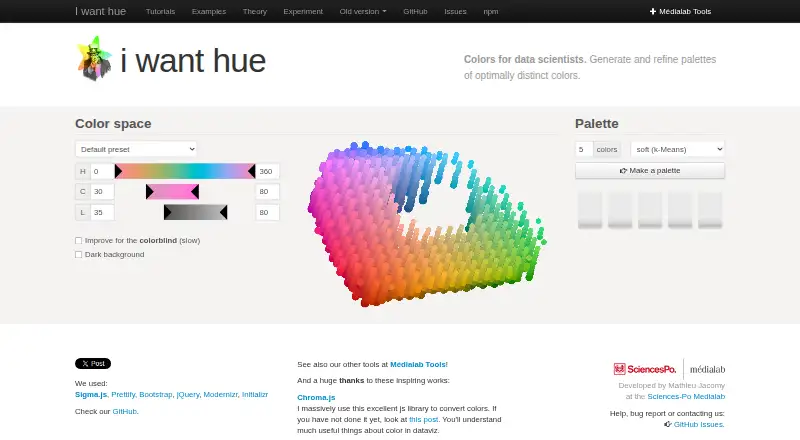
What iWantHue is
iWantHue generates and refines palettes of distinct colors for data scientists working with data visualization. You can constrain colors by hue, chroma, and lightness, then sort a palette by color difference, hue, chroma, lightness, or at random. Its calculations use CIE Lab, with HCL controls, and it offers k-means clustering or force-vector repulsion to distribute colors. A colorblind-improvement option is available. The web interface exports palettes as HEX, RGB, HCL, and LAB JSON, CSS color lists, or JavaScript settings. Developers can install the JavaScript package with npm for Node.js or browser use, generate palettes in code, and use a seed to reproduce a palette from a data attribute. Precomputed palettes from 2 to 15 colors, including colorblind alternatives, are also included in the npm module. Very large palettes may contain similar colors when the selected color space is constrained; the first colors are selected for maximum possible distinction. iWantHue is free.
Good
- Constrains palettes by hue, chroma, and lightness.
- Offers k-means and force-vector repulsion generation.
- Includes an option to improve colorblind accessibility.
- Exports HEX, RGB, HCL, LAB JSON, CSS, and JavaScript.
Watch out
- Large palettes may contain similar colors.
- The Fancy preset is limited to 10 colors.
Who it suits
iWantHue suits data scientists who need to create or refine color palettes for data visualization. Developers can also use its JavaScript package in Node.js or a browser.
Verdict
iWantHue provides palette controls, sorting, and multiple export formats for data visualization work. Its largest palettes may have less distinct colors, depending on the selected color space.
The facts
Each one read from iWantHue's own pages, with the date it was checked.
What it does
- Accessibility
- The interface includes an option to improve palettes for colorblind users.checked 10 Oct 2026
- Audience
- The project describes itself as a tool for data scientists and explains its palette use in data visualization.checked 9 Oct 2026
- Availability
- Sciences Po médialab describes its digital tools as free, and lists I Want Hue as a web interface for generating and refining color palettes.checked 9 Oct 2026
- Color algorithms
- Palette generation uses k-means or force-vector repulsion algorithms to distribute colors.checked 10 Oct 2026
- Color blindness
- The generator includes a colorblind improvement option, and its JavaScript settings list colorblind distance functions.checked 9 Oct 2026
- Color computation
- The generator computes colors in CIE Lab and uses HCL to set color constraints.checked 9 Oct 2026
- Color controls
- Users can constrain palettes by hue, chroma, and lightness.checked 10 Oct 2026
- Developer use
- The project can be installed for Node.js and browser use with npm install iwanthue.checked 10 Oct 2026
- Exports
- The interface provides palette output as HEX, RGB, HCL, and LAB JSON, CSS color lists, and JavaScript settings.checked 10 Oct 2026
- Generation methods
- It offers k-means clustering and force-vector repulsion algorithms to distribute colors.checked 9 Oct 2026
- Integrations
- The repository documents use in JavaScript projects through Node.js and browser npm packages.checked 10 Oct 2026
- JavaScript use
- The project says it can be installed with npm for Node.js and the browser, and documents palette generation in JavaScript.checked 9 Oct 2026
- Large palettes
- When the requested palette is too large for the selected color space, some colors may be similar, though the first colors are sorted to be the most distinct possible.checked 9 Oct 2026
- Notable limit
- The Fancy preset produces generic palettes up to 10 colors, and the page says its narrow chroma and lightness ranges limit palette size.checked 10 Oct 2026
- Palette controls
- Users can constrain palettes by hue, chroma, and lightness.checked 9 Oct 2026
- Palette refinement
- The interface offers options to sort colors by difference, hue, chroma, lightness, or randomly.checked 10 Oct 2026
- Perceptual model
- The project uses CIE Lab for computation and HCL to set color constraints.checked 10 Oct 2026
- Precomputed palettes
- The npm module includes precomputed palettes from 2 to 15 colors, including colorblind alternatives.checked 10 Oct 2026
- Purpose
- iWantHue generates and refines palettes of optimally distinct colors for data scientists.checked 10 Oct 2026
- Reproducibility
- The JavaScript generator accepts a seed to produce the same palette each time from a data attribute.checked 9 Oct 2026
- Security
- The pages reviewed provide no security or compliance claims.checked 9 Oct 2026
- Security and compliance
- The maker's product and repository pages opened here do not state security certifications or compliance claims.checked 10 Oct 2026
- Support
- The maker directs users to GitHub Issues for help, bug reports, and requests.checked 10 Oct 2026
The full review of iWantHue
iWantHue is a palette generator built around the needs of data visualization. It suits data scientists and developers who want to control color separation and carry palettes into code. Its technical controls and formats are a stronger draw than quick, general-purpose palette browsing.
Overview
The generator computes colors in CIE Lab and uses HCL to constrain hue, chroma, and lightness. Users can sort results by color difference, hue, chroma, lightness, or randomly, making refinement practical when a visualization needs a particular ordering as well as a set of colors. This focus on measurable color relationships makes iWantHue a considered choice for chart palettes, but less compelling for people seeking ready-made decorative combinations.
Key features
Palette distribution uses either k-means clustering or force-vector repulsion. A colorblind improvement option helps address accessibility, and JavaScript settings include colorblind distance functions. Those controls give technically minded users useful ways to shape results, though the interface may feel more involved than necessary for a small, informal design task.
Web exports include HEX, RGB, HCL, and LAB JSON, CSS color lists, and JavaScript settings. The npm package supports Node.js and browser use, documents generation in JavaScript, and accepts a seed to reproduce a palette from a data attribute. It also includes precomputed palettes from 2 to 15 colors, including colorblind alternatives. That combination is useful for repeatable development workflows; readers who only need a palette in a single format may not need the package or the broader export choices.
There is a meaningful limit to palette size. When a requested set is too large for the selected color space, some colors may resemble one another, even though the first colors are ordered to be as distinct as possible. The Fancy preset is limited to generic palettes of up to 10 colors because its chroma and lightness ranges are narrow. For a large visualization, users should treat the chosen color space and preset as constraints, not assume every generated color will remain equally distinct.
Pricing
iWantHue is free, with a free plan and no free trial. There are no paid tiers to weigh against the free offering, so its palette controls, exports, and JavaScript package are accessible without a subscription. Users who need a commercially supported service or stated compliance commitments should look elsewhere: iWantHue's product and repository pages make no security or compliance claims. Help and bug reports go through GitHub Issues.
Platforms
The listed platforms are Android, API, iOS, Linux, macOS, web, and Windows. The documented development route is the web interface or npm package for Node.js and browsers; the package documentation is the clearest fit for developers who want repeatable generation in code.
Who it's for
iWantHue is best for data scientists and developers building data visualizations who need to constrain, sort, export, or reproduce palettes. Its controls are especially relevant when distinct categories matter and the palette must move into a JavaScript project. It is less suitable when the priority is a broad design toolkit or simple palette picking without technical tuning.
Pros and cons
- Pros: Hue, chroma, and lightness constraints plus multiple sorting options give users meaningful control over palette structure.
- Pros: HEX, RGB, HCL, LAB JSON, CSS, and JavaScript outputs support both visual selection and implementation.
- Pros: Seeded JavaScript generation supports reproducibility, while colorblind options help account for accessibility.
- Cons: Large palettes can contain similar colors when the selected color space cannot accommodate the requested count.
- Cons: The Fancy preset tops out at 10 generic colors because of its narrow chroma and lightness ranges.
- Cons: Its emphasis on data visualization and technical controls is a poor match for users who want a straightforward decorative palette tool.
Alternatives
For another browser-based option, Pantone Connect Palette Generator has a free Basic plan with access to more than 15,000 colors and Search, Pick, and Measure tools, plus a free trial. ColorKit is another free web option. ColorPalette Pro offers a free web plan with no ads or subscriptions planned. On Linux, Gpick is free and has no paid plans or usage limits stated. Color Palette Generator AI offers free unlimited generations, every export format, shareable links, and an API without an account. Windows users may prefer Colora, a free, open-source tool under the BSD 3-Clause license. ColorBox is a free, ad-free web and extension option. ColorDesigner has a free plan with ads, 12 free tools, HEX export, and caps on saved colors, palettes, and projects. Browse more options in Color Palette Generators.
Verdict
Choose iWantHue if your work is data visualization and you want perceptual controls, accessible color options, and reproducible JavaScript output without paying. Its main trade-off is that color distinction can weaken as palette size pushes beyond the selected space's capacity. For large sets where every color must remain clearly separated, or for less technical palette browsing, a different tool may be a better fit.
Getting started
- Open the iWantHue web interface
- Set hue, chroma, and lightness constraints
- Choose k-means or force-vector repulsion
- Generate and refine the palette
- Sort colors or enable colorblind improvement
- Export the palette or install iwanthue with npm
Limits worth knowing
Palettes requested beyond the selected color space may include similar colors. The Fancy preset produces generic palettes of up to ten colors.
Questions
Is iWantHue free?
Yes. It has a free plan and no free trial is offered.
Which platforms are listed for iWantHue?
The listing includes Android, iOS, Linux, macOS, web, and Windows.
What formats can the web interface export?
It outputs HEX, RGB, HCL, and LAB JSON, CSS color lists, and JavaScript settings.
Can developers use iWantHue in code?
Yes. The package installs with npm for Node.js and browser use, and palettes can be generated in JavaScript.
Can palette generation be reproduced?
Yes. The JavaScript generator accepts a seed that can reproduce the same palette from a data attribute.
Does it support colorblind-friendly palettes?
The interface includes a colorblind-improvement option, and precomputed npm palettes include colorblind alternatives.
Alternatives to iWantHue
- 1

Pantone Connect Palette Generator
Free planAndroidiOSWebExtension8.0Free plan - 2
PaletteWB
Free planWindows7.1$14.99 one-time - 3

Colorfool
Free planWeb6.6Free plan - 4
qualpal
Open sourceWebAPILinuxmacOS6.6 - 5

ColorDesigner
Free planWebExtension6.5From $37.20 a year - 6

ColorPalette Pro
Free planWeb6.5Free plan