
Interactive Chemistry
Interactive Chemistry offers free science games and simulations for teaching principles from middle school through university level.
What Interactive Chemistry is
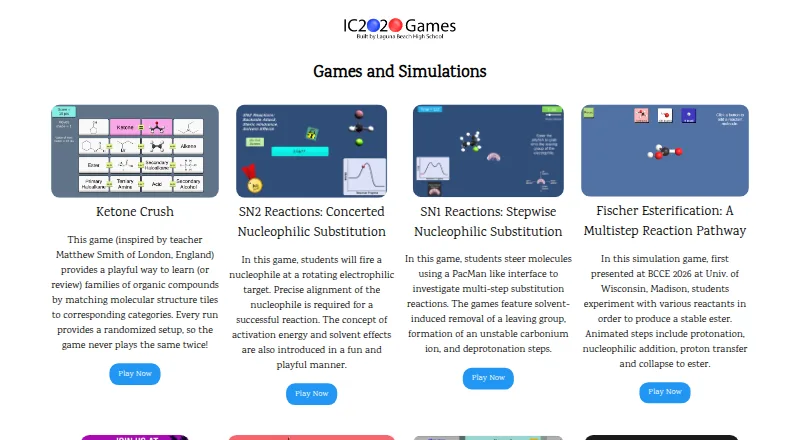
Interactive Chemistry offers free science games and simulations for teaching principles from middle school through university level. Its activities cover topics such as ionic and covalent bonding, cellular respiration, chemical reactions, and molecular interactions. Chemistry teacher Steven Sogo created the games with help from high school students at Laguna Beach High School. The site’s stated aim is to provide web-based activities for science learning, and its listed plan is Free at no cost. The Cell Model 2025 game works on iPads, Android tablets, and most phones. The Double Replacement Reaction Simulator is available on laptops, Chromebooks, and mobile devices. In the Matchmaker double replacement game, students receive immediate feedback when they form correct products and can practice balancing equations; its page also links to suggested lessons and an instructional video. The maker describes experiments and prototypes as unfinished, so they may have bugs or other problems. It also says prototype code is available on GitHub for users to finish themselves. The listed platforms include Android, iOS, macOS, web, and Windows.
Good
- Free web-based games and simulations.
- Covers bonding, respiration, reactions, and molecular interactions.
- Matchmaker gives immediate feedback on correct products.
- Suggested lessons and an instructional video are linked.
Watch out
- Experiments and prototypes may contain bugs or problems.
- Prototype code may require users to finish it themselves.
Who it suits
Interactive Chemistry suits students and teachers looking for free chemistry games and simulations across a range of school levels. The linked lesson materials and equation practice may also help teachers using the Matchmaker activity.
Verdict
Interactive Chemistry brings chemistry practice and simulations to several device types without a listed charge. Its maker warns that experimental projects are unfinished and may have problems.
Plans and prices
From Interactive Chemistry's own pricing page, checked 29 Sep 2026.
| Plan | Price | What it gives you |
|---|---|---|
| Free | Free | Free web-based games and simulations |
The facts
Each one read from Interactive Chemistry's own pages, with the date it was checked.
What it does
- Classroom materials
- The Matchmaker double replacement game page links to suggested lessons and an instructional video.checked 29 Sep 2026
- Contact support
- The site invites users to report bugs or suggest features through linked forms, and lists [email protected] for email contact.checked 29 Sep 2026
- Creator
- The games were created by chemistry teacher Steven Sogo with support from high school students at Laguna Beach High School.checked 29 Sep 2026
- Learning feedback
- The Matchmaker double replacement game gives immediate feedback when students create correct products and provides practice balancing equations.checked 29 Sep 2026
- Mission
- The site says its mission is to provide free web-based games and simulations for teaching science principles.checked 29 Sep 2026
- Mobile access
- The Cell Model 2025 game is playable on iPads, Android tablets, and most phones.checked 29 Sep 2026
- Open source
- The maker says prototype code is available on GitHub for users to finish themselves.checked 29 Sep 2026
- Prototype limits
- The maker describes its experiments and prototypes as unfinished projects that may contain bugs and problems.checked 29 Sep 2026
- Topics
- Its games cover chemistry topics including ionic bonding, covalent bonding, cellular respiration, reactions, and molecular interactions.checked 29 Sep 2026
- What it offers
- Interactive Chemistry provides science games and simulations for teaching principles from middle school through university level.checked 29 Sep 2026
Where it runs
- Device access
- The Double Replacement Reaction Simulator is playable on laptops, Chromebooks, and mobile devices.checked 29 Sep 2026
The company
- Founded
- 2019checked 23 Sep 2026
- Team background
- The maker says it was founded in 2019 and is led by Mr. Sogo, a chemistry teacher at Laguna Beach High School.checked 29 Sep 2026
The full review of Interactive Chemistry
Overview
Interactive Chemistry is a collection of chemistry games and simulations built around individual science concepts, rather than a single virtual laboratory. It suits students and teachers looking for free activities from middle school through university, especially for focused practice in reactions and bonding. Its range is useful for lessons, but the maker cautions that experimental projects remain unfinished and may have bugs.
Chemistry teacher Steven Sogo created the games with help from students at Laguna Beach High School. The project dates to 2019 and is intended to provide free, web-based science teaching tools. Its mix of virtual labs, molecular modeling, reaction simulations and equation tools makes it a flexible supplement, not a uniformly finished course platform.
Interactive Chemistry belongs among Chemistry Simulation Software choices for targeted classroom activities, though the prototype warning matters if reliability is essential.
Key features
The topic-specific format is a strength when a class needs practice on a particular idea; it is less compelling for learners seeking one cohesive environment spanning an entire course.
- Focused chemistry topics: Games cover ionic and covalent bonding, cellular respiration, reactions and molecular interactions, offering teachers several entry points across chemistry and related science.
- Reaction and equation practice: The Double Replacement Reaction Simulator works on laptops, Chromebooks and mobile devices. Matchmaker gives immediate feedback when students make correct products and includes equation-balancing practice, making it a more directed exercise than an open-ended simulation.
- Classroom support: Matchmaker links to suggested lessons and an instructional video, useful for teachers who want to place the game within a lesson rather than assign it without context.
- Mobile activities: Cell Model 2025 can be played on iPads, Android tablets and most phones, while the reaction simulator also supports mobile devices. This helps mixed-device classrooms, although the broader platform range does not guarantee every individual activity works on every device.
- Community feedback and code: Users can report bugs or suggest features through forms, or contact the project by email. Prototype code is available on GitHub for people who want to continue the work themselves; that openness does not remove the practical risk of unfinished projects.
Pricing
The Free plan costs nothing and includes free web-based games and simulations. With no software charge, it is an easy fit for students and teachers who need occasional concept practice or want to supplement instruction without committing to a paid tool. No paid tier is part of this offer, so there is no lower-priced plan that trades away features; the meaningful trade-off is accepting prototype-level bugs and uneven polish.
Platforms
Interactive Chemistry supports Android, iOS, macOS, web and Windows, with mixed delivery formats. Individual activities have their own device reach: Cell Model 2025 supports iPads, Android tablets and most phones, and the Double Replacement Reaction Simulator supports laptops, Chromebooks and mobile devices. That flexibility is helpful for schools with varied hardware, but users should choose an activity with its stated device compatibility in mind.
Who it's for
Teachers who want free, focused exercises on topics such as bonding or double replacement reactions are the clearest audience, particularly when immediate answer feedback or linked lesson materials are useful. Students can use the games for targeted practice from middle school through university. It is a weaker choice for anyone who needs a polished, consistently reliable virtual lab or a single structured learning path, given the maker's warning that experiments and prototypes may have problems.
Pros and cons
- Pro — No-cost access: The free plan includes web-based games and simulations, making classroom supplementation possible without a software fee.
- Pro — Useful reaction practice: Matchmaker combines immediate feedback on correct products with equation-balancing practice, giving students a clear task and response.
- Pro — Classroom and device flexibility: Suggested lessons and an instructional video support teaching, while selected activities run on phones, tablets, laptops and Chromebooks.
- Con — Prototype reliability: The maker says experimental projects are unfinished and may contain bugs, a material drawback for lessons that depend on predictable performance.
- Con — Activity-by-activity experience: The collection spans distinct concepts and delivery formats rather than one consistent lab environment, so it is better for targeted exercises than a unified course workflow.
Alternatives
Beyond Labz is worth considering when an instructor wants free access to teach, preview and build assignments, or a paid Chemistry option at 31.95 USD once for 20 weeks; Interactive Chemistry is the simpler no-cost choice for its focused games.
Collisions Higher Education fits US-based college and university educators seeking free instructor access, while students can get a subscription for $15 a year. Interactive Chemistry is a broader-fit option across middle school through university and does not center on that stated educator eligibility.
PhET Interactive Simulations is a strong alternative when open-source simulations that can be used online or downloaded are the priority; its free simulations are for students and teachers.
ChemCollective Virtual Lab suits users who want a free virtual lab that educators and students can install, use and distribute.
Molecular Workbench is another free, open-source option, developed and maintained by the Concord Consortium, for users whose devices include Linux.
PraxiLabs makes sense for someone who wants a limited trial before paying: its free plan gives one month, three simulations, basic real-time guidance and an English or Arabic interface, while Interactive Chemistry stays free without that stated trial cap.
ChemTube3D is a free educational resource for readers seeking that alternative.
Atomency keeps public individual learning tools open; official school or district adoption, required coursework, institutional pilots and managed deployment require a paid plan, so Interactive Chemistry may suit users who want free classroom games without that adoption path.
Verdict
Choose Interactive Chemistry for free, concept-specific chemistry practice, especially Matchmaker's reaction feedback and equation work or activities suited to a school's mixed devices. Its breadth and classroom links make it a useful supplement for teachers and students, but look elsewhere if an unfinished prototype's bugs would disrupt a lesson or you need one polished, consistent virtual lab.
Getting started
- Open https://interactivechemistry.org/
- Choose a chemistry game or simulation
- Use Cell Model 2025 on an iPad, Android tablet, or phone
- Run Double Replacement Reaction Simulator on a laptop, Chromebook, or mobile device
- Use Matchmaker with its linked lessons and instructional video
- Report bugs or suggest features through the site forms or listed email
Limits worth knowing
The maker describes experiments and prototypes as unfinished projects that may contain bugs or problems.
Questions
Is Interactive Chemistry free?
Yes. The listed Free plan costs nothing and provides free web-based games and simulations.
Which platforms are supported?
The listed platforms are Android, iOS, macOS, web, and Windows.
What chemistry topics are covered?
Activities include ionic and covalent bonding, cellular respiration, reactions, and molecular interactions.
Who created the games?
Chemistry teacher Steven Sogo created them with support from high school students at Laguna Beach High School.
Is the code open source?
The maker says prototype code is available on GitHub for users to finish themselves.
Alternatives to Interactive Chemistry
- 1

Beyond Labz
Free planAndroidiOSWebmacOS8.2$31.95 one-time - 2
PraxiLabs
Free planAndroidiOSWeb8.1From $29.99 a year - 3
Molecular Workbench
Free planOpen sourceWebLinuxmacOSWindows7.6Free plan - 4
ChemCollective Virtual Lab
Free planAndroidiOSWebmacOS7.5Free plan - 5
Avidemux
Free planOpen sourceWebLinuxmacOSWindows7.3Free plan - 6
MolView
Free planWebAPISelf-hosted7.3From $9 a year