
Atomency
Atomency is a browser-based chemistry and physics learning platform with interactive simulations, virtual labs, an interactive periodic table, worked example…
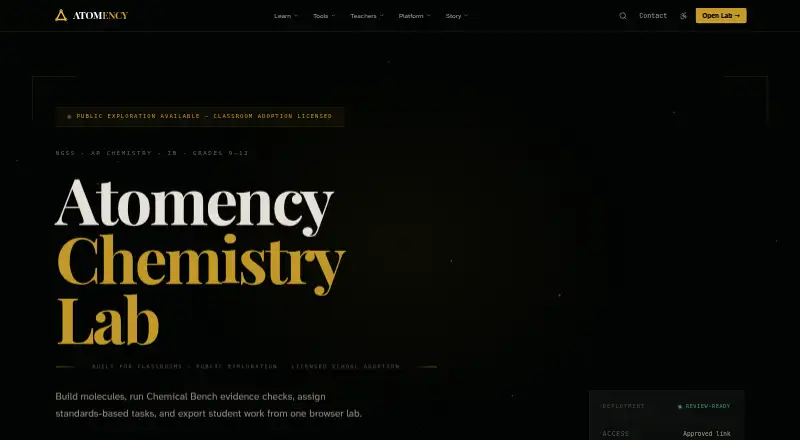
What Atomency is
Atomency is a browser-based chemistry and physics learning platform with interactive simulations, virtual labs, an interactive periodic table, worked examples, and teacher tools. Its molecule builder displays VSEPR geometry, bond angles, lone pairs, hybridization, formal charge, and polarity. The site lists 29 browser simulations and 17 guided virtual labs, with activities including calorimetry, spectrophotometry, buffer preparation, galvanic cells, and osmosis. Teachers can create assignments with molecule-building tasks, balancing challenges, and open-ended questions; answers are hidden in assignment mode. Assignments can be shared through school-approved links or exported for Google Classroom, email, or a district LMS. Learning experiences map to NGSS performance expectations, with content organized around AP Chemistry, IB Chemistry, and A-Level topics. Core public tools work in a modern browser without installation, though some teacher and classroom-management workflows require an account. Public learning tools are free. Official adoption, required coursework, institutional pilots, or managed deployment require a paid license or written authorization.
Good
- Core public tools run in a browser without installation.
- Includes 29 simulations and 17 guided virtual labs.
- Teachers can create and share assignments.
- Learning experiences map to NGSS expectations.
- Public learning tools are free.
Watch out
- Some classroom workflows require an account.
- Official institutional use requires a paid license or authorization.
Who it suits
Atomency suits secondary chemistry and physics students, teachers, families, and school reviewers exploring browser-based learning tools. Schools considering official adoption should note that a paid license or written authorization is required.
Verdict
Atomency offers free public learning tools alongside labs, simulations, and assignment features. Institutional use has separate licensing or authorization requirements.
Plans and prices
From Atomency's own pricing page, checked 30 Sep 2026.
| Plan | Price | What it gives you |
|---|---|---|
| Public individual exploration | Free | Public learning tools open; official school or district adoption, required coursework, institutional pilots, and managed deployment require a paid license or written authorization |
| School or district license | Priced on request | Paid license or written authorization required for official adoption, required coursework, institutional pilots, or managed deployment |
The facts
Each one read from Atomency's own pages, with the date it was checked.
What it does
- Access
- Core public learning tools run in a modern web browser without installation; some teacher and classroom-management workflows use an account.checked 30 Sep 2026
- Adoption limits
- Official school or district adoption, required coursework, institutional pilots, and managed deployment require a paid license or written authorization.checked 30 Sep 2026
- Audience
- The platform is designed for secondary chemistry and physics students, teachers, families, curriculum reviewers, and school or district evaluators.checked 30 Sep 2026
- Curriculum
- Atomency maps learning experiences to NGSS performance expectations and organizes content around AP Chemistry, IB Chemistry, and A-Level topics.checked 30 Sep 2026
- Founder
- The site identifies Ky'lin Spears as Atomency's founder and associates him with Suitland High School and PGCPS.checked 30 Sep 2026
- Molecule builder
- The molecule builder shows live VSEPR geometry, bond angles, lone pairs, hybridization, formal charge, and polarity.checked 30 Sep 2026
- Product
- Atomency is a browser-based chemistry and physics learning platform with interactive simulations, virtual labs, an interactive periodic table, worked examples, and teacher tools.checked 30 Sep 2026
- Recognition caveat
- Atomency says its resource-catalog references are not claims of formal district-wide adoption, endorsement, paid licensing, or partnership.checked 30 Sep 2026
- Sharing and exports
- Assignments can be shared through a school-approved link or exported file for use with Google Classroom, email, or a district LMS.checked 30 Sep 2026
- Simulations
- The site lists 29 browser simulations covering chemistry and physics topics.checked 30 Sep 2026
- Support and review
- The site invites schools to contact Atomency about district adoption, licensing, deployment scope, and review materials before official rollout.checked 30 Sep 2026
- Teacher assignments
- Teachers can build assignments with molecule-building tasks, balancing challenges, and open-ended questions, with answers hidden in assignment mode.checked 30 Sep 2026
- Virtual labs
- The site lists 17 guided virtual labs, including calorimetry, spectrophotometry, buffer preparation, galvanic cells, and osmosis.checked 30 Sep 2026
Alternatives to Atomency
- 1

Beyond Labz
Free planAndroidiOSWebmacOS8.2$31.95 one-time - 2
PraxiLabs
Free planAndroidiOSWeb8.1From $29.99 a year - 3
Molecular Workbench
Free planOpen sourceWebLinuxmacOSWindows7.6Free plan - 4
ChemCollective Virtual Lab
Free planAndroidiOSWebmacOS7.5Free plan - 5
Avidemux
Free planOpen sourceWebLinuxmacOSWindows7.3Free plan - 6
MolView
Free planWebAPISelf-hosted7.3From $9 a year