imagor
imagor is an open-source image processing server and Go library that transforms images through HTTP requests.
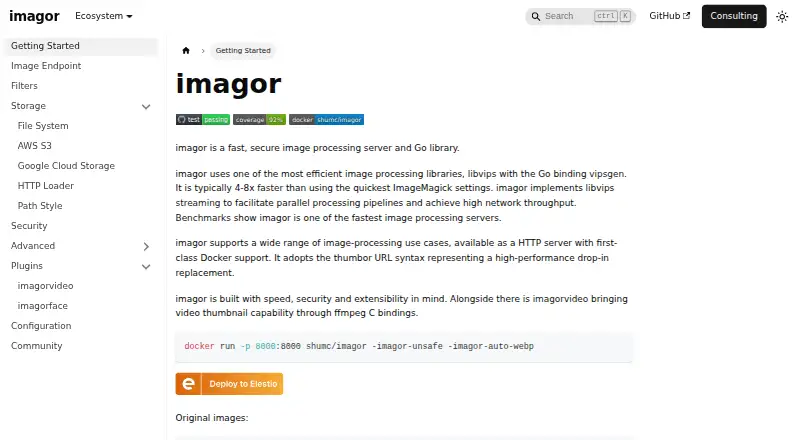
What imagor is
imagor is an open-source image processing server and Go library that transforms images through HTTP requests. Its endpoint supports URL-based cropping, resizing, fitting, padding, and smart crop, with filters for effects such as blur, watermark, format conversion, and text overlay. It can output JPEG, PNG, GIF, WebP, AVIF, JXL, TIFF, and JP2. imagor uses libvips through the vipsgen Go binding, with streaming for parallel processing pipelines, and runs as an HTTP server with Docker support. Built-in adaptors cover HTTP(S), proxy, local files, AWS S3, Google Cloud Storage, and compatible storage such as Cloudflare R2, MinIO, and DigitalOcean Spaces. The docs describe imagor as typically 4–8x faster than the quickest ImageMagick settings. Production guidance recommends signed URLs using IMAGOR_SECRET, source restrictions, URL expiry, and image-size limits. The default signing method is SHA1 HMAC; the docs recommend SHA256 or SHA512 instead. Adjacent projects add video thumbnail extraction and self-hosted face detection, redaction, and metadata. The software is open source, and the docs provide no pricing information.
Good
- Supports URL-based image transformations
- Includes Docker support
- Built-in adaptors cover several storage services
- Open source with no listed price
Watch out
- Default URL-signing method is SHA1 HMAC
- Production use requires attention to URL security settings
Who it suits
imagor suits developers who need a self-hosted HTTP image processing server or Go library, particularly when they need URL-based transformations and storage adaptors. Its security guidance is important to review before production use.
Verdict
imagor offers a broad image transformation pipeline for self-hosted use, with Docker and storage integrations. Review the signing and source restrictions in its security guidance before deploying it.
The facts
Each one read from imagor's own pages, with the date it was checked.
What it does
- Deployment
- imagor is an HTTP server with first-class Docker support.checked 9 Oct 2026
- Face detection
- The imagorface companion supports face-centred smart crop, face redaction and a metadata endpoint, with detection performed self-hosted and without third-party API calls.checked 9 Oct 2026
- Filters
- The filter pipeline includes image transforms such as blur, watermark, format conversion, and text overlay.checked 9 Oct 2026
- Image engine
- imagor uses libvips with the vipsgen Go binding and implements libvips streaming for parallel processing pipelines.checked 9 Oct 2026
- Image limits
- Configurable resolution, width and height limits reject oversized images before processing.checked 9 Oct 2026
- Image processing
- It supports URL-based cropping, resizing, fitting, padding, smart crop, filters, and format conversion.checked 9 Oct 2026
- Limits
- The docs note that the default URL-signing algorithm is SHA1 HMAC and recommend SHA256 or SHA512 because SHA1 is not considered cryptographically secure today.checked 9 Oct 2026
- Performance
- imagor uses libvips through vipsgen and implements streaming for parallel processing pipelines and high network throughput.checked 9 Oct 2026
- Pricing
- The official docs provide no pricing information for imagor.checked 9 Oct 2026
- Product
- imagor is a fast, secure image processing server and Go library.checked 9 Oct 2026
- Purpose
- imagor is a fast image processing server and Go library.checked 9 Oct 2026
- Resource limits
- The security guide documents image resolution limits, request and loader timeouts, processing concurrency caps, and a queue size that can return HTTP 429 when full.checked 9 Oct 2026
- Security
- The security guide recommends requiring signed URLs with IMAGOR_SECRET in production and warns that IMAGOR_UNSAFE disables signature verification.checked 9 Oct 2026
- Source restrictions
- The HTTP Loader can restrict source hosts with allowlists, lock loading to a base URL, or refuse plain HTTP sources.checked 9 Oct 2026
- Speed
- The docs say imagor is typically 4–8x faster than the quickest ImageMagick settings.checked 9 Oct 2026
- Storage integrations
- Built-in adaptors support HTTP(S), proxy, file system, AWS S3 and Google Cloud Storage; S3-compatible options include Cloudflare R2, MinIO and DigitalOcean Spaces.checked 9 Oct 2026
- Support
- imagor remains open source, with bugs and feature requests handled through GitHub Issues; optional commercial support is provided independently by Adrian C. Shum.checked 9 Oct 2026
- Transformations
- Its image endpoint supports cropping, resizing, fitting, padding, and smart crop.checked 9 Oct 2026
- URL compatibility
- imagor adopts thumbor URL syntax as a high-performance drop-in replacement.checked 9 Oct 2026
- URL expiry
- Signed URLs can use the expire filter, and requests with an expired timestamp are rejected even if the signature is valid.checked 9 Oct 2026
- URL security
- The security guide recommends setting IMAGOR_SECRET to require HMAC-signed request URLs in production.checked 9 Oct 2026
- Video
- The imagorvideo companion adds video thumbnail extraction through ffmpeg C bindings and sends the selected frame through imagor’s image pipeline.checked 9 Oct 2026
- Video extension
- The docs describe imagorvideo as an adjacent project that adds video thumbnail capability through ffmpeg C bindings.checked 9 Oct 2026
Alternatives to imagor
- 1
imgproxy
Free planOpen sourceAndroidiOSWebAPI8.6Free plan - 2

Topaz Gigapixel
AndroidiOSWebAPI7.5From $149 a year - 3
Converseen
Free planOpen sourceLinuxmacOSWindows7.3Free plan - 4

Fotosizer
Free planWindows7.3$13.88 one-time - 5

PixelMod
Free planWebmacOSWindows7.2From $7 a month - 6
BatchPhoto
macOSWindows7.1$29.95 one-time