
Hopsworks Feature Store
Hopsworks Feature Store is a layer for managing, reusing, and serving machine-learning features.
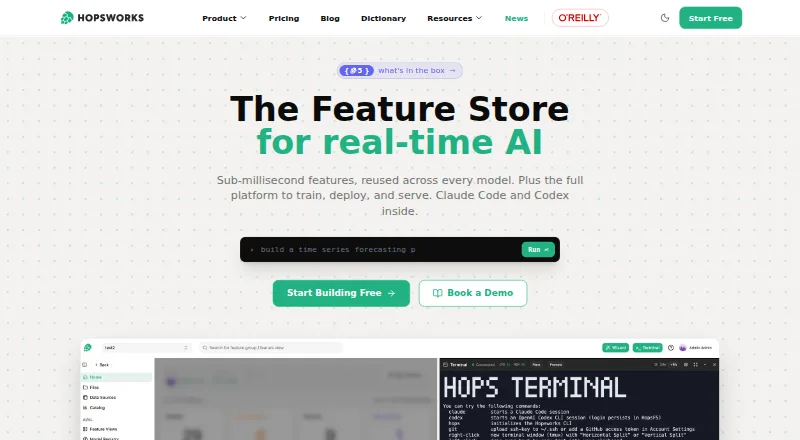
What Hopsworks Feature Store is
Hopsworks Feature Store is a layer for managing, reusing, and serving machine-learning features. It pairs an offline store based on Apache Hudi tables on HopsFS with an online RonDB key-value store. The platform can generate training datasets using feature values from a historical point in time, helping prevent data leakage. Its Feature Registry offers metadata search, automatic analysis and statistics, version comparison, and access control. Hopsworks also tracks feature distributions, detects drift, and can send alerts. Integrations listed include Airflow, Apache Flink, Databricks, Snowflake, Spark, AWS SageMaker, Vertex AI, and Weights & Biases. Deployment options include managed SaaS, Kubernetes on AWS, Azure, or GCP, and air-gapped data centres. Security features described include encryption at rest and in transit, project-based controls, two-factor authentication, and SSO. The free tier includes one project and community support; SaaS usage is pay as you go, while Enterprise pricing is custom.
Good
- Online and offline feature stores
- Creates point-in-time training datasets
- Tracks feature drift and can send alerts
- Free tier includes one project
Watch out
- Free tier includes community support
- Enterprise pricing is custom
- Self-hosting requires Kubernetes 1.27 or higher
Who it suits
Hopsworks presents the platform for data scientists, data engineers, developers, platform and security engineers, and administrators building production AI systems. It suits teams that need both online and offline feature storage and deployment choices from SaaS to air-gapped environments.
Verdict
Hopsworks combines feature management, historical training data, monitoring, and multiple deployment approaches. The free tier is limited to one project, while SaaS and Enterprise details depend on usage or a custom quote.
Plans and prices
From Hopsworks Feature Store's own pricing page, checked 29 Sep 2026.
| Plan | Price | What it gives you |
|---|---|---|
| Free | Free | 1 project · Feature Store + Model Registry · Community support · No credit card required |
| Enterprise | Priced on request | All SaaS features · On-premise and air-gapped deployments · Dedicated support team · Custom integrations · Guaranteed SLA · Custom |
| SaaS | Priced on request | Unlimited projects · Feature Store + Model Registry · Model Serving · Usage-based pricing · Community support · Platform SLA · Pay as you go |
The facts
Each one read from Hopsworks Feature Store's own pages, with the date it was checked.
What it does
- Certifications
- Hopsworks states that it is certified under ISO 27001 and SOC 2 Type 2 and is GDPR compliant.checked 29 Sep 2026
- Deployment options
- The documentation describes managed SaaS and deployment on AWS, Azure, or GCP Kubernetes, as well as air-gapped data centres.checked 29 Sep 2026
- Feature monitoring
- Hopsworks says it tracks feature distributions, detects drift, and can send alerts.checked 29 Sep 2026
- Feature registry
- The Feature Registry offers metadata search, automatic feature analysis and statistics, version comparison, and access control.checked 29 Sep 2026
- Integrations
- Listed integrations include Airflow, Apache Flink, Databricks, Snowflake, Spark, AWS SageMaker, Vertex AI, and Weights & Biases.checked 29 Sep 2026
- Online and offline storage
- The Feature Store pairs an offline store based on Apache Hudi tables on HopsFS with an online RonDB key-value store.checked 29 Sep 2026
- Point-in-time training data
- The platform can generate training datasets that reflect feature state at a historical point to prevent data leakage.checked 29 Sep 2026
- Product
- Hopsworks describes its Feature Store as a managed layer for managing, reusing, and serving machine-learning features.checked 29 Sep 2026
- Security
- The security page describes encryption at rest and in transit, project-based access controls, and authentication options including two-factor authentication and SSO.checked 29 Sep 2026
- Self-hosting requirements
- The Kubernetes installer page lists AWS EKS, Google GKE, Azure AKS, and OVHCloud, Kubernetes 1.27 or higher, and recommends at least 4–5 nodes.checked 29 Sep 2026
- Support
- The Free and SaaS pricing tiers list community support; Enterprise lists a dedicated support team.checked 29 Sep 2026
- Who it is for
- Hopsworks presents the platform for data scientists, data engineers, developers, platform engineers, security engineers, and administrators building production AI systems.checked 29 Sep 2026
The company
- Company
- Hopsworks says it was founded in 2017 and lists offices in Palo Alto, London, and Stockholm.checked 29 Sep 2026
- Founded
- 2017checked 23 Sep 2026
The full review of Hopsworks Feature Store
Overview
Hopsworks Feature Store is a managed layer for organizing, reusing, and serving features in machine-learning systems. It suits teams building production AI across data and platform roles, particularly those that need historical training data and a choice of managed or self-hosted deployment. Its breadth is a strength, but the free plan’s one-project cap makes it better for evaluating or narrowly scoped work than for a growing portfolio.
Key features
Hopsworks pairs an offline store built on Apache Hudi tables on HopsFS with an online RonDB key-value store. That combination supports both historical data workflows and online feature access, rather than forcing teams to choose between the two. Point-in-time training datasets reflect feature values as they stood at a past moment, helping prevent data leakage when building training data.
The Feature Registry adds metadata search, automatic feature analysis and statistics, version comparison, and access control. These capabilities help teams find and manage features as shared assets; they are most useful when several people or projects need consistent feature definitions. Monitoring tracks feature distributions, detects drift, and can send alerts, giving teams a way to spot changes that may affect production models.
Integrations include Airflow, Apache Flink, Databricks, Snowflake, Spark, AWS SageMaker, Vertex AI, and Weights & Biases. Security features include encryption at rest and in transit, project-based access controls, two-factor authentication, and SSO. Hopsworks states that it is ISO 27001 and SOC 2 Type 2 certified and GDPR compliant.
Pricing
The Free plan costs nothing and includes one project, the Feature Store and Model Registry, and community support. No credit card is required. The project limit is the key trade-off: it provides a no-cost way to start, but restricts teams that need to separate multiple production projects.
SaaS uses custom pricing billed Pay as you go. It includes unlimited projects, Feature Store and Model Registry, Model Serving, usage-based pricing, community support, and a platform SLA. This is the fit for teams that want managed service and room to scale; usage-based billing means cost depends on use.
Enterprise has custom pricing, billed Custom. It includes all SaaS features, on-premise and air-gapped deployments, a dedicated support team, custom integrations, and a guaranteed SLA. It is aimed at organizations that need controlled deployment or tailored support, rather than teams seeking a published, predictable entry price.
Platforms
Hopsworks supports API, Linux, self-hosted, and web access. Deployment options span managed SaaS and Kubernetes on AWS, Azure, or GCP, as well as air-gapped data centres. Self-hosting is a substantial infrastructure commitment: the installer requires Kubernetes 1.27 or higher, supports AWS EKS, Google GKE, Azure AKS, and OVHCloud, and recommends at least four to five nodes. SaaS is the simpler route for teams that do not want to operate that environment.
Who it's for
Hopsworks presents itself for data scientists, data engineers, developers, platform engineers, security engineers, and administrators building production AI systems. It makes the most sense for teams that need shared feature management, historical training data, monitoring, and deployment flexibility in one platform. A single-project experiment or a team without Kubernetes capacity may be better served by the free tier only as a starting point, or by a lighter open-source option.
Pros and cons
- Pros: Online and offline stores plus point-in-time training data cover serving and leakage-aware training workflows.
- Pros: Registry search, analysis, version comparison, access controls, and drift alerts support collaboration and operational oversight.
- Pros: Managed, cloud Kubernetes, and air-gapped deployment choices accommodate different infrastructure constraints.
- Cons: The free plan allows only one project, limiting its usefulness for teams with multiple environments or product lines.
- Cons: Self-hosting calls for Kubernetes 1.27 or higher and a recommended four to five nodes, a meaningful operational burden.
- Cons: SaaS and Enterprise require custom pricing rather than a published amount, so teams cannot estimate cost from a fixed plan price.
Alternatives
Choose Feast if a free, open-source feature store across API, Linux, self-hosted, and web platforms better suits your needs. Canal is another free option, with an Apache-2.0 open-source project and API, Linux, macOS, and self-hosted platforms. OpenMLDB suits readers looking for a free open-source machine-learning database with standalone and cluster versions. Chronon offers a free Apache 2.0 open-source option for API and self-hosted use, with no usage limits stated.
Consider Amazon SageMaker Autopilot instead if you want a paid service with a free trial and pay-only-for-use on-demand pricing; the stated rate is not specific to Autopilot. Chalk is a paid API, self-hosted, and web alternative. Snowflake Feature Store is worth considering for consumption-based pricing and Snowpark, data sharing, optimized storage, and Time Travel in its Standard plan.
Browse more options in Feature Store Software.
Verdict
Hopsworks is a strong choice for production AI teams that need online and offline features, point-in-time training data, registry controls, and a route from SaaS to controlled deployments. Its main reason to choose it is the combination of feature lifecycle capabilities and deployment range. Look elsewhere if a one-project free tier is too restrictive, self-hosting capacity is limited, or you need a published price before committing.
Getting started
- Visit https://www.hopsworks.ai/.
- Start with the Free plan, which includes one project and requires no credit card.
- Choose managed SaaS or review the deployment options for AWS, Azure, GCP, or air-gapped data centres.
- For Kubernetes self-hosting, use a listed provider: AWS EKS, Google GKE, Azure AKS, or OVHCloud.
- Set up a project and use the Feature Store and Model Registry.
Limits worth knowing
The Free plan is limited to one project. SaaS is pay as you go with unlimited projects; Enterprise pricing is custom.
Questions
Does Hopsworks have a free plan?
Yes. Free includes one project, Feature Store and Model Registry, and community support, with no credit card required.
How is Hopsworks SaaS priced?
The SaaS plan is pay as you go with usage-based pricing. Its price is not given here.
What deployment options are available?
Options include managed SaaS, deployment on AWS, Azure, or GCP Kubernetes, and air-gapped data centres.
What does the Free plan include?
It includes one project, Feature Store and Model Registry, and community support.
What integrations are listed?
Integrations include Airflow, Apache Flink, Databricks, Snowflake, Spark, AWS SageMaker, Vertex AI, and Weights & Biases.
What does Enterprise include?
Enterprise includes all SaaS features, on-premise and air-gapped deployments, a dedicated support team, custom integrations, and a guaranteed SLA.