Chronon
Chronon is an open-source feature platform for building, deploying, managing, and monitoring machine-learning data pipelines.
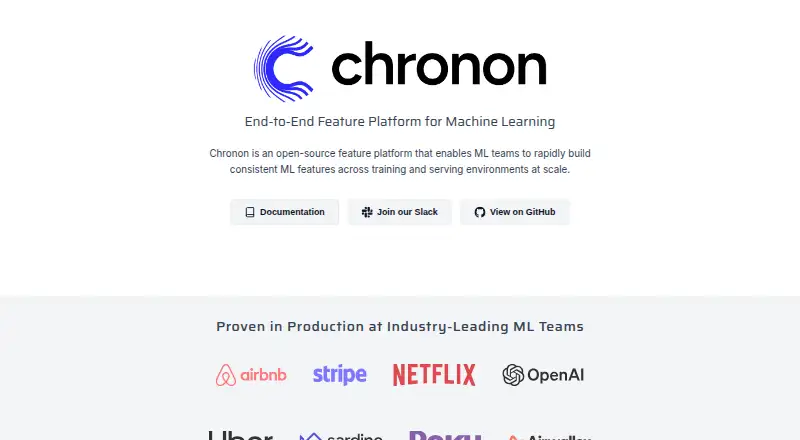
What Chronon is
Chronon is an open-source feature platform for building, deploying, managing, and monitoring machine-learning data pipelines. It computes features in batches and in real time for online serving, offline training, and evaluation. Teams define features with a Python API for transformations and aggregations, drawing on sources such as event streams, warehouse tables, databases, change data streams, service endpoints, and request context. Point-in-time-correct backfills are intended to keep offline training features aligned with production inference data. Chronon can generate monitoring pipelines for training-data quality, training-serving skew, and feature drift. Batch processing uses Spark; streaming options include Spark Streaming and an experimental Flink connector. Online serving uses Java or Scala Fetcher libraries embedded in a service or application, with a user-provided key-value store such as Redis or DynamoDB. Chronon is self-hosted and licensed under Apache 2.0. Jobs require Spark, and the quickstart uses Docker and docker-compose for local setup. The project points users to GitHub Issues for bugs and feature requests and community Slack for discussion and support.
Good
- Open source under Apache 2.0.
- Supports batch and real-time feature computation.
- Generates pipelines for feature quality and drift monitoring.
- Supports point-in-time-correct training backfills.
Watch out
- Chronon jobs require Spark.
- Local quickstart requires Docker.
- Users provide a key-value store.
- Streaming Flink connector is experimental.
Who it suits
Chronon suits machine-learning teams that need to compute and serve features for training and production systems. It is a fit for teams prepared to run Spark jobs and manage self-hosted infrastructure.
Verdict
Chronon covers feature computation, serving, and monitoring in a self-hosted open-source platform. Its Spark requirement and supporting infrastructure make setup an important consideration.
Plans and prices
From Chronon's own pricing page, checked 4 Oct 2026.
| Plan | Price | What it gives you |
|---|---|---|
| Open source | Free | Apache 2.0 license · no usage limits stated |
The facts
Each one read from Chronon's own pages, with the date it was checked.
What it does
- Adoption
- The project lists Airbnb, Stripe, OpenAI, Roku, Netflix, Uber, Intuit, Airwallex, Sardine AI, and Monzo Bank as adopters.checked 4 Oct 2026
- Batch and streaming
- Chronon uses Spark for batch jobs and supports streaming with Spark Streaming or an experimental Flink connector.checked 4 Oct 2026
- Compute integrations
- The homepage describes Apache Spark for batch processing and Apache Flink for streaming aggregations.checked 4 Oct 2026
- Consistency
- Chronon supports temporally accurate offline backfills intended to keep training data consistent with production inference data.checked 4 Oct 2026
- Data inputs
- Documented inputs include event streams, warehouse tables, production databases, change data streams, service endpoints, and request-context data.checked 4 Oct 2026
- Data sources
- Chronon can consume event streams, database snapshots, change data streams, service endpoints, and warehouse tables.checked 4 Oct 2026
- Deployment requirement
- Chronon jobs require Spark, and users configure execution through a spark_submit.sh script.checked 4 Oct 2026
- Feature computation
- Chronon supports batch and real-time feature computation for online serving and offline training or evaluation.checked 4 Oct 2026
- Feature definitions
- Users define features with a Python API using concepts such as GroupBy, Join, and StagingQuery.checked 4 Oct 2026
- Feature monitoring
- Chronon can generate monitoring pipelines for training-data quality, training-serving skew, and feature drift.checked 4 Oct 2026
- Getting started
- The project quickstart requires Docker and describes running Chronon locally with a docker-compose file.checked 4 Oct 2026
- License
- The Chronon project is published under the Apache 2.0 license.checked 4 Oct 2026
- Monitoring
- It can generate monitoring pipelines for training-data quality, training-serving skew, and feature drift.checked 4 Oct 2026
- Orchestration
- Airflow is the best-supported orchestration method, though the documentation says other integrations are possible.checked 4 Oct 2026
- Point-in-time correctness
- Chronon supports point-in-time-correct training backfills to help keep offline training features consistent with online serving.checked 4 Oct 2026
- Product
- Chronon is an open-source feature platform for building, deploying, managing, and monitoring machine-learning data pipelines.checked 4 Oct 2026
- Security reporting
- The repository security policy asks users to report potential security issues through Airbnb's Bug Bounty program rather than public issues or pull requests.checked 4 Oct 2026
- Serving API
- Chronon provides Java and Scala Fetcher libraries, and the Fetcher can also be used to create a service callable over REST.checked 4 Oct 2026
- Setup requirement
- Chronon jobs require Spark to run, and the data integration guide assumes access to a Spark environment connected to the data warehouse.checked 4 Oct 2026
- Storage integration
- Chronon uses a bring-your-own key-value store approach, with Redis and DynamoDB listed as examples.checked 4 Oct 2026
- Streaming integration
- For online streaming, Chronon requires a StreamDecoder to convert Kafka message bytes into Chronon events or mutations.checked 4 Oct 2026
- Support
- The project README directs users to GitHub Issues for bugs or feature requests and its community Slack for discussion, tips, and support.checked 4 Oct 2026
- What it does
- Chronon is an open-source feature platform for building, deploying, managing, and monitoring machine-learning data pipelines.checked 4 Oct 2026
The full review of Chronon
Chronon is a self-hosted, open-source feature platform for machine-learning data pipelines. It suits engineering teams that already operate Spark and related data infrastructure and need one system for offline and online features. The payoff is strong control and point-in-time accuracy; the cost is taking responsibility for deployment, storage, and serving.
Overview
Chronon covers feature definition, computation, deployment, serving, and monitoring in an Apache 2.0 project. A Python API expresses transformations and aggregations, with inputs ranging from event streams and warehouse tables to production databases, change streams, service endpoints, and request-context data. That breadth lets teams bring existing data into a common feature workflow rather than limiting them to one source type.
Its most consequential capability is temporally accurate backfilling for training. By preserving point-in-time correctness, Chronon is designed to keep offline training data aligned with what would have been available during production inference. It can also generate monitoring pipelines for training-data quality, training-serving skew, and feature drift, giving teams useful checks around the feature lifecycle instead of only a calculation engine.
Key features
Batch, streaming, and point-in-time joins
Spark runs batch computation, while streaming can use Spark Streaming; an experimental Flink connector is also supported, and the homepage describes Flink for streaming aggregations. Kafka-based online streaming requires a StreamDecoder to convert message bytes into Chronon events or mutations. The point-in-time join and backfill model is particularly valuable for teams whose model quality depends on avoiding future-data leakage, but it requires careful pipeline operation rather than eliminating that work.
Serving and storage
Chronon supports both an online and offline store through a bring-your-own key-value approach, with Redis and DynamoDB given as examples. Production online serving uses Java or Scala Fetcher libraries embedded in an application or service. This is a practical route for teams comfortable integrating libraries into their own runtime; it is less suitable for organizations wanting a managed endpoint with infrastructure handled by a vendor.
Operations and monitoring
Airflow is the best-supported orchestration option, although other integrations are possible. Jobs require Spark and are configured through a spark_submit.sh script, while the quickstart uses Docker and docker-compose for local operation. Support is community-oriented through GitHub Issues and Slack. Security reports go through Airbnb's Bug Bounty program rather than public issues or pull requests.
Pricing
| Plan | Price | Includes |
|---|---|---|
| Open source | free | Apache 2.0 license, online store, offline store, point-in-time joins, both serving modes, and no usage limits stated |
There is no paid tier or free trial. The zero-cost plan is compelling for teams able to fund their own Spark environment, key-value store, orchestration, and operational support; software fees are not the same as zero deployment cost.
Platforms
Chronon is offered through an API and a self-hosted deployment model. Spark is required for jobs, and the data integration setup assumes a Spark environment connected to the warehouse. Local evaluation uses Docker and docker-compose, while production serving is embedded through Java or Scala libraries.
Who it's for
Choose Chronon if your team needs offline and online features, point-in-time joins, and monitoring while retaining control of compute and storage. It is a strong match for organizations already running Spark, Airflow, and compatible data systems. Teams without that infrastructure, or those seeking a turnkey managed feature service, should expect substantial platform ownership.
Pros and cons
Pros
- Point-in-time-correct backfills help prevent training and serving data mismatches.
- One open-source platform handles batch, streaming, serving, stores, and feature monitoring.
- Broad input support covers streams, tables, databases, change feeds, endpoints, and request context.
- Apache 2.0 licensing and a free plan remove software charges and stated usage caps.
Cons
- Spark is mandatory for jobs, raising the infrastructure bar for smaller teams.
- Redis or DynamoDB and orchestration remain the user's responsibility under the bring-your-own store model.
- The Flink connector is experimental, and Kafka streaming needs an additional StreamDecoder.
- Serving requires Java or Scala Fetcher integration rather than a hosted API.
Alternatives
Browse the Feature Store Software category for more options. Canal is another free, open-source self-hosted/API choice for teams wanting a smaller deployment footprint. Pick Hopsworks Feature Store when a freemium product with a one-project free tier, model registry, and community support is preferable, or its custom enterprise plan when those limits do not fit. Amazon SageMaker Autopilot suits teams preferring a paid, web/API service with pay-as-you-go billing and a free trial. Feast is a free open-source feature store across API, Linux, self-hosted, and web environments. OpenMLDB offers a free standalone or cluster machine-learning database. Metarank and Feathr are other free options, while Chalk is a paid API, self-hosted, and web alternative.
Verdict
Chronon is a sound choice for infrastructure-capable ML teams that value point-in-time-correct features and want an Apache-licensed system spanning computation, serving, and monitoring. Look elsewhere if you need managed operations, a hosted serving endpoint, or streaming support without experimental components and Spark administration.
Alternatives to Chronon
- 1

Hopsworks Feature Store
Free planWebAPILinuxSelf-hosted6.2Free plan - 2

Feast
Free planWebAPILinuxSelf-hosted6.1Free plan - 3
OpenMLDB
Free planAPILinuxmacOSSelf-hosted6.0Free plan - 4
Feathr
WebAPILinuxSelf-hosted5.9 - 5
Metarank
APILinuxmacOSSelf-hosted5.9 - 6

Snowflake Feature Store
WebAPI5.8