
Feast
Feast is an open-source feature store for delivering structured data to AI and LLM applications during training and inference.
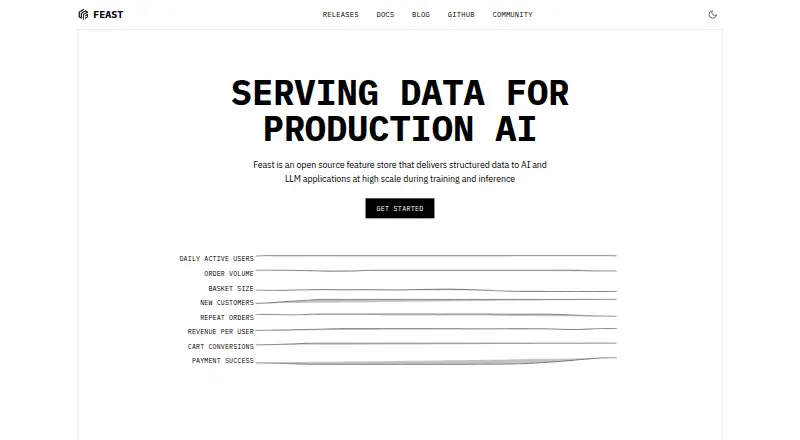
What Feast is
Feast is an open-source feature store for delivering structured data to AI and LLM applications during training and inference. It supports feature management and serving for batch and real-time applications, with online and offline stores. Its point-in-time joins help prevent future feature values from entering model training data. Feature services support discovery, collaboration, and versioning of feature sets. The Python SDK and command-line interface manage version-controlled feature definitions, materialize values, build training datasets, and retrieve online features. A Python feature server provides an HTTP endpoint with JSON input and output, accessible to clients in any language that can make HTTP requests. Feast’s documentation describes integrations with data sources and stores, including community and custom integrations. It can run on Kubernetes, where servers and jobs operate as workloads. Feast supports OIDC and Kubernetes RBAC authorization, but its default configuration is no_auth. It does not provide authentication itself, so clients must manage and pass authentication tokens. Batch transformations require a separate transformation engine.
Good
- Free and open source.
- Supports batch and real-time feature serving.
- Point-in-time joins help prevent training-data leakage.
- Python SDK and CLI manage feature workflows.
- Online and offline store support.
Watch out
- Default authorization configuration is no_auth.
- Clients must manage authentication tokens.
- Batch transformations require a separate engine.
- Spark stream processor is experimental.
Who it suits
Feast is designed for data scientists, MLOps engineers, data engineers, and AI engineers managing features for AI or machine-learning applications. It suits teams that need batch and real-time serving or point-in-time-correct training data.
Verdict
Feast brings feature management, training-data creation, and online serving into one open-source feature store. Teams should account for its authentication responsibilities and separate engine requirement for batch transformations.
Plans and prices
From Feast's own pricing page, checked 30 Sep 2026.
| Plan | Price | What it gives you |
|---|---|---|
| Feast | Free | Open-source feature store |
The facts
Each one read from Feast's own pages, with the date it was checked.
What it does
- Access control
- Feast supports OIDC and Kubernetes RBAC authorization, while its default authorization configuration is no_auth.checked 30 Sep 2026
- Authentication responsibility
- Feast does not provide authentication capabilities; clients are responsible for managing and passing authentication tokens to the server.checked 30 Sep 2026
- Batch and real-time
- Feast supports machine learning feature management and serving for both batch and real-time applications.checked 30 Sep 2026
- Community support
- The Feast homepage invites users to join its Slack community for support from Feast developers.checked 30 Sep 2026
- Deployment
- Feast can be deployed on Kubernetes, where feature servers and scheduled or ad-hoc jobs can run as Kubernetes workloads.checked 30 Sep 2026
- Feature server
- The Python feature server serves features through an HTTP endpoint with JSON input and output, usable from any language that can make HTTP requests.checked 30 Sep 2026
- Feature versioning
- Feast enables discovery and collaboration on existing features and versioning of feature sets through feature services.checked 30 Sep 2026
- Intended users
- The quickstart identifies data scientists, MLOps engineers, data engineers, and AI engineers as users Feast is designed to serve.checked 30 Sep 2026
- Point-in-time correctness
- Feast joins feature tables using point-in-time logic to prevent future feature values from leaking into model training data.checked 30 Sep 2026
- SDK and CLI
- The Python SDK and CLI manage version-controlled feature definitions, materialize values, build training datasets, and retrieve online features.checked 30 Sep 2026
- Stores and sources
- Feast docs describe integrations with offline and online stores and data sources, including community and custom integrations.checked 30 Sep 2026
- Stream processing
- Feast's component overview describes an experimental Spark processor that can consume data from Kafka.checked 30 Sep 2026
- Transformations
- The architecture docs say Feast supports transformations for on-demand and streaming sources, while batch transformations require a separate transformation engine.checked 30 Sep 2026
- What it does
- Feast is an open-source feature store that delivers structured data to AI and LLM applications for training and inference.checked 30 Sep 2026
The full review of Feast
Overview
Feast is an open-source feature store for teams building AI and machine-learning applications that need structured data at training and inference time. It is a strong fit for data and ML groups that want shared feature management across batch and real-time workloads, provided they can take responsibility for authentication and batch transformations.
Key features
Feast serves both batch and real-time use cases, with online and offline stores, data sources, and feature monitoring. Point-in-time joins help prevent future values from leaking into historical training data, a practical safeguard when datasets are assembled from changing feature tables.
Feature services support discovery and collaboration around existing features, while versioning feature sets helps teams coordinate shared definitions. The Python SDK and CLI cover version-controlled definitions, materialization, training-dataset creation, and retrieval of online features. A Python feature server exposes an HTTP endpoint that accepts and returns JSON, allowing clients in other languages to request features without using the Python SDK.
Feast supports transformations for on-demand and streaming sources, but batch transformations require a separate engine. Its Spark processor for consuming Kafka data is experimental, so teams looking for a mature stream-processing path should weigh that limitation. Kubernetes deployments can run feature servers and scheduled or ad-hoc jobs as workloads.
Access control supports OIDC and Kubernetes RBAC, but the default authorization configuration is no_auth. Feast does not provide authentication: clients must manage and pass authentication tokens to the server. That is a meaningful operational responsibility for teams exposing feature services.
Pricing
Feast is open source and free: its Feast plan costs nothing. The plan includes online and offline stores, point-in-time joins, and feature monitoring, with both deployment models and both serving modes. It is a straightforward fit for teams comfortable operating an open-source feature store; there is no paid tier or separate plan to step up to.
Platforms
Feast is available through an API, on Linux, as self-hosted software, and on the web. Its deployment model and serving modes both support batch and real-time use.
Who it's for
Data scientists, MLOps engineers, data engineers, and AI engineers are the intended users. It suits teams coordinating reusable features across training and inference, especially when point-in-time correctness matters. Teams that need built-in authentication or batch transformations within the feature store should look elsewhere or plan to provide those capabilities separately. Feast's homepage also points users to its Slack community for support from Feast developers.
Pros and cons
- Pros: Point-in-time joins help guard training data against future-value leakage.
- Pros: Feature services combine collaboration and feature-set versioning; the SDK, CLI, and HTTP server cover definition, materialization, dataset building, and serving.
- Pros: Free open-source access includes online and offline stores, monitoring, and both serving modes.
- Cons: Authentication is left to clients, and authorization defaults to no_auth, creating setup and security responsibilities for operators.
- Cons: Batch transformations need a separate engine, while the documented Spark processor remains experimental.
Alternatives
Feature Store Software is the broader category to compare before choosing a feature store.
Choose Hopsworks Feature Store if a free tier with one project, a Feature Store, Model Registry, and community support better matches your needs; its Enterprise plan uses custom pricing.
Chalk is a paid alternative for API, self-hosted, and web platforms.
Chronon is another free, self-hosted option, with an open-source plan that states no usage limits.
Databricks Feature Store may suit teams preferring usage-based monthly billing with per-second granularity; its rates vary by product, cloud provider, and region, and it offers a free trial.
Snowflake Feature Store is a paid, consumption-billed option with Standard and Enterprise plans.
OpenMLDB is a free open-source machine-learning database available in standalone and cluster versions, including Linux and macOS platforms.
Feathr is another free option available through API, Linux, self-hosted, and web platforms.
Red Hat OpenShift AI Feature Store is a paid alternative available on the web.
Verdict
Choose Feast if your team wants a free, open-source feature store for shared batch and real-time feature management, with point-in-time joins and multiple serving routes. Look elsewhere if built-in authentication or batch transformations are essential, or if an experimental stream-processing component is not suitable for your workload.
Getting started
- Open the Feast website and documentation
- Choose a self-hosted deployment or Kubernetes deployment
- Define and version features with the Python SDK or CLI
- Connect documented offline and online stores or data sources
- Use the feature server HTTP endpoint for online retrieval
- Manage client authentication tokens when calling the server
Limits worth knowing
Feast is provided as a free, open-source plan. Batch transformations require a separate transformation engine, and the default authorization configuration is no_auth.
Questions
How much does Feast cost?
The Feast plan is free. Its pricing note identifies Feast as open source.
Which platforms does Feast support?
Listed platforms are API, Linux, self-hosted, and web. Deployment can use either self-hosted infrastructure or Kubernetes.
Does Feast support online and offline stores?
Yes. Feast lists both online-store and offline-store support.
What programming tools are available?
A Python SDK and CLI manage feature definitions, materialization, training datasets, and online-feature retrieval. A Python feature server exposes an HTTP endpoint with JSON input and output.
Does Feast provide authentication?
Feast supports OIDC and Kubernetes RBAC authorization, but it does not provide authentication capabilities. Clients manage and pass authentication tokens.
Alternatives to Feast
- 1
Chronon
Free planAPISelf-hosted6.3Free plan - 2

Hopsworks Feature Store
Free planWebAPILinuxSelf-hosted6.2Free plan - 3
OpenMLDB
Free planAPILinuxmacOSSelf-hosted6.0Free plan - 4
Feathr
WebAPILinuxSelf-hosted5.9 - 5
Metarank
APILinuxmacOSSelf-hosted5.9 - 6

Snowflake Feature Store
WebAPI5.8