Databricks Feature Store
Databricks Feature Store is a central registry for features used in AI and machine-learning models.
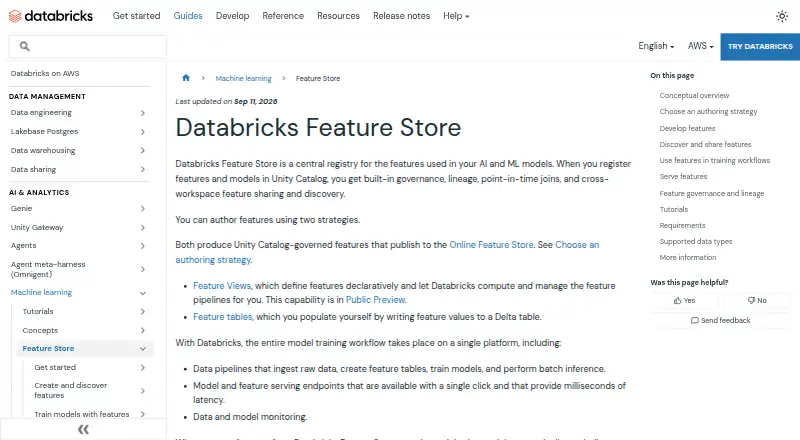
What Databricks Feature Store is
Databricks Feature Store is a central registry for features used in AI and machine-learning models. With Unity Catalog, teams can register features and models for governance, lineage, point-in-time joins, and discovery and sharing across workspaces. Features can be authored as declarative Feature Views managed through Databricks pipelines or as feature tables populated in Delta tables; Feature Views and their materialization capability are in Public Preview. Models trained using Feature Store features track lineage and look up the latest values at inference. Databricks says reusing feature computations between training and inference avoids training/serving skew. Feature serving endpoints and online stores support real-time applications, with the overview describing millisecond latency. Supported third-party online stores include Amazon DynamoDB, Amazon Aurora (MySQL-compatible), and Amazon RDS MySQL, with availability depending on the mode. The paid cloud service has a free trial and usage-based billing. It requires a workspace enabled for Unity Catalog, and its APIs cannot be called from local or other non-Databricks environments, though local IDE development and unit testing are supported.
Good
- Tracks feature lineage into inference
- Supports point-in-time joins
- Online and offline stores are available
- Feature serving supports real-time applications
Watch out
- Feature Views are in Public Preview
- Requires Unity Catalog-enabled workspace
- APIs cannot be called from non-Databricks environments
- Paid service; pricing varies by product, cloud, and region
Who it suits
This service suits teams building and serving AI or ML models that need governed feature discovery, lineage, and point-in-time joins. It requires a Unity Catalog-enabled Databricks workspace.
Verdict
Databricks Feature Store brings feature registration, governance, and model serving into a Unity Catalog-based workflow. Check the preview status and workspace requirement, and note that API use is limited to Databricks environments.
Plans and prices
From Databricks Feature Store's own pricing page, checked 30 Sep 2026.
| Plan | Price | What it gives you |
|---|---|---|
| Pay as you go | Priced on request | No up-front costs · Pay for products used · Rates vary by product, cloud provider, and region · Monthly based on usage; per-second granularity. |
The facts
Each one read from Databricks Feature Store's own pages, with the date it was checked.
What it does
- Client limitation
- Feature Engineering and Feature Store APIs cannot be called from local or other non-Databricks environments, although local IDE development and unit testing are supported.checked 30 Sep 2026
- Feature authoring
- Features can be authored as declarative Feature Views managed through Databricks pipelines or as feature tables populated by writing values to Delta tables.checked 30 Sep 2026
- Feature Views status
- Feature Views and their feature materialization capability are in Public Preview.checked 30 Sep 2026
- Governance and discovery
- Registering features and models in Unity Catalog provides governance, lineage, point-in-time joins, and cross-workspace feature sharing and discovery.checked 30 Sep 2026
- Integrations
- Supported third-party online stores include Amazon DynamoDB, Amazon Aurora (MySQL-compatible), and Amazon RDS MySQL, with availability differing by Feature Store mode.checked 30 Sep 2026
- Model training and inference
- Models trained with Feature Store features automatically track feature lineage and look up the latest feature values at inference time.checked 30 Sep 2026
- Pricing components
- Materialization uses serverless compute, feature serving endpoints use the Model Serving SKU, and online stores use Lakebase compute priced by capacity units and replicas.checked 30 Sep 2026
- Pricing model
- Feature Store is billed at cost for underlying serverless compute, online store, and serving infrastructure, with no premium on top.checked 30 Sep 2026
- Purpose
- Databricks Feature Store is a central registry for the features used in AI and ML models.checked 30 Sep 2026
- Python client
- The Feature Engineering Python client is distributed as databricks-feature-engineering on PyPI and is pre-installed in Databricks Runtime 13.3 LTS ML and above.checked 30 Sep 2026
- Real-time serving
- Feature serving endpoints and online stores support serving features for real-time applications, with the main overview describing endpoints as providing millisecond latency.checked 30 Sep 2026
- Security and access
- Access to Unity Catalog feature tables is managed through Unity Catalog access controls.checked 30 Sep 2026
- Training and serving consistency
- Databricks says using the same feature computations at inference as during training eliminates training/serving skew.checked 30 Sep 2026
- Workspace requirement
- The current Databricks Feature Store requires a workspace enabled for Unity Catalog.checked 30 Sep 2026
The company
- Headquarters
- San Francisco, California, United Stateschecked 28 Sep 2026