
Haystack
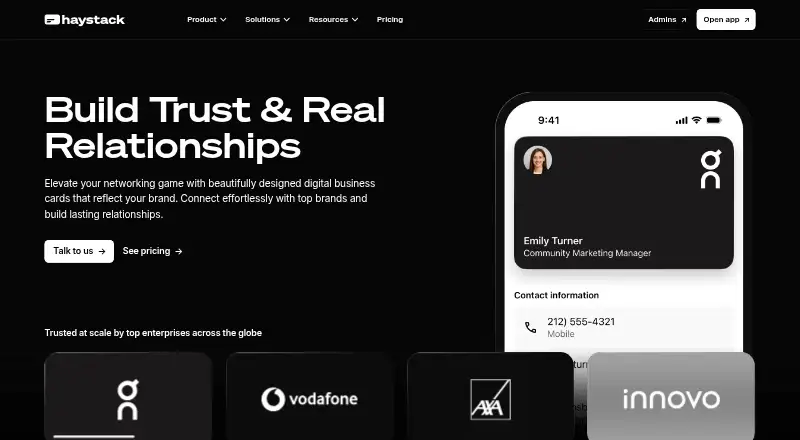
Haystack provides branded digital business cards for networking and contact sharing.
What Haystack is
Haystack provides branded digital business cards for networking and contact sharing. Cards can be shared by QR code, text, email, LinkedIn, iMessage, NFC or unique link, and recipients can open them without installing the Haystack app. Its paper-card scanner uses AI to add received business cards to contacts or a CRM. Team administrators can manage shared contact details, set field-editing permissions, customize card design and track engagement. Named integrations include Microsoft Entra ID, Google Workspaces, HRIS software, Zapier, webhooks and a public REST API; the FAQ also names Salesforce, MS Dynamics and HubSpot among connectable CRM platforms. Haystack says it has SOC 2 accreditation, complies with GDPR, conducts regular penetration testing and third-party cybersecurity audits, and does not sell user data to advertisers. The Personal plan is free; paid plans are listed at $4.95 per month for Business and $7.95 per month for Pro, both billed monthly, with 14 days free. The FAQ says the free version allows one card per email address; multiple cards for the same address are available on paid plans.
Good
- Share cards by QR code, NFC, links and messaging.
- Recipients need no Haystack app to open cards.
- AI scanner adds paper cards to contacts or a CRM.
- Team admins can manage fields and card design.
- Free Personal plan is available.
Watch out
- Free version allows one card per email address.
- Business costs $4.95 per month, billed monthly.
- Pro costs $7.95 per month, billed monthly.
Who it suits
Haystack suits individuals and organizations that need digital business cards and contact sharing. Its team controls, integrations and engagement tracking are relevant to groups managing shared contact information.
Verdict
Haystack offers several ways to share cards, along with tools for digitizing paper cards and managing team details. Check the free-plan card limit and the monthly plan prices if multiple cards or team controls are needed.
Plans and prices
From Haystack's own pricing page, checked 15 Oct 2026.
| Plan | Price | What it gives you |
|---|---|---|
| Personal | Free | Unlimited digital cards · Unlimited shares · Unlimited AI card scans · Logos/photos · Contacts/socials |
| Business (annual) | $2.50 a year | Pro features · Teams for shared contact organization · annual |
| Pro (annual) | $4.50 a year | Personal features · Custom designs · Permissions · Custom links · Email signatures · CRM integrations · Exposure analytics · annual |
| Business | $4.95 a month | For large teams (10+) · Everything in Pro · Teams for organizing shared contact information · 14 days free · Monthly |
| Business (monthly) | $4.95 a month | Pro features · Teams for shared contact organization · monthly |
| Pro | $7.95 a month | For small teams (1+) · Customized card design · User permissions · Customizable links · Smart email signatures · CRM integrations · Exposure analytics · 14 days free · Monthly |
| Pro (monthly) | $7.95 a month | Personal features · Custom designs · Permissions · Custom links · Email signatures · CRM integrations · Exposure analytics · monthly |
| Enterprise | Priced on request | Business features · Dedicated customer success · Usage pricing · HRIS integrations · Custom fields · Security questionnaire |
The facts
Each one read from Haystack's own pages, with the date it was checked.
What it does
- AI scanner
- The mobile app scans paper business cards into contacts or a CRM using AI and supports more than 25 scanning languages.checked 15 Oct 2026
- API and extensibility
- Haystack advertises a public REST API plus webhook and Zapier integrations for custom workflows.checked 15 Oct 2026
- Availability claim
- The security page advertises 99.99% uptime and enterprise service-level agreements.checked 15 Oct 2026
- Contact syncing
- Haystack automatically syncs professional contacts into other apps and programs.checked 15 Oct 2026
- CRM integration
- The service captures and synchronizes leads with CRM systems such as Salesforce, Microsoft Dynamics and HubSpot.checked 15 Oct 2026
- CRM integrations
- The FAQ names Salesforce, MS Dynamics, and HubSpot among CRM platforms that can be connected.checked 4 Oct 2026
- Documentation
- The help center contains articles covering cards, contacts, scanning, sharing, syncing, billing, accessibility, paid features, SSO, SCIM, provisioning and team onboarding.checked 15 Oct 2026
- Email signatures
- Paid plans generate centrally managed branded email signatures that link to each employee’s card.checked 15 Oct 2026
- Engagement analytics
- Team dashboards track card views, shares, clicks and other engagement activity.checked 15 Oct 2026
- Funding
- SmartCompany reported a $1.1 million seed round in April 2016 and total funding of $1.7 million after an extension.checked 15 Oct 2026
- Integrations
- The integrations page names Microsoft Entra ID (Azure Active Directory), Google Workspaces, HRIS software, Zapier, webhooks, and a public REST API.checked 4 Oct 2026
- Intended users
- Haystack says its digital business card solution is for people and organizations of any size that need business cards.checked 4 Oct 2026
- Languages
- Cards support multiple languages and the scanner handles more than 25 languages.checked 15 Oct 2026
- Legal name
- Crunchbase identifies the legal entity as Haystack Australia Pty Ltd.checked 15 Oct 2026
- Limit: contact editing
- G2 reviewers report difficulties copying details, editing saved contacts, adding custom fields and saving scanned contacts directly.checked 15 Oct 2026
- NFC limitation
- Haystack warns that NFC compatibility is inconsistent across iOS and especially Android devices.checked 15 Oct 2026
- Notable news: Vodafone
- SmartCompany reported in August 2017 that Vodafone planned to deploy 100,000 Haystack cards across 26 countries.checked 15 Oct 2026
- One-tap sharing
- Cards can be shared from the phone home screen by QR code, email or SMS.checked 15 Oct 2026
The company
- Company profile
- LinkedIn lists Haystack Australia as privately held, headquartered in Brisbane, founded in 2014 and employing 11–50 people.checked 15 Oct 2026
- Founded
- 2014checked 28 Sep 2026
- Founding team
- The official team page says four founders created Haystack in 2014 and identifies Ran Heimann, Nir Heimann and Jordie Knowles as executives.checked 15 Oct 2026
- Headquarters
- Murarrie, Queensland, Australiachecked 28 Sep 2026
Where it runs
- Limit: Android scanning
- A Google Play reviewer said scanning was clunky, sometimes misread or rotated cards and required retaking them.checked 15 Oct 2026
- Limit: Apple branding
- An App Store reviewer complained that automatic logo branding produced poor images and offered no sizing guidance.checked 15 Oct 2026
The full review of Haystack
Haystack is a digital business-card platform for individuals, salespeople and organizations that need flexible sharing plus centralized contact control. It is strongest when a team needs branded profiles, scanning and integrations rather than a single static card. The free Personal tier is capable for solo use, while permissions, analytics and CRM connections require a paid plan.
Overview
Haystack replaces paper cards with branded profiles that open in a browser, so recipients do not have to install an app. You can send a card by QR code, text, email, LinkedIn, iMessage, NFC or a unique link. That breadth covers quick handoffs at events as well as remote introductions, and avoids making your contact choose a particular app.
The service also handles contacts you receive. Its AI scanner converts paper business cards into contacts or a CRM, and it can work with phone contacts. For organizations, administrators can maintain shared details, restrict which fields users may edit, alter card design and measure engagement. Those controls are meaningful for keeping a distributed team consistent, but unnecessary overhead if you only need one personal profile.
Key features
Sharing and capture
Multiple delivery channels make Haystack practical in varied networking situations, while app-free recipient access removes a common adoption obstacle. Unlimited AI scans on the Personal plan are particularly useful for people who still collect paper cards. Company contacts and email sync extend its role beyond a simple landing page.
Team administration
Team managers can control shared contact information and editing rights, apply a consistent visual identity and monitor exposure. Pro adds customizable links and smart email signatures, making cards useful in outbound communication as well as meetings.
Integrations and security
Connections include Microsoft Entra ID (Azure Active Directory), Google Workspaces, HRIS software, Zapier, webhooks and a public REST API. Salesforce, Microsoft Dynamics and HubSpot are named CRM connections. Haystack states that it holds SOC 2 accreditation, complies with GDPR, performs regular penetration testing and undergoes third-party cybersecurity audits. It also says it does not sell user data to advertisers.
Pricing
Haystack uses a freemium model. Personal costs nothing and includes unlimited digital cards, unlimited shares and unlimited AI scans, plus logos, photos, contacts and social links. The free version permits only one card per email address; multiple cards for the same address require a paid plan. That is generous for a single identity but restrictive for people separating roles or brands.
Pro costs $7.95 a month, billed monthly, for small teams (1+). It adds customized design, user permissions, customizable links, smart email signatures, CRM integrations and exposure analytics, with a 14-day free trial. Business costs $4.95 a month, billed monthly, targets large teams (10+) and includes everything in Pro plus team organization for shared contact information and a 14-day trial. The lower monthly Business price is aimed at larger deployments, while Pro is the more natural fit for a small group that needs controls and analytics.
Enterprise uses custom, usage-based pricing for organizations of 250 or more. It includes dedicated customer success, a cybersecurity questionnaire, HRIS integrations and custom fields. Haystack also advertises paid access from $2.50 per user per month when billed annually; check the applicable seat and billing terms before choosing between that rate and the published monthly plan prices.
Platforms
Haystack supports Android, iOS and web access, along with an API. Both major mobile platforms are covered, and the API and web options suit organizations connecting card data to existing systems.
Who it's for
Haystack fits freelancers and professionals who want app-free sharing and frequent paper-card scanning, and teams that need managed branding, permissions or engagement data. It is also a sensible choice for companies already using the named identity, HR, automation or CRM integrations. Look elsewhere if you need several free cards under one email address or only want a minimal profile without team administration.
Pros and cons
Pros
- App-free viewing: recipients can open cards immediately in a browser.
- Broad sharing: QR, NFC, messaging, email, LinkedIn and links cover in-person and remote exchanges.
- Generous solo tier: unlimited cards, shares and AI scans cost nothing.
- Serious team controls: permissions, shared details, design management and engagement tracking support consistency.
- Integration depth: CRM, HRIS, identity, automation and API options support larger workflows.
Cons
- Free identity cap: one card per email address blocks multiple free profiles for the same user.
- Key team capabilities are paid: permissions, analytics, CRM links and team organization start on Pro or Business.
- Enterprise budgeting is less predictable: usage-based custom pricing requires a sales-led decision.
Alternatives
Digital Business Card Software and Contact Management Software round up broader category choices. Blinq Email Signatures is a better match when a personal email signature and two free cards are the priority. One Good Card suits groups wanting a central CRM and deal manager for up to 30 users on its free tier. IdentiQ is worth considering when NFC assignments, lead-capture quotas and retained analytics are central requirements. AntCards offers a straightforward free profile with QR, NFC, link sharing and personal view analytics. Dot is aimed at buyers who want profiles tied to a dot device and many themes. HiHello Email Signature Manager is preferable when signatures and a defined allowance of cards and scans matter most. KADO focuses on interactive cards, branding and contact capture for networkers. Linq is the alternative for API-centric workflows with messaging fallbacks and webhooks.
Verdict
Choose Haystack if you want one system for app-free digital cards, paper-card capture and controlled team identities, especially when CRM or HR integrations matter. Its Personal plan is an excellent starting point for one identity, but the email-address cap and paid team features make it less suitable for users who need multiple free cards or only a basic, no-management profile.
Alternatives to Haystack
- 1

KADO
Free planAndroidiOSWeb7.4From $2.50 a month - 2

Linq
Free planAndroidiOSWebAPI7.4From $260 a month - 3
Uniqode
Free planAndroidiOSWebAPI7.4From $6 a year - 4
Wave Connect
Free planAndroidiOSWeb7.3From $5 a month - 5

Dot
Free planAndroidiOSWeb7.2From $15 a month - 6
DBC: Digital Business Card
AndroidiOSWeb7.0