Harvester
Harvester is free, open-source hyperconverged infrastructure for bare-metal servers, combining virtualization and distributed storage.
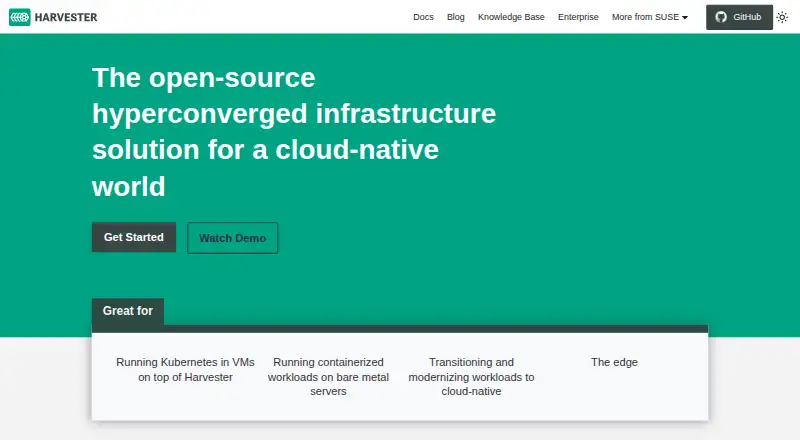
What Harvester is
Harvester is free, open-source hyperconverged infrastructure for bare-metal servers, combining virtualization and distributed storage. It is intended for virtual machines, Kubernetes running in VMs, container workloads on bare metal, and edge workloads. Its architecture uses Kubernetes, KubeVirt, Longhorn, Grafana, Prometheus, and SUSE Linux Micro. Users can create, edit, clone, and delete VMs, with SSH key injection, cloud-init, and graphical or serial consoles. Live migration moves a VM to another host without downtime, but requires matching physical CPU specifications. Storage includes distributed block storage and tiering; VM backups use NFS or S3-compatible targets and support only Longhorn volumes. Harvester installs from a bootable ISO directly onto bare metal. New installations starting with v1.8 require UEFI boot. Three nodes are needed to realize multi-node features and high availability; single-node clusters lack high availability, multiple replicas, and live migration. Production recommendations include at least 16 CPU cores, 64 GB memory, 500 GB disk, and 10 Gbps Ethernet. Laptops and nested virtualization are unsupported.
Good
- Free, open-source software with no license fees stated
- Supports VM creation, cloning, and deletion
- Live migration between hosts without downtime
- Distributed block storage and tiering
Watch out
- Live migration requires matching physical CPU specifications
- Backups support only Longhorn volumes
- Three nodes are needed for high availability
- Laptops and nested virtualization are unsupported
Who it suits
Harvester suits teams running VMs, Kubernetes in VMs, bare-metal containers, or edge workloads on supported server hardware. It is for users who can deploy and manage bare-metal infrastructure.
Verdict
Harvester combines virtualization and distributed storage for bare-metal deployments, with VM management and live migration. Account for its node, hardware, networking, and backup constraints when assessing a deployment.
Plans and prices
From Harvester's own pricing page, checked 2 Oct 2026.
| Plan | Price | What it gives you |
|---|---|---|
| Harvester | Free | 100% open source · no license fees stated |
The facts
Each one read from Harvester's own pages, with the date it was checked.
What it does
- Cluster requirements
- Three nodes are required to fully realize multi-node features and high availability; single-node clusters do not support high availability, multiple replicas, or live migration.checked 2 Oct 2026
- Deployment
- Harvester installs directly on bare-metal servers from a bootable ISO; new installations starting with v1.8 require UEFI boot.checked 2 Oct 2026
- Hardware limits
- The production recommendations include at least 16 CPU cores, 64 GB memory, 500 GB disk, and 10 Gbps Ethernet; laptops and nested virtualization are unsupported.checked 2 Oct 2026
- Intended workloads
- Harvester is aimed at running VMs, Kubernetes in VMs, containerized workloads on bare metal, and workloads at the edge.checked 2 Oct 2026
- Live migration
- Harvester supports moving a VM to another host or node with zero downtime, and live migration requires matching CPU specifications across physical servers.checked 2 Oct 2026
- Networking
- Harvester supports virtual IPs, multiple network interface cards, VLAN or untagged networks, and requires port trunking for VLAN support.checked 2 Oct 2026
- Operating system
- Harvester uses an immutable operating system that prevents direct changes to the core system image outside designated configuration directories.checked 2 Oct 2026
- Product
- Harvester is open-source hyperconverged infrastructure for bare-metal servers, combining virtualization and distributed storage.checked 2 Oct 2026
- Rancher integration
- Rancher can import and manage multiple Harvester clusters and manage their VMs alongside Kubernetes clusters.checked 2 Oct 2026
- Security and access
- Rancher integration supports authentication and role-based access control for multi-tenancy; Harvester's Rancher RBAC integration is documented as experimental.checked 2 Oct 2026
- Storage and backup
- Harvester provides distributed block storage and tiering; VM backups use NFS or S3-compatible targets, and backup support is limited to Longhorn volumes.checked 2 Oct 2026
- Support lifecycle
- The maker's docs state that Prime releases receive six months of active support followed by twelve months of maintenance support for critical security-related issues.checked 2 Oct 2026
- Technology
- Its architecture uses Kubernetes, KubeVirt, Longhorn, Grafana, and Prometheus, with SUSE Linux Micro at its core.checked 2 Oct 2026
- VM management
- The platform supports creating, editing, cloning, and deleting VMs, with SSH key injection, cloud-init, and graphical and serial consoles.checked 2 Oct 2026
Alternatives to Harvester
- 1

DataCore SANsymphony
WebAPISelf-hostedWindows6.3 - 2
Cisco Catalyst Center
WebAPILinuxmacOS6.2 - 3
StorMagic SvHCI
WebAPILinuxSelf-hosted6.0From $2,049 a year - 4
VergeOS
WebAPISelf-hosted6.0 - 5

Scale Computing Platform
WebAPILinuxSelf-hosted5.7 - 65.0