Harp
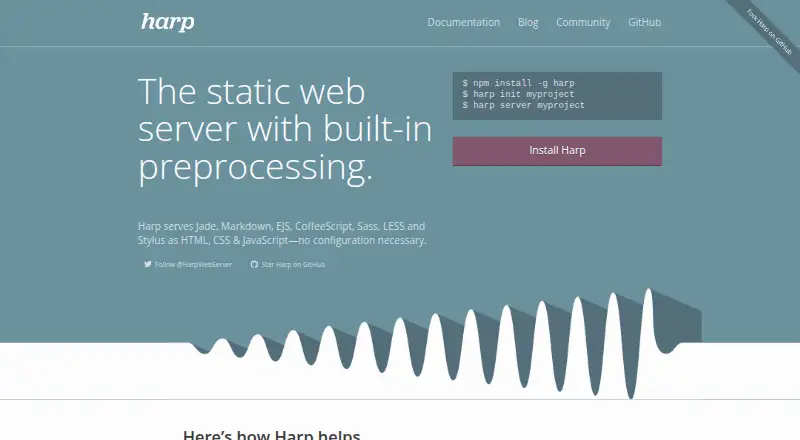
The facts below are what the maker publishes about Harp, checked and dated. Our editors have not written about it yet.
The facts
Each one read from Harp's own pages, with the date it was checked.
What it does
- Access control
- Harp supports HTTP Basic Authentication, but the feature is not included in compiled static output served by another web server or GitHub Pages.checked 8 Oct 2001
- Automatic preprocessing
- Harp compiles preprocessor source files to standard web output on the fly, without a configuration file or build step.checked 8 Oct 2001
- Build output
- Harp can compile a project into static HTML, CSS, and JavaScript files for deployment.checked 9 Oct 2001
- Content sources
- markdownchecked 22 Sep 2001
- Distribution
- The install guide documents macOS, Linux, and Windows terminal use and installs Harp globally with npm.checked 8 Oct 2001
- Hosting destinations
- The documentation names Amazon S3, Netlify, GitHub Pages, Cloudflare Pages, and a user's own server as static hosting options.checked 9 Oct 2001
- Integrations
- Harp can be used as middleware in an Express and Node.js application as an asset pipeline.checked 8 Oct 2001
- Layouts and partials
- Layouts and partials are available for Jade and EJS templates.checked 9 Oct 2001
- Limit
- The development server does not provide live reload; users refresh the browser to see edits.checked 8 Oct 2001
- Local preview server
- Yeschecked 22 Sep 2001
- Local server
- The `harp` command serves a project locally, with port 9000 as its documented default.checked 8 Oct 2001
- Manual refresh
- When developing locally, changes appear after manually refreshing the browser; the quick-start guide says Harp does not auto-reload.checked 9 Oct 2001
- Metadata
- Harp lets templates use flexible metadata stored in files such as `_data.json`.checked 9 Oct 2001
- Middleware
- Harp can run as middleware and serve as the asset pipeline for an Express and Node.js application.checked 9 Oct 2001
- Node.js requirement
- Harp runs on Node.js and is installed globally with npm.checked 9 Oct 2001
- Open source
- Harp is open source, and its code is available on GitHub.checked 9 Oct 2001
- Output
- Harp serves Jade, Markdown, EJS, CoffeeScript, Sass, LESS, and Stylus as HTML, CSS, and JavaScript without configuration.checked 8 Oct 2001
- Preprocessors
- Harp supports Markdown, Jade, EJS, LESS, Stylus, Sass, and CoffeeScript without additional configuration.checked 9 Oct 2001
- Product
- Harp describes itself as a static web server with built-in preprocessing.checked 8 Oct 2001
- Production caching
- Setting `NODE_ENV=production` enables additional caching.checked 8 Oct 2001
- Production server
- Harp can run as a production web server with caching, Basic Authentication, and 200/404 fallbacks.checked 9 Oct 2001
- Purpose
- Harp is a static web server with built-in preprocessing that serves source files as HTML, CSS, and JavaScript.checked 9 Oct 2001
- Security and compliance
- Harp's documentation describes HTTP Basic Authentication for restricting site visitors; the opened maker pages made no security certification or compliance claim.checked 8 Oct 2001
Money
- Free plan
- Yeschecked 22 Sep 2001
Alternatives to Harp
- 1

Gatsby
Free planWebAPISelf-hosted8.1From $9 a month - 2
Jekyll
Free planOpen sourceWebLinuxmacOSSelf-hosted8.1Free plan - 3

Cecil
Free planLinuxmacOSWindows7.4Free plan - 4

Eleventy
Free planLinuxmacOSSelf-hostedWindows7.4Free plan - 5

Nikola
Free planLinuxmacOSSelf-hostedWindows7.4Free plan - 6

Publii
Free planLinuxmacOSWindows7.3Free plan