Jekyll
Jekyll is a free, open-source tool for building static websites and blogs from plain text.
What Jekyll is
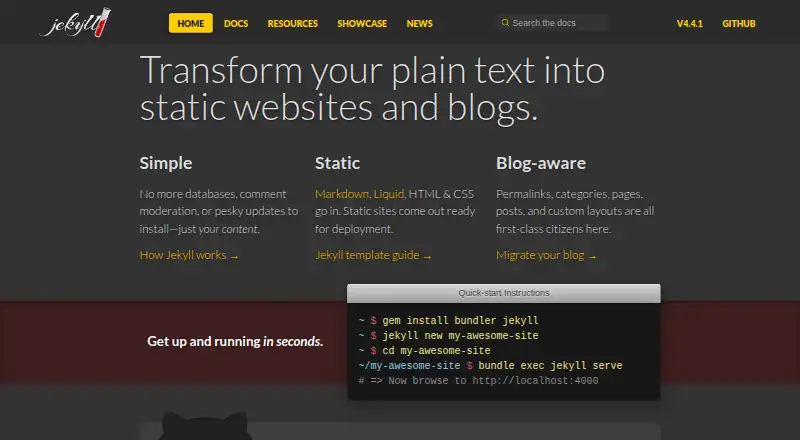
Jekyll is a free, open-source tool for building static websites and blogs from plain text. It combines content written in Markdown, Liquid, HTML, or CSS with layouts, then generates static output ready for deployment. Blog features include permalinks, categories, pages, posts, and custom layouts. A plugin system with hooks can generate custom content and extend the build process without changing Jekyll itself. Community-maintained themes provide templates and styles, and site content can override theme files. Generated sites can be deployed manually, through automation, or with third-party services. GitHub Pages is powered by Jekyll and offers free hosting with custom domain support. Jekyll supports Linux, macOS, Windows, and self-hosted use. Installation requires Ruby 2.7.0 or higher, RubyGems, GCC, and Make. Safe mode requires plugins to be explicitly allowed through a whitelist setting. The project is maintained by a core team of volunteers, and no pricing or usage limits are stated.
Good
- Free and open source
- Supports Markdown, Liquid, HTML, and CSS
- Includes plugins and community-maintained themes
- Generated sites support multiple deployment approaches
Watch out
- Installation requires Ruby, RubyGems, GCC, and Make
- Plugin use in safe mode requires explicit approval
Who it suits
Jekyll suits people who want to generate static websites or blogs from text and layouts. It is also relevant to users comfortable installing its Ruby and build-tool requirements.
Verdict
Jekyll provides a text-and-layout workflow for producing static websites, with blog features, themes, and extensible builds. Its installation prerequisites make it a better fit for users comfortable setting up the required tools.
Plans and prices
From Jekyll's own pricing page, checked 11 Oct 2026.
| Plan | Price | What it gives you |
|---|---|---|
| Jekyll | Free | Static site generator · no pricing or usage limits stated |
| Open-source Jekyll | Free | Static-site generator · GitHub Pages hosting available free · Optional third-party themes, plugins and services may cost extra |
The facts
Each one read from Jekyll's own pages, with the date it was checked.
What it does
- Assets
- Jekyll processes Sass and can support CoffeeScript through a Ruby gem, with Liquid tags and filters available in asset files.checked 15 Oct 2026
- Blog features
- Permalinks, categories, pages, posts and custom layouts are built-in concepts.checked 15 Oct 2026
- Collections
- Custom collections can render structured documents into individual pages when output is enabled.checked 15 Oct 2026
- Command line
- The CLI includes new, build, serve, clean, help, new-theme and doctor commands.checked 15 Oct 2026
- Content formats
- Markdown, Liquid, HTML, and CSS go in, and static sites ready for deployment come out.checked 11 Oct 2026
- Current release
- The official news page lists Jekyll 4.4.1 as released on January 29, 2025.checked 15 Oct 2026
- Database model
- The official site says Jekyll avoids databases, comment moderation and update maintenance.checked 15 Oct 2026
- Data files
- YAML, JSON, CSV and TSV files in _data are available through site.data and Liquid.checked 15 Oct 2026
- Deployment
- Because output is static, Jekyll sites can be deployed manually, through automation or with third-party hosting.checked 15 Oct 2026
- Documentation and support
- The project publishes extensive guides covering installation, commands, content, site structure, plugins, migrations, upgrades and deployment, with community help via Jekyll Talk and IRC.checked 15 Oct 2026
- Front matter
- YAML front matter turns files into processed Jekyll pages and exposes custom variables to Liquid templates.checked 15 Oct 2026
- GitHub Pages
- GitHub Pages is powered by Jekyll and offers free hosting with custom domain support.checked 11 Oct 2026
- GitHub Pages integration
- GitHub Pages is powered by Jekyll and offers free hosting with custom domains.checked 15 Oct 2026
- How it works
- It takes text written in a markup language and uses layouts to create a static website.checked 11 Oct 2026
- Independent assessment
- Bejamas describes Jekyll as lightweight, fast and well documented for small content-only sites, while noting missing built-in image optimization and server-side features.checked 15 Oct 2026
- Independent integration facts
- Wikipedia states that Jekyll works with GitHub Pages and can connect to CloudCannon, Forestry and Siteleaf for nontechnical content editing.checked 15 Oct 2026
- Independent security observation
- Scripted describes Jekyll as having no CMS, database or server scripts to manipulate, reducing the attack surface compared with dynamic CMSs.checked 15 Oct 2026
- Installation requirements
- The quickstart requires Ruby 2.7 or newer, RubyGems, GCC and Make, followed by the jekyll and bundler gems.checked 15 Oct 2026
- Install requirements
- Installation requires Ruby 2.7.0 or higher, RubyGems, GCC, and Make.checked 11 Oct 2026
- License
- Jekyll is open source and distributed under the MIT License.checked 15 Oct 2026
- Limit: dynamic functionality
- Reviewers say contact forms and other server-side features require third-party software because Jekyll itself is static.checked 15 Oct 2026
- Limit: GitHub Pages plugins
- A TrustRadius reviewer notes that GitHub Pages permits only a whitelist of plugins during its build process.checked 15 Oct 2026
- Limit: nontechnical editing
- Reviewers complain that Jekyll lacks a friendly WordPress-style backend and is difficult for nontechnical authors to update.checked 15 Oct 2026
- Maintainers
- Jekyll is maintained by a core team of volunteers.checked 11 Oct 2026
Alternatives to Jekyll
- 1

Gatsby
Free planWebAPISelf-hosted8.2From $9 a month - 2

Cecil
Free planLinuxmacOSWindows7.4Free plan - 3

Eleventy
Free planLinuxmacOSSelf-hostedWindows7.4Free plan - 4

Nikola
Free planLinuxmacOSSelf-hostedWindows7.4Free plan - 5

Publii
Free planLinuxmacOSWindows7.3Free plan - 6
Metalsmith
Free planAPILinuxmacOSWindows7.2Free plan