
Eleventy
Eleventy is a free static site generator that compiles templates into HTML.
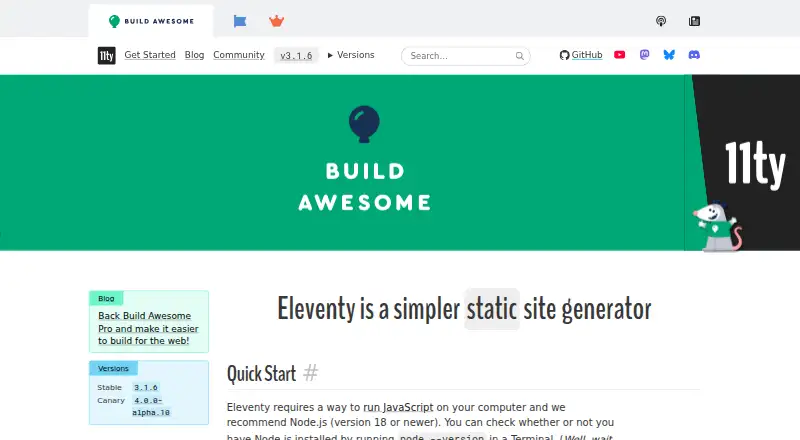
What Eleventy is
Eleventy is a free static site generator that compiles templates into HTML. It starts without requiring configuration, but offers flexible configuration options as projects grow. Content can come from Markdown, and templates can use a wide range of formats, including HTML, JavaScript, Liquid, Nunjucks, TypeScript, JSX, MDX, and Sass. Eleventy does not require a JavaScript framework and produces no client-side JavaScript by default. It can work within an existing directory structure, allowing teams to convert selected templates instead of rebuilding everything at once. A local preview server, CMS integrations, and multilingual support are available. Eleventy requires JavaScript and recommends Node.js version 18 or newer. Setup commands are provided for macOS, Linux, Windows, npm, pnpm, and Yarn. Its documentation says it is probably not a suitable choice for single-page applications, given its default approach and full-page navigation. Eleventy is available for Linux, macOS, Windows, and self-hosted use under an MIT license.
Good
- Starts without configuration and supports flexible options.
- Works with existing directories and selected templates.
- Supports many template and content formats.
- Includes a local preview server and CMS integrations.
- Produces no client-side JavaScript by default.
Watch out
- Requires JavaScript and recommends Node.js 18 or newer.
- Documentation says it is probably unsuitable for single-page applications.
Who it suits
Eleventy suits developers building static sites with templates and content such as Markdown. It may not suit projects that need a single-page application approach.
Verdict
Eleventy offers a template-based static site workflow with broad language support and incremental adoption. Its documented defaults and full-page navigation make it a poor fit for some single-page applications.
Plans and prices
From Eleventy's own pricing page, checked 28 Sep 2001.
| Plan | Price | What it gives you |
|---|---|---|
| Eleventy | Free | MIT license · self-hosted static-site generator |
The facts
Each one read from Eleventy's own pages, with the date it was checked.
What it does
- API data integration
- The official Eleventy Fetch plugin can fetch remote URLs, cache JSON, HTML, images, videos, and other assets, and continue using cached data when offline.checked 28 Sep 2001
- Build Performance
- The page reports Eleventy building 4,000 Markdown files in 1.93 seconds.checked 28 Sep 2001
- Client JavaScript
- Eleventy does not require a JavaScript framework and produces zero client-side JavaScript by default.checked 28 Sep 2001
- CMS integration
- Yeschecked 20 Sep 2001
- Community support
- The official site links to documentation, Discord, Mastodon, Bluesky, a newsletter, YouTube, and GitHub.checked 28 Sep 2001
- Community Support
- Community channels include Discord, Mastodon, Bluesky, YouTube, and a newsletter.checked 28 Sep 2001
- Configuration Model
- Eleventy starts with zero configuration and supports flexible configuration options.checked 28 Sep 2001
- Content sources
- markdownchecked 20 Sep 2001
- Creator and origin
- Eleventy was created by Zach Leatherman in Omaha, Nebraska, in 2017.checked 28 Sep 2001
- Deployment integration
- The Fetch documentation gives deployment examples for Netlify Functions and AWS Lambda using a writable /tmp cache location.checked 28 Sep 2001
- Fetch security warning
- Eleventy Fetch caches complete network responses and recommends adding its cache directory to .gitignore to avoid exposing private data.checked 28 Sep 2001
- Incremental adoption
- Eleventy works with an existing directory structure and supports converting only selected templates.checked 28 Sep 2001
- License
- The official documentation repository is marked as MIT licensed.checked 28 Sep 2001
- Local preview server
- Yeschecked 20 Sep 2001
- Multilingual support
- Yeschecked 20 Sep 2001
- Package runners
- The official quick start documents npm, pnpm, and Yarn commands for running Eleventy.checked 28 Sep 2001
- Performance claim
- The homepage reports a 1.93-second build for 4,000 Markdown files in its comparison table.checked 28 Sep 2001
- Product Type
- Eleventy is a simpler static site generator.checked 28 Sep 2001
- Runtime
- Eleventy recommends Node.js version 18 or newer.checked 28 Sep 2001
- Runtime Requirement
- Eleventy requires JavaScript and recommends Node.js version 18 or newer.checked 28 Sep 2001
- Security reporting
- The project asks users to report vulnerabilities privately through GitHub or by emailing [email protected], and the page says there are no published security advisories.checked 28 Sep 2001
- SPA suitability
- The documentation says Eleventy probably is not the right tool for a single-page application because projects use zero-client-JavaScript defaults and full-page navigation.checked 28 Sep 2001
The company
- Founded
- 2017checked 28 Sep 2001
Money
- Free plan
- Yeschecked 20 Sep 2001
The full review of Eleventy
Eleventy is a free, MIT-licensed static site generator that turns templates into HTML. It suits developers building content-led sites or moving selected templates into a static workflow; its default zero-client-JavaScript output is a poor match for single-page applications.
Overview
Eleventy begins with zero configuration but leaves room to adapt its setup as a project grows. It can fit into an existing directory structure, making it possible to convert selected templates rather than replace a whole site at once. That incremental path is a practical advantage for teams modernizing an established project.
Its defaults favor generated pages and full-page navigation, not a client-rendered application. That makes Eleventy a natural fit for content-focused sites, but the documentation cautions against choosing it for a single-page application.
Key features
Templates and content
Eleventy supports HTML, Markdown, WebC, JavaScript, Liquid, Nunjucks, Handlebars, Mustache, EJS, Haml, Pug, TypeScript, JSX, MDX, Sass and custom formats. This range gives developers latitude to use familiar formats or combine them, but it is a code-oriented workflow rather than a visual site editor. Markdown sources, CMS integration, multilingual support and a local preview server cover useful parts of a publishing workflow.
Builds and remote data
The homepage reports a build time of 1.93 seconds for 4,000 Markdown files, a striking benchmark for content-heavy projects, though it is a reported example rather than a guarantee for every site. The Eleventy Fetch plugin can retrieve remote resources and cache JSON, HTML, images, videos and other assets; cached data can still be used offline. Because its cache stores complete network responses, the project recommends excluding the cache directory from version control to avoid exposing private data. For Netlify Functions and AWS Lambda deployments, the documentation shows using a writable /tmp cache location.
Runtime and community
Eleventy requires JavaScript and recommends Node.js 18 or newer. Its quick start provides npm, pnpm and Yarn commands, with instructions for macOS, Linux, Windows and cross-platform use. Community channels include Discord, Mastodon, Bluesky, YouTube and a newsletter. The project asks users to report vulnerabilities privately through GitHub or [email protected]; it reports no published security advisories. Its documentation repository is MIT licensed.
Pricing
Eleventy is free: its plan costs nothing and uses the MIT license. It is a self-hosted static-site generator, so the price does not include a hosted site service. There are no paid tiers to trade features for lower cost; users take on the JavaScript runtime and self-hosted workflow instead.
Platforms
Eleventy supports Linux, macOS, Windows and self-hosted use. The quick start documents commands across the three desktop operating systems and cross-platform use. Its runtime requirement means users need JavaScript, with Node.js 18 or newer recommended.
Who it's for
Choose Eleventy if you want to generate static pages from templates, work with Markdown or CMS content, or adopt static generation gradually within an existing directory structure. Its broad template support is useful when a project already has preferred formats, and the default absence of client-side JavaScript suits sites that do not need a JavaScript framework in the browser.
Look elsewhere if the project depends on single-page application behavior: Eleventy's full-page navigation and zero-client-JavaScript defaults point in the opposite direction. It also asks more of developers than a visual site builder, since the workflow centers on templates and a JavaScript runtime.
Pros and cons
- Pro: Zero configuration and incremental adoption let teams start small or work within an existing site rather than commit to a full migration.
- Pro: Support for many template formats, Markdown, CMS integration and multilingual content accommodates varied publishing projects.
- Pro: Zero client-side JavaScript by default keeps generated output focused on static HTML.
- Con: Full-page navigation makes Eleventy a poor fit for single-page applications.
- Con: The JavaScript runtime and template-centered workflow are not suited to readers seeking a visual editor or a runtime-free setup.
- Con: Fetch's response cache needs care: private data can be exposed if the cache directory is committed, and serverless deployment examples rely on a writable temporary location.
Alternatives
For a broader comparison, browse Static site generators. Consider Gatsby if its free open-source framework or separate free plan better fits your project; the latter has a 300 credit limit per month. Cecil is another free option for Linux, macOS and Windows, distributed under the EUPL-1.2 license. Nanoc is a free option for those platforms described as a passion project. Hugo is an open-source, free-to-use alternative for Windows, macOS and Linux. Bridgetown is a free option across API, Linux, macOS, self-hosted and Windows platforms. Zola is a free, single-executable option for Linux, macOS, self-hosted and Windows use. Metalsmith is a free MIT/(L)GPL-licensed option for API and desktop platforms. Publii is a free option for Windows, macOS and Linux.
Verdict
Eleventy is a strong choice for developers who want a flexible, free template-to-HTML workflow, especially when they need to adopt static generation gradually or keep browser-side JavaScript out of the default output. Its main reason to look elsewhere is equally clear: projects built around single-page application behavior need a different approach.
Getting started
- Install JavaScript and preferably Node.js 18 or newer
- Use the Eleventy website's quick-start commands
- Run the documented npm, pnpm, or Yarn setup
- Choose macOS, Linux, Windows, or cross-platform instructions
- Add Markdown content or supported template files
- Use the local preview server while developing
Limits worth knowing
Eleventy is a free, self-hosted static-site generator under an MIT license. Its default approach produces zero client-side JavaScript and uses full-page navigation, which the documentation says may not suit single-page applications.
Questions
Is Eleventy free?
Yes. The listed Eleventy plan is free, and the project is MIT licensed.
Which platforms support Eleventy?
It supports Linux, macOS, Windows, and self-hosted use.
Which content and template languages can it use?
Markdown is a content source. Supported formats include HTML, WebC, JavaScript, Liquid, Nunjucks, Handlebars, Mustache, EJS, Haml, Pug, TypeScript, JSX, MDX, Sass, and custom formats.
Does Eleventy require a JavaScript framework?
No. It does not require a JavaScript framework and produces zero client-side JavaScript by default.
What runtime does Eleventy need?
Eleventy requires JavaScript and recommends Node.js version 18 or newer.
Can Eleventy fetch remote data?
The Eleventy Fetch plugin can fetch and cache remote URLs, JSON, HTML, images, videos, and other assets.
Alternatives to Eleventy
- 1

Gatsby
Free planWebAPISelf-hosted8.1From $9 a month - 2
Jekyll
Free planOpen sourceWebLinuxmacOSSelf-hosted8.1Free plan - 3

Cecil
Free planLinuxmacOSWindows7.4Free plan - 4

Nikola
Free planLinuxmacOSSelf-hostedWindows7.4Free plan - 5

Publii
Free planLinuxmacOSWindows7.3Free plan - 6
Metalsmith
Free planAPILinuxmacOSWindows7.2Free plan