
Gatsby
Gatsby is an open-source, React-based framework for building websites such as eCommerce and marketing sites, blogs and documentation.
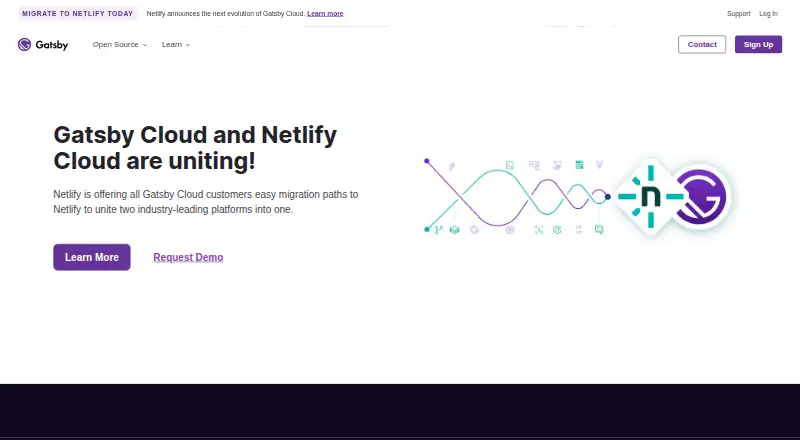
What Gatsby is
Gatsby is an open-source, React-based framework for building websites such as eCommerce and marketing sites, blogs and documentation. It supports JavaScript and Node.js, with rendering options including Static Site Generation, Deferred Static Generation and Server-Side Rendering. Its GraphQL data layer gives page components a consistent way to request information from content, APIs and services. Gatsby also provides code-splitting, image optimization, lazy loading and webpack. Its plugin library covers CMS, styling, analytics, e-commerce, payments, authentication and search; official integrations include hosting providers and content management systems. The open-source framework is free. A separate Free plan costs nothing and includes a 300-credit monthly limit, unlimited deploy previews and custom domains with SSL. Personal is listed at $9 a month and Pro at $20 a month; Enterprise pricing is custom. Projects pause when monthly usage limits are reached. Gatsby 5 requires Node 18 and React 18.
Good
- Supports SSG, DSG and SSR rendering options.
- GraphQL data layer connects content, APIs and services.
- Includes code-splitting and image optimization.
- Plugin library covers CMS, analytics and commerce.
- Free plan includes unlimited deploy previews.
Watch out
- Free plan has a 300-credit monthly limit.
- Projects pause after monthly usage limits are reached.
- Gatsby 5 requires Node 18 and React 18.
- Enterprise pricing is custom.
Who it suits
Gatsby suits React developers building content-rich websites and choosing among static, deferred or server-side rendering. Its plugins and CMS integrations support a range of site types and content sources.
Verdict
Gatsby combines a React framework with a GraphQL data layer and several rendering approaches. The open-source framework is free, while hosted plan usage is subject to credit limits and projects can pause when those limits are reached.
Plans and prices
From Gatsby's own pricing page, checked 28 Sep 2001.
| Plan | Price | What it gives you |
|---|---|---|
| Gatsby open source | Free | open-source framework · always free |
| Free | Free | 300 credit limit / month · unlimited deploy previews · custom domains with SSL · $0 forever |
| Personal | $9 a month | 1,000 credits / month · priority email support · 1-day observability · $9 /month |
| Pro | $20 a month | 3+ concurrent builds · 30-day analytics & metrics · monthly credits from plan · $20 /month with unlimited members |
| Enterprise | Priced on request | 99.99% SLA · enterprise network tier · SSO & SCIM · 24/7 dedicated support · Custom |
| Free | Free | Build and deploy free forever |
| Personal | $9 a month | Ready for real traffic |
| Pro | $20 a month | Ship faster as a team |
| Enterprise | Priced on request | Scale with confidence |
The facts
Each one read from Gatsby's own pages, with the date it was checked.
What it does
- CMS integration
- Yeschecked 20 Sep 2001
- CMS integrations
- Official CMS integrations include Contentful, Cosmic, DatoCMS, Sanity, Agility, Contentstack, Drupal, Flotiq, Kontent, Strapi, and WordPress.checked 28 Sep 2001
- Content sources
- apichecked 20 Sep 2001
- Data layer
- Gatsby uses GraphQL to provide a uniform way for page and StaticQuery components to declare the data they need.checked 28 Sep 2001
- Gatsby 5
- Gatsby 5 requires Node 18 and React 18.checked 28 Sep 2001
- GraphQL data layer
- Its data layer combines content, APIs, and services into one web experience.checked 27 Sep 2001
- Hosting integrations
- Official hosting integrations include Azure, Amazon Web Services S3, Fastly, Firebase, Google Storage, Netlify, and Vercel.checked 28 Sep 2001
- Incremental builds
- Yeschecked 20 Sep 2001
- Local preview server
- Yeschecked 20 Sep 2001
- Multilingual support
- Yeschecked 20 Sep 2001
- Open-source framework
- Gatsby is a React-based, open-source framework for building websites.checked 27 Sep 2001
- Performance
- Gatsby provides code-splitting, image optimization, lazy-loading, webpack, and Deferred Static Generation out of the box.checked 28 Sep 2001
- Plugins
- The Gatsby Plugin Library lists 3,269 results and includes plugins for CMS, CSS and UI, analytics, e-commerce, payment, authentication, and search.checked 28 Sep 2001
- Private by default
- New projects on credit-based accounts start private until published.checked 27 Sep 2001
- Rendering
- Gatsby can use Static Site Generation, Deferred Static Generation, or Server-Side Rendering.checked 28 Sep 2001
- Rendering options
- Gatsby supports SSR, DSG, and Cloud Functions for additional flexibility.checked 27 Sep 2001
- Repository integrations
- Integrations include GitHub Enterprise Server, self-managed GitLab, and Bitbucket.checked 27 Sep 2001
- Security
- Gatsby says its security program is SOC 2 Type 2 certified for Security, Availability, and Confidentiality, and that it adheres to GDPR.checked 28 Sep 2001
The company
- Company identity
- Gatsby is powered by the Gatsby community and Gatsby, the company.checked 27 Sep 2001
- Company transition
- Gatsby Inc. announced that it joined Netlify and that Gatsby Cloud would be incorporated into Netlify’s platform.checked 28 Sep 2001
Money
- Free deploy previews
- The Free plan includes unlimited deploy previews.checked 27 Sep 2001
- Free domains and SSL
- The Free plan includes custom domains with SSL.checked 27 Sep 2001
- Free plan
- Yeschecked 20 Sep 2001
- Free tier limit
- The Free plan includes a 300-credit monthly limit.checked 27 Sep 2001
The full review of Gatsby
Gatsby is an open-source framework for React developers building websites, from stores and marketing pages to blogs and documentation. It suits teams that want a GraphQL content layer alongside several rendering choices and are prepared to work in JavaScript and Node.js. Its free framework is compelling; hosted plans add credits and support, but usage caps can pause projects.
Overview
Gatsby brings content, APIs, and services together through a GraphQL data layer, letting pages and StaticQuery components declare the data they need in a common way. That structure can help projects draw from multiple sources, but it also makes Gatsby a more opinionated choice than a minimal static-site tool.
It supports Static Site Generation, Deferred Static Generation, and Server-Side Rendering. Code-splitting, image optimization, lazy-loading, webpack, and Deferred Static Generation are included out of the box, giving React developers several performance and delivery tools without requiring a separate framework for each rendering approach.
Key features
Content and integrations
The plugin library spans CMS, styling and UI, analytics, commerce, payments, authentication, and search. Official CMS integrations include Contentful, Sanity, Strapi, and WordPress, among others; hosting integrations include Netlify, Vercel, AWS S3, Azure, and Firebase. This breadth makes Gatsby useful when a site must connect an existing content or hosting stack, though teams should expect to choose and maintain the integrations that fit their setup.
CMS integration, incremental builds, multilingual support, and a local preview server are supported. The uniform GraphQL layer is a practical advantage for content-heavy sites, while Gatsby 5's requirement for Node 18 and React 18 sets a firm baseline for projects adopting that version.
Hosted platform and security
Netlify's platform adds team roles and permissions, multi-team collaboration, one-time-password authentication apps, and integrations with GitHub Enterprise Server, self-managed GitLab, and Bitbucket. New projects on credit-based accounts start private until published. Gatsby says its security program is SOC 2 Type 2 certified for Security, Availability, and Confidentiality and adheres to GDPR; Netlify describes its platform as SOC 2 certified. Gatsby does not run a formal bug bounty or pay monetary rewards for vulnerability reports.
Support ranges from community issue reporting and questions to priority email and 24/7/365 support with an SLA. Gatsby Inc. joined Netlify, with Gatsby Cloud being incorporated into Netlify's platform, so Gatsby's hosted offering sits within that platform transition.
Pricing
The framework itself is free and open source. Hosted pricing starts at free on the Free plan and rises to $9 a month for Personal and $20 a month for Pro. Enterprise has custom pricing.
| Plan | Price and included terms | Best fit |
|---|---|---|
| Gatsby open source | free; billed always free. Open-source framework. | Developers who want the framework without a hosted-plan allowance. |
| Free | free; billed $0 forever. 300 credits per month, unlimited deploy previews, custom domains with SSL. | Small projects or evaluation that can stay within the monthly credit cap. |
| Personal | $9 a month; billed $9 /month. 1,000 credits per month, priority email support, 1-day observability. | Individual projects needing a larger allowance and priority email support. |
| Pro | $20 a month; billed $20 /month with unlimited members. 3+ concurrent builds, 30-day analytics and metrics, monthly credits from plan. | Teams that need concurrent builds, longer analytics history, and unlimited members. |
| Enterprise | Custom pricing. 99.99% SLA, enterprise network tier, SSO and SCIM, 24/7 dedicated support. | Organizations requiring enterprise access controls and dedicated support. |
The lower hosted tiers trade capacity and support for lower cost: Free has 300 monthly credits and no stated priority support, while Personal raises the allowance to 1,000 and adds priority email. Pro's unlimited-member term is useful for larger teams, but its monthly credits still make usage a consideration. Projects pause when monthly usage limits are reached until the next billing cycle, so a cap can interrupt a live project rather than merely slow it down.
Gatsby Cloud Serverless Functions on the free plan are limited to 100,000 invocations per month, 128MB of memory, and a 15-second timeout. Those caps matter for projects that depend on serverless workloads; they are separate practical constraints alongside hosted-plan credits.
Platforms
Gatsby is available as an API-based, self-hosted, and web offering. Its supported development languages are JavaScript and Node.js, making it a natural fit for React teams already working in that ecosystem rather than developers seeking a language-agnostic site builder.
Who it's for
Gatsby is best suited to React developers building content-rich or commerce websites who value multiple rendering strategies, an integrated GraphQL data layer, and a broad integration ecosystem. It is less suitable for projects that need predictable uninterrupted hosted usage beyond a credit cap, or teams that do not want to work with React, JavaScript, and Node.js.
Pros and cons
- Pros: SSR, DSG, and static generation give teams meaningful choices for how pages are delivered.
- Pros: GraphQL, incremental builds, local previews, and a wide plugin and CMS ecosystem support complex content workflows.
- Pros: The free hosted tier includes unlimited deploy previews and custom domains with SSL.
- Cons: Credit limits can pause projects until the next billing cycle, making the free plan a constrained choice for sustained usage.
- Cons: Gatsby 5 requires Node 18 and React 18, which may rule out older project environments.
- Cons: Free serverless functions have fixed invocation, memory, and timeout limits.
Alternatives
For a broader comparison, see Static site generators.
- Bridgetown is a free-plan alternative available for API, Linux, macOS, self-hosted, and Windows environments.
- Hugo is a free, open-source option for Windows, macOS, and Linux.
- Cecil is free software under the EUPL-1.2 license for Linux, macOS, and Windows.
- Eleventy is a free, MIT-licensed, self-hosted static-site generator for Linux, macOS, Windows, and self-hosted environments.
- Nanoc is a free passion project for Linux, macOS, and Windows.
- Publii is a free-plan option for Windows, macOS, and Linux.
- Metalsmith is free, MIT/(L)GPL-licensed software available for API, Linux, macOS, and Windows.
- Nikola is a free-plan alternative for Windows, macOS, and Linux.
Verdict
Choose Gatsby if you are a React team that needs a flexible rendering model and a unified way to pull content and services into websites. Its free framework and deep integration range are strong reasons to adopt it; look elsewhere if hosted credit limits or Gatsby 5's React and Node requirements do not suit your project.
Getting started
- Visit the Gatsby website.
- Choose the open-source framework or a platform plan.
- Use JavaScript and Node.js to build a site with Gatsby.
- Connect content sources or APIs through the GraphQL data layer.
- Choose a hosting integration, such as Netlify, Vercel, Azure, or Amazon Web Services S3.
- For Gatsby 5, use Node 18 and React 18.
Limits worth knowing
The Free plan includes 300 credits per month; projects pause when monthly usage limits are reached until the next billing cycle. Gatsby Cloud Serverless Functions on the free plan are limited to 100,000 invocations per month, 128MB memory, and a 15-second timeout.
Questions
Is Gatsby free?
The open-source framework is free. The separate Free plan costs nothing.
What does the Free plan include?
It includes 300 credits per month, unlimited deploy previews, and custom domains with SSL. Projects pause when they reach their monthly usage limit until the next billing cycle.
What do the paid plans cost?
Personal costs $9 a month, and Pro costs $20 a month. Enterprise pricing is custom.
Which languages and rendering options does Gatsby support?
Its supported languages are JavaScript and Node.js. Rendering options include static generation, deferred static generation, and server-side rendering.
Which platforms and integrations are available?
Gatsby lists API, self-hosted, and web platforms. Official integrations include hosting services such as Netlify, Vercel, Azure, and Amazon Web Services S3, plus CMS products including Contentful, Sanity, Drupal, and WordPress.
What does Gatsby 5 require?
Gatsby 5 requires Node 18 and React 18.
Alternatives to Gatsby
- 1
Jekyll
Free planOpen sourceWebLinuxmacOSSelf-hosted8.1Free plan - 2

Cecil
Free planLinuxmacOSWindows7.4Free plan - 3

Eleventy
Free planLinuxmacOSSelf-hostedWindows7.4Free plan - 4

Nikola
Free planLinuxmacOSSelf-hostedWindows7.4Free plan - 5

Publii
Free planLinuxmacOSWindows7.3Free plan - 6
Metalsmith
Free planAPILinuxmacOSWindows7.2Free plan