Guspora
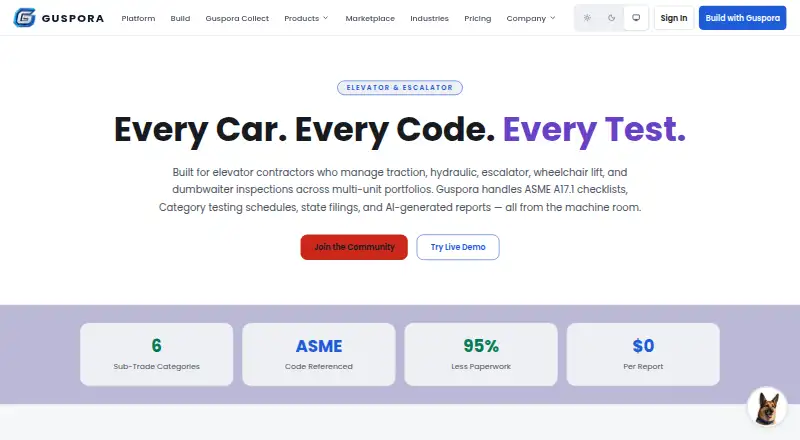
Guspora is elevator inspection and compliance software for contractors handling traction, hydraulic, escalator, wheelchair lift, and dumbwaiter inspections.
What Guspora is
Guspora is elevator inspection and compliance software for contractors handling traction, hydraulic, escalator, wheelchair lift, and dumbwaiter inspections. Its checklists reference ASME A17.1, A17.2, A18.1, and ADA standards, with pass/fail criteria, photo requirements, and state-specific addendums. The scheduling engine tracks Category 1 annual, Category 3 three-year, and Category 5 five-year test cycles, sending alerts 90, 60, and 30 days before due dates. Deficiencies can be recorded with severity, code reference, photo evidence, and a correction deadline, with automated reminders until resolution.
Equipment records can include manufacturer, model, capacity, speed, stops, controller type, and installation date; QR codes link records to inspection history. Inspection photos carry GPS, timestamp, and device information, while on-device face blurring runs by default. A customer portal lets building owners view elevator status, upcoming inspections, deficiency history, and certificate expirations. Guspora focuses on inspections, compliance documentation, scheduling, and deficiency tracking rather than elevator dispatch. Public customers are directed to its responsive web app; Android and iOS native work is limited to approved tester paths. Free Core is $0/mo, and paid plans begin with Starter at $29/mo.
Good
- Checklists reference ASME and ADA standards
- Tracks Category 1, 3, and 5 testing cycles
- Deficiencies include evidence, deadlines, and reminders
- Equipment records link to inspection history with QR codes
- On-device face blurring runs by default
Watch out
- The product focuses on inspection and compliance, not dispatch
- Public customers are directed to the responsive web app
- Free Core includes one workspace and one owner/admin user
- Free Core charges $20 per initial compliance report
Who it suits
Guspora suits elevator contractors who need inspection workflows, equipment records, compliance documentation, and recurring test schedules. It can also serve building owners who want portal access to status, upcoming inspections, deficiencies, and certificate expirations.
Verdict
Choose Guspora if your work centers on elevator inspections, compliance records, deficiency follow-up, and test-cycle scheduling. Look elsewhere if elevator dispatch is central to your workflow, or if you need a publicly available native mobile app.
Plans and prices
From Guspora's own pricing page, checked 15 Oct 2026.
| Plan | Price | What it gives you |
|---|---|---|
| Free Core | Free | 1 workspace · 1 owner/admin · basic records, import, archive, deficiency tracking and sharing · 25 AI reports/month · 2 GB storage · $20 per initial compliance report · $0/mo |
| Starter | $29 a month | 1 workspace · solo operator · tickets · basic scheduling · 1 included report filing/month · $15 each additional filing · $29/mo |
| Operator | $69 a month | Starter features · work requests and basic work orders · dispatch basics · 5 included report filings/month · $12 each additional · $69/mo |
| Professional | $129 a month | Up to 5 technician seats · full inspection engine, bulk inspect and plan builder · 300 AI reports/month · 100 GB storage · 20 filings/month · $8 each additional · $129/mo |
| Growth | $249 a month | Up to 15 technician seats · cross-location reporting · scoped integration planning · 300 AI reports/month · 250 GB storage · priority support · 50 filings/month · $5 each additional · $249/mo |
| Enterprise | Priced on request | 16+ seats · recording sharing · scoped integrations · dedicated implementation · highest limits · custom filing terms · Let's talk |
The facts
Each one read from Guspora's own pages, with the date it was checked.
What it does
- AI review requirement
- AI-generated inspection reports are drafts requiring qualified technician review and approval.checked 15 Oct 2026
- API
- Guspora provides Swagger UI for an OpenAPI 3.0.3 API with session-cookie or API-key authentication and tenant-scoped audit logging.checked 15 Oct 2026
- API limits
- API rate limits apply and bulk exports require written authorization.checked 15 Oct 2026
- Broader integrations
- The integrations page describes Stripe payments, AWS/S3 storage, calendar integrations, email/SMS notifications, APIs/webhooks, and document import.checked 5 Oct 2026
- Category test scheduling
- The scheduling engine tracks Category 1 annual, Category 3 three-year, and Category 5 five-year test cycles and sends alerts 90, 60, and 30 days before due dates.checked 5 Oct 2026
- Code checklists
- Its checklists reference ASME A17.1, A17.2, A18.1, and ADA standards and include pass/fail criteria, photo requirements, and state-specific addendums.checked 5 Oct 2026
- Customer portal
- Owners can view inspection status, upcoming tests, deficiencies and certificates through a portal.checked 15 Oct 2026
- Deficiencies
- Deficiencies can be logged with severity, code reference, photo evidence, and correction deadline, with automated reminders until resolution.checked 5 Oct 2026
- Deficiency tracking
- Deficiencies store severity, code references, photos and deadlines with automated reminders.checked 15 Oct 2026
- Elevator scope
- The elevator product supports traction, hydraulic, escalator, wheelchair-lift and dumbwaiter inspections.checked 15 Oct 2026
- Elevator standards
- Elevator checklists reference ASME A17.1, A17.2, A18.1, ADA and state addenda.checked 15 Oct 2026
- Equipment lifecycle
- Equipment records can be linked with QR codes and retained through their lifecycle.checked 15 Oct 2026
- Equipment tracking
- Equipment records can include manufacturer, model, capacity, speed, number of stops, controller type, and installation date, with QR codes linking to inspection history.checked 5 Oct 2026
- Field evidence
- Photos can include GPS, timestamps and device identifiers, with on-device face blurring described.checked 15 Oct 2026
- Founder background
- Cody Ferguson is described as a U.S. Army veteran who spent a decade in fire protection before starting Guspora.checked 15 Oct 2026
- Hosting
- Standard deployment is multi-tenant SaaS on AWS with tenant-ID row isolation and per-tenant storage prefixes; dedicated environments can be scoped.checked 15 Oct 2026
- Independent developer profile
- Devpost identifies Cody Ferguson as Guspora founder in Bardstown and lists REST APIs, multi-tenant SaaS, RBAC, AWS, offline-first apps and security among his skills.checked 15 Oct 2026
- Independent project
- Devpost lists Guspora Stewardship as an OpenAI Build Week project using Codex, GPT-5.6/OpenAI Responses API, Next.js, React, TypeScript, Vitest and Zod.checked 15 Oct 2026
- Independent trademark portfolio
- Justia lists two GUSPORA marks filed January 30 and February 21, 2026 covering SaaS and downloadable mobile inspection applications.checked 15 Oct 2026
- Inspection scheduling
- Category 1 annual, Category 3 three-year and Category 5 five-year tests can generate 90-, 60- and 30-day alerts.checked 15 Oct 2026
- Integrations
- The integrations page lists Stripe, AWS/S3, calendars, governed email/SMS, APIs/webhooks and document import.checked 15 Oct 2026
- Licence
- The platform code, documentation, workflows, design and AI models are stated to be Guspora LLC intellectual property, with no open-source licence offered.checked 15 Oct 2026
The company
- Company
- Guspora LLC lists 250 American Drive, Bardstown, Kentucky as its address and identifies Cody Ferguson as founder.checked 15 Oct 2026
- Headquarters
- Bardstown, Kentucky, United Stateschecked 28 Sep 2026
The full review of Guspora
Overview
Guspora is elevator inspection and compliance software for contractors working with elevators, escalators, wheelchair lifts, and dumbwaiters. It is best for teams that need documented inspections and recurring test schedules, rather than a system for assigning and dispatching service calls.
Its core advantage is a connected compliance workflow: code-oriented checklists, equipment histories, scheduled tests, and deficiency follow-up. The main buying constraint is cost per report as well as the monthly subscription, so filing volume matters when choosing a plan.
Key features
Inspections and equipment records
Checklists reference ASME A17.1, A17.2, A18.1, and ADA standards, with pass/fail criteria, photo requirements, and state-specific addendums. That structure suits contractors who need inspection records tied to relevant requirements across several types of lift equipment. Asset records can hold manufacturer, model, capacity, speed, number of stops, controller type, and installation date; QR codes connect equipment to its inspection history. This is useful for tracing an asset’s record at the equipment level, but it is not a substitute for dispatch tools.
Test cycles and deficiency follow-up
The scheduler tracks Category 1 annual, Category 3 three-year, and Category 5 five-year tests, with alerts 90, 60, and 30 days before they are due. This gives compliance teams advance visibility into recurring deadlines; operations centered on routing service work will need another system. Deficiencies can carry severity, code reference, photo evidence, and a correction deadline, with automated reminders until resolution, making follow-up more structured than a basic inspection log.
Evidence, customers, and integrations
Inspection photos receive GPS, timestamp, and device tags, while on-device face blurring is enabled by default. Building owners can use the customer portal to see elevator status, upcoming inspections, deficiency history, and certificate expirations. Stripe and AWS SES are live integrations; CompanyCam is being built, while communication updates and ServiceTitan are planned. The broader integrations offering describes Stripe payments, AWS/S3 storage, calendar integrations, email and SMS notifications, APIs and webhooks, and document import.
Guspora describes account-based role access, separation of organization and account information, activity records, and extra confirmation for some sensitive actions. Milo support is described as available 24/7, and email support responds within four hours.
Pricing
Guspora has a free tier and paid plans from $29/mo. Report-filing allowances and per-report charges are central to the price: the cheaper plans suit lower-volume operators, while teams filing more reports or needing multiple technician seats pay more for larger allowances.
- Free Core — free (billed $0/mo): One company workspace, one owner/admin user, basic records and archive, and $20 per initial compliance report. It is a way for a solo operator to keep basic records, but each initial report costs extra.
- Starter — $29 a month (billed $29/mo): One company workspace for a solo operator and one initial report filing per month; each additional filing costs $15. It fits very low filing volume, but the single included report makes overage charges relevant quickly.
- Operator — $69 a month (billed $69/mo): A small-business workspace with five initial report filings per month; additional filings cost $12 each. It offers more room than Starter, though the listed plan does not include a technician-seat count.
- Professional — $129 a month (billed $129/mo): Up to five technician seats, 300 AI-generated reports per month, 100 GB of storage, and 20 initial report filings; each additional filing costs $8. This is the clearest fit for a team needing defined technician capacity and a higher filing allowance.
- Growth — $249 a month (billed $249/mo): Up to 15 technician seats, 300 AI-generated reports per month, 250 GB of storage, and 50 initial report filings; each additional filing costs $5. It suits larger teams with heavier filing needs, though the AI-generated report allowance remains 300 per month.
- Enterprise — custom pricing: For 16 or more technician seats, sized to the operation, with custom commercial terms and a custom report-filing allowance or rate. It is aimed at larger operations that need terms beyond Growth.
The listed plan terms do not give a trial length or renewal conditions, so those should be confirmed before committing.
Platforms
Guspora supports Android and web. Public customers are directed to its responsive web app; native Android and iOS work is limited to approved tester paths, with an Android APK available to approved testers. That distinction matters for field teams expecting a generally available native mobile app: the public route is the web app.
Who it's for
Guspora is a good fit for elevator contractors who need inspection workflows, an asset register, compliance records, scheduled Category testing, and tracked deficiency correction. Its customer portal also suits operators who want building owners to see status, upcoming inspections, deficiency history, and certificate expirations.
It is not the right primary system for teams whose work centers on elevator dispatch. It is also a poor fit for buyers requiring a publicly available native mobile app rather than responsive web access.
Pros and cons
- Pros: Standards-referenced checklists and state addendums make inspection documentation more specific to elevator compliance than a generic job record.
- Pros: Category test alerts, deadlines, and automated deficiency reminders keep recurring obligations and unresolved corrections visible.
- Pros: QR-linked equipment histories and photo metadata support traceability, while default on-device face blurring adds a privacy measure to field evidence.
- Cons: No service dispatch means contractors coordinating call assignment and field routing need a separate system.
- Cons: Low-volume plans include few or no initial report filings, with per-report charges that can add up as activity grows.
- Cons: Native mobile use is not generally open to customers; the public mobile option is the responsive web app.
Alternatives
For other options, see Elevator Service Software. Consider ElevatorPlus if its one-time fixed-cost model better suits your buying preference, bearing in mind mandatory annual AMC and server costs are additional. Zentid is worth comparing if its paid plans and free trial suit your evaluation or user needs. LiftFlow is another paid Android and web option with a free trial. Tiliom Elevate is a paid option for Android, iOS, and web. Total Service may suit buyers seeking a custom plan shaped around active field technicians, modules, payroll complexity, locations, and implementation scope. Field Ascend is an alternative with a 30-day free trial and paid plans. Liftkeeper is a paid web option. Meazurable is an AMC product from Resonics Technologies, a company founded in 2011, with pricing by personalized demo.
Verdict
Choose Guspora if elevator inspections, compliance records, deficiency follow-up, and test-cycle scheduling are the center of your operation. Its strongest reason to buy is the joined-up record of equipment, inspection evidence, and recurring obligations; its clearest reason to look elsewhere is that it does not handle dispatch, while public native mobile access is limited.
Getting started
- Visit https://guspora.com/industries/elevator
- Use the responsive web app as a public customer
- Choose Free Core or a paid plan based on workspace, filing, and seat needs
- Approved testers can use the Android APK or native mobile tester paths
Limits worth knowing
Free Core provides one company workspace and one owner/admin user, with basic records and archive. Each initial compliance report costs $20. Starter includes one initial report filing per month, with each additional filing at $15.
Questions
What does Guspora cost?
Free Core is free, billed $0/mo. Starter is $29 a month, billed $29/mo; higher listed tiers are Operator at $69/mo, Professional at $129/mo, and Growth at $249/mo.
What does the free plan include?
Free Core includes one company workspace, one owner/admin user, basic records and archive. Initial compliance reports cost $20 each.
Which platforms can I use?
Guspora lists Android and web. Public customers are directed to the responsive web app; native Android and iOS work is limited to approved tester paths.
Does Guspora handle elevator dispatch?
No. Its elevator product focuses on inspection, compliance documentation, Category testing schedules, and deficiency tracking rather than dispatch.
Which integrations are available?
The elevator page lists Stripe and AWS SES as live, CompanyCam as building, and communication updates and ServiceTitan as planned. The broader integrations page describes Stripe payments, AWS/S3 storage, calendar integrations, email/SMS notifications, APIs/webhooks, and document import.
Who built Guspora?
The About page identifies Cody Ferguson as the builder and says his prior work in fire protection informed Guspora.
Alternatives to Guspora
- 1
Zentid
AndroidiOSWebAPI7.6From 299 AED a month - 2

Joblogic
AndroidiOSWebAPI7.3From $540 a year - 3
ElevatorZip
AndroidiOSWeb7.1From $83 a month - 4

Field Ascend
AndroidiOSWeb7.0From $13 a month - 5

ElevaTechPro
AndroidiOSWebAPI6.9 - 6

KomplyOS
AndroidiOSWebAPI6.9From $209 a month