gretl
gretl is a free, open-source desktop package for econometric analysis, available for Linux, macOS and Windows.
What gretl is
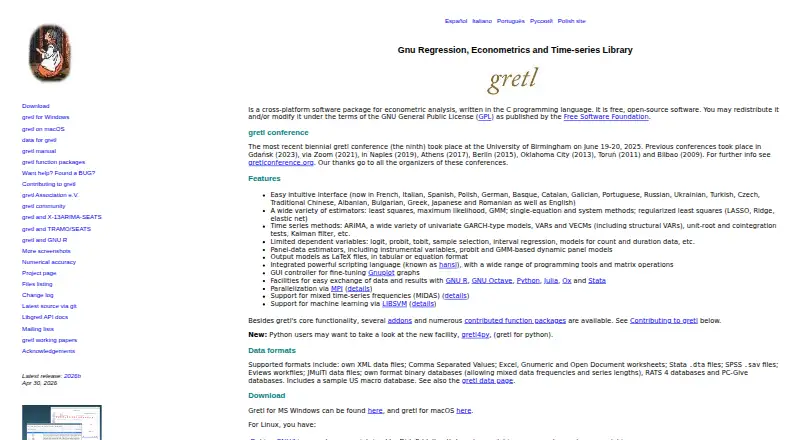
gretl is a free, open-source desktop package for econometric analysis, available for Linux, macOS and Windows. It includes statistical tests and regression models, with estimators such as least squares, maximum likelihood and GMM, along with regularized methods including LASSO, Ridge and elastic net. Its time-series methods cover ARIMA, GARCH-type models, VARs, VECMs, unit-root and cointegration tests, and the Kalman filter. It also handles panel data and limited dependent-variable models, including probit and dynamic panel methods based on GMM. Users can script in hansl and output models as LaTeX tables or equations. Data import includes CSV, Excel, OpenDocument, Stata, SPSS and other formats. gretl can exchange data and results with R, Octave, Python, Julia, Ox and Stata, and supports machine learning via LIBSVM. The GNU GPL permits redistribution and modification; the maker notes its statistical-method coverage is less comprehensive than GNU R's.
Good
- Free, open-source software under the GNU GPL.
- Available for Linux, macOS and Windows.
- Includes time-series and panel-data methods.
- Supports hansl scripting and LaTeX model output.
- Imports data from CSV, Excel and econometrics formats.
Watch out
- Statistical-method coverage is less comprehensive than GNU R's.
- macOS packages have version-specific system requirements.
Who it suits
gretl suits students, researchers and analysts seeking a free desktop environment for econometric modeling and time-series work. It may be a less suitable choice for users who need the broader statistical-method coverage attributed to GNU R.
Verdict
gretl provides a broad set of econometric tools and data connections without a software charge. Consider whether its method coverage meets your needs, particularly if you require the breadth associated with GNU R.
Plans and prices
From gretl's own pricing page, checked 3 Oct 2026.
| Plan | Price | What it gives you |
|---|---|---|
| gretl | Free | Free, open-source software · redistribution and modification under the GNU GPL |
The facts
Each one read from gretl's own pages, with the date it was checked.
What it does
- Bayesian analysis
- Yeschecked 20 Sep 2026
- Data formats
- Supported formats include CSV, Excel, Gnumeric, Open Document, Stata, SPSS, EViews, JMulTi, RATS 4 and PC-Give files, as well as gretl's own formats.checked 3 Oct 2026
- Data import formats
- XML, CSV, Excel, Gnumeric, OpenDocument, Stata, SPSS, EViews, JMulTi, RATS 4 and PC-Givechecked 20 Sep 2026
- Deployment
- desktopchecked 20 Sep 2026
- Estimators
- It includes least squares, maximum likelihood, GMM, single-equation and system methods, and regularized least squares methods including LASSO, Ridge and elastic net.checked 3 Oct 2026
- Integrations
- The site lists data and results exchange with GNU R, GNU Octave, Python, Julia, Ox and Stata, plus parallelization via MPI.checked 3 Oct 2026
- Intended users
- The maker describes gretl as a free, user-friendly and sophisticated econometrics package, and notes that its statistical-method coverage is less comprehensive than GNU R's.checked 3 Oct 2026
- Other models
- It supports limited dependent-variable models and panel-data estimators, including instrumental variables, probit and dynamic panel models based on GMM.checked 3 Oct 2026
- Purpose
- gretl is a cross-platform software package for econometric analysis, written in C.checked 3 Oct 2026
- Regression models
- Yeschecked 20 Sep 2026
- Scripting and output
- gretl has an integrated scripting language called hansl and can output models as LaTeX files in tabular or equation format.checked 3 Oct 2026
- Scripting support
- Yeschecked 20 Sep 2026
- Security and license
- The maker describes gretl as free, open-source software that may be redistributed and modified under the GNU General Public License.checked 3 Oct 2026
- Statistical tests
- Yeschecked 20 Sep 2026
- Support
- Users can seek help through the gretl-users mailing list and submit bug reports and feature requests through the SourceForge Tracker system.checked 3 Oct 2026
- Time series
- Time-series methods include ARIMA, GARCH-type models, VARs and VECMs, unit-root and cointegration tests, and the Kalman filter.checked 3 Oct 2026
Money
- Free plan
- Yeschecked 20 Sep 2026
Where it runs
- Machine learning
- The site states that gretl supports machine learning via LIBSVM and mixed time-series frequencies via MIDAS.checked 3 Oct 2026
- macOS requirements
- The macOS download page offers gretl for macOS 10.9 or higher, with separate packages listed for Apple Silicon on macOS 11 or higher and for Intel Macs.checked 3 Oct 2026
- Platforms
- The download page links to packages for Windows and macOS, and Debian and Fedora packages for Linux; it also provides source packages for compiling.checked 3 Oct 2026
The full review of gretl
Overview
gretl is a free, open-source desktop package for econometric analysis on Linux, macOS, and Windows. It suits students, researchers, and analysts whose work centers on regression, time series, panel data, and related economic models. The bottom line is a capable specialist toolkit at no software cost, although its method coverage is narrower than a general environment such as GNU R.
Key features
The estimator selection is unusually broad for a dedicated econometrics package. Alongside least squares and maximum likelihood, gretl provides GMM, single-equation and system methods, and regularized least squares through LASSO, Ridge, and elastic net. That combination covers conventional inference and shrinkage-based modeling, making it suitable for applied projects that would otherwise require several separate tools.
Its time-series support is a major strength: ARIMA, GARCH-type models, VARs, VECMs, unit-root and cointegration tests, and the Kalman filter are all included. Panel-data and limited-dependent-variable work is covered with instrumental variables, probit, and dynamic panel models based on GMM. Statistical tests and Bayesian analysis add useful breadth, while LIBSVM support brings machine-learning capability and MIDAS handles mixed time-series frequencies.
Reproducible workflows can use the integrated hansl scripting language. Results can be written as LaTeX tables or equations, which is practical for academic papers and technical reports. Import supports XML, CSV, Excel, Gnumeric, OpenDocument, Stata, SPSS, EViews, JMulTi, RATS 4, PC-Give, and gretl formats. Exchanges with GNU R, GNU Octave, Python, Julia, Ox, and Stata, together with MPI parallelization, make gretl easier to place in a wider analytical workflow. The trade-off is specialization: readers needing a more comprehensive statistical ecosystem may outgrow it.
Pricing
| Plan | Price | What you get |
|---|---|---|
| gretl | free | Free, open-source software that can be redistributed and modified under the GNU GPL. |
There is no trial period because the complete package is free. The absence of a license charge makes it a straightforward choice for personal, classroom, and research use; organizations that require a broader method catalogue rather than lower cost should compare general statistical platforms instead.
Platforms
gretl is a desktop application for Linux, macOS, and Windows. The macOS download supports version 10.9 or later, with separate packages for Apple Silicon on macOS 11 or later and Intel Macs. Users who need browser-based access will need a different product.
Who it's for
Choose gretl for econometrics courses, policy analysis, academic research, and applied modeling where regression and time-series methods are central. Its scripting, LaTeX output, and broad file-import options favor repeatable, publication-oriented work. It is less suitable as a one-stop replacement for a general statistical environment when your projects span methods outside econometrics.
Pros and cons
- Pros: Extensive econometric estimators, including GMM and regularized regression, support both standard and advanced applied work.
- Pros: Strong time-series, panel, and limited-dependent-variable coverage reduces the need for add-on software.
- Pros: hansl scripting, LaTeX export, and interoperability with R, Python, Julia, Octave, Ox, and Stata support reproducible workflows.
- Pros: Free GPL licensing permits use, redistribution, and modification without a subscription.
- Cons: The package is not as method-comprehensive as GNU R, limiting its appeal for broad, non-econometric analysis.
- Cons: Desktop-only deployment excludes users who specifically need browser access.
Alternatives
For a point-and-click interface with R-powered analyses and web access, choose jamovi; its free Guest plan includes the full module library across browser, Windows, macOS, and Linux. JASP is another entirely free desktop option on the same three operating systems, with a 4 GB RAM minimum and 4 GB of free disk space.
Pick Stata when paid software and an annual university faculty/staff license fit your organization. EViews is an alternative for users who require its paid academic or commercial licensing model on macOS or Windows. GNU PSPP suits users wanting free statistical software with no artificial limits on cases or variables.
SAS/STAT is the choice for organizations prepared to request a quote. Choose R when you want a free software environment with broader statistical scope. IBM SPSS Statistics fits teams seeking a paid subscription with a Base plan at $99 a month per authorized user.
Verdict
gretl is an excellent fit for anyone who wants a no-cost, scriptable econometrics workstation with serious regression and time-series depth across the major desktop operating systems. Choose it for focused econometric research and teaching; look elsewhere when your work demands the wider statistical-method coverage of GNU R or a browser-first workflow.