Gmail Bulk Unsubscribe & Cleanup Tool
Gmail Bulk Unsubscribe & Cleanup Tool helps Gmail users handle unwanted messages in batches.
What Gmail Bulk Unsubscribe & Cleanup Tool is
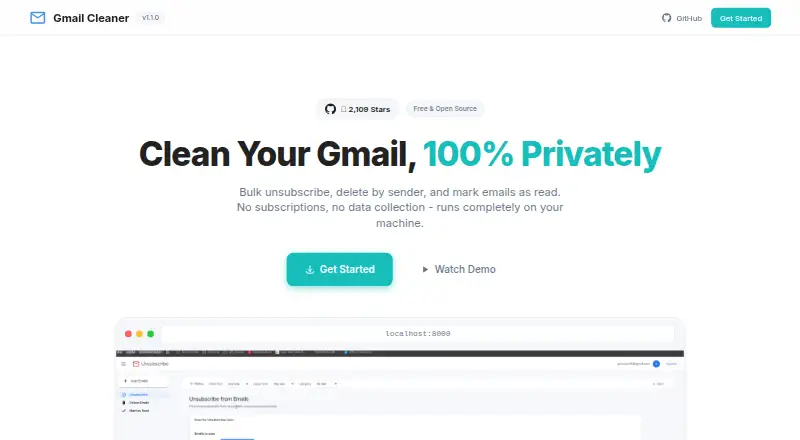
Gmail Bulk Unsubscribe & Cleanup Tool helps Gmail users handle unwanted messages in batches. It can unsubscribe using automatic one-click or manual methods, delete messages from multiple senders, archive email, manage labels, mark messages read or important, and export email metadata as CSV. Filters cover date range, email size, category, sender, and labels. The tool works through the Gmail API, and users must create their own Google Cloud project and OAuth credentials. The maker says it runs locally without external servers or data collection, and describes its requested access as read and modify permissions. Setup requires Docker or Python 3.9+ with uv, along with users' own Google credentials. The software is free to use under the MIT license. A one-on-one setup service is listed at $8, paid once. Deleted messages go to Gmail Trash, where they can be recovered within 30 days. The maker says responses to issues and pull requests may be delayed while taking personal time.
Good
- Bulk unsubscribe supports automatic and manual methods
- Filters include date, size, category, sender, and labels
- Can archive, delete, and manage labels in batches
- Maker says it runs locally without data collection
- Free to use under the MIT license
Watch out
- Supports Gmail only
- Requires users to create Google Cloud and OAuth credentials
- Requires Docker or Python 3.9+ with uv
- Maker may be delayed responding to issues
Who it suits
It suits Gmail users who want to clean up messages in batches and are comfortable supplying Google credentials and setting up Docker or Python. People who need installation help can consider the listed one-on-one service.
Verdict
The tool offers several Gmail cleanup actions and says processing stays local, but setup requires users to supply their own Google credentials. Check that the permissions and setup requirements fit your comfort level.
Plans and prices
From Gmail Bulk Unsubscribe & Cleanup Tool's own pricing page, checked 2 Oct 2001.
| Plan | Price | What it gives you |
|---|---|---|
| Free | Free | No subscription · free to use under MIT license |
| 1-on-1 Setup Service | $8, paid once | Personal setup help via Google Meet · setup is guided until installation works |
The facts
Each one read from Gmail Bulk Unsubscribe & Cleanup Tool's own pages, with the date it was checked.
What it does
- Deletion limit
- Deleted messages go to Gmail Trash and can be recovered there within 30 days.checked 2 Oct 2001
- Filters
- Filters include date range, email size, category, sender, and labels.checked 2 Oct 2001
- Integration
- The tool uses the Gmail API and requires users to create their own Google Cloud project and OAuth credentials.checked 2 Oct 2001
- Intended user
- The maker offers a paid one-on-one setup service for people who need help with Docker, Google Cloud Console, or credentials.json.checked 2 Oct 2001
- More cleanup actions
- It can bulk delete from multiple senders, archive emails, manage labels, mark messages important, and download email metadata as CSV.checked 2 Oct 2001
- Permissions
- The repository describes the requested access as read and modify permissions and says users control their own Google OAuth app.checked 2 Oct 2001
- Privacy
- The maker says the app runs locally without external servers or data collection, so emails stay on the user's machine.checked 2 Oct 2001
- Purpose
- The tool bulk unsubscribes from emails, deletes emails by sender, and marks emails as read.checked 2 Oct 2001
- Setup requirement
- Users need Docker or Python 3.9+ with uv and must supply their own Google credentials.checked 2 Oct 2001
- Support
- The repository says the maker may be delayed in responding to issues and pull requests while taking personal time.checked 2 Oct 2001
- Unsubscribe
- It supports automatic one-click and manual unsubscribe methods.checked 2 Oct 2001
Where it runs
- Platforms
- Docker and Python installations are listed for Linux x86_64, Windows x86_64, macOS Intel, and Apple Silicon M1/M2/M3/M4.checked 2 Oct 2001
The full review of Gmail Bulk Unsubscribe & Cleanup Tool
Overview
Gmail Bulk Unsubscribe & Cleanup Tool is a Gmail utility for unsubscribing from mail and taking bulk cleanup actions. It is best suited to users willing to run software locally and configure their own Google credentials; its breadth is useful, but the setup is a real commitment.
Key features
Unsubscribe automatically with one click or use the manual method, then delete messages from multiple senders, archive them, or mark them read or important. Filters for date range, message size, category, sender, and labels make it possible to narrow a bulk action rather than sweep an inbox indiscriminately. Label management and CSV downloads of email metadata add useful housekeeping options beyond unsubscribing.
The tool uses the Gmail API and requires read and modify access. Its maker says it runs locally without external servers or data collection, and users control their own Google OAuth app. That arrangement may suit people who prefer not to route email through an outside service, but it does not remove the need to trust the permissions they grant or to handle credential setup themselves. Deleted messages go to Gmail Trash and can be recovered there for 30 days.
Pricing
| Plan | Price | What it includes |
|---|---|---|
| Free | free | Free to use under the MIT license, with no subscription. |
| 1-on-1 Setup Service | $8, paid once | Personal setup help via Google Meet, guided until installation works. |
The free option makes sense for technically confident users who can handle Docker or Python 3.9+ with uv, a Google Cloud project, and their own OAuth credentials. The one-time setup service is aimed at people who want assistance with Docker, Google Cloud Console, or credentials.json; it helps with installation rather than changing the tool's Gmail focus. There is no free trial, subscription renewal, or published quota to weigh against the free plan.
Platforms
It supports Linux, macOS, Windows, web use, and self-hosting. In practice, the listed desktop operating systems do not make this a conventional plug-and-play app: users still need Docker or Python 3.9+ with uv and must supply Google credentials.
Who it's for
This is a fit for Gmail users who want detailed, sender- and message-filtered bulk actions and are comfortable managing their own OAuth setup. The local-running model may appeal to privacy-conscious users, while the read-and-modify permission scope and technical installation make it a poor match for anyone seeking a quick, account-connected cleanup service. Support is also less dependable for urgent troubleshooting: the maker says responses to issues and pull requests may be delayed while taking personal time.
Pros and cons
- Pro: It combines unsubscribe, delete, archive, read-state, importance, label, and CSV metadata actions, giving Gmail users more control than a single-purpose unsubscribe tool.
- Pro: Filters by date, size, category, sender, and labels help target bulk changes more carefully.
- Pro: Local operation, according to the maker, avoids external servers and data collection; users control their own Google OAuth app.
- Con: Users must create a Google Cloud project, supply OAuth credentials, and install with Docker or Python 3.9+ and uv, a substantial barrier for casual inbox cleanup.
- Con: Read and modify permissions are broad enough to warrant careful consideration before granting access.
- Con: The maker warns that support responses may be delayed, so users who depend on prompt setup help should factor that in.
Alternatives
Email Cleanup Software is the category overview for comparing other inbox-cleaning options. Clean Email may suit users who want Android or iOS access and a free account capped at 1,000 messages, with paid features for more; its free tier omits Screener, Sender and Mailing List Settings, and Auto Clean. InboxSweeper is another free, open-source option with Linux, macOS, web, and Windows support and no account or subscription.
Cleanfox is a free Android, iOS, and web alternative for inbox cleaning and newsletter unsubscribing. Unroll.Me is also free on Android, iOS, and web, but requires access to commercial emails and uses commercial-email data for measurement products. Trimbox offers its first 10 unsubscribes free across Android, iOS, web, and browser extension.
ClearInbox may appeal to users looking for a self-hosted or web option that starts with connecting a mailbox. Unsubscribe for Gmail is another freemium Gmail-unsubscribe option. GoodByEmail offers a free trial and a Lite plan at $9.99 a month, with unlimited inboxes, unsubscribes, and inbox size, entire email history, and one device.
Verdict
Choose Gmail Bulk Unsubscribe & Cleanup Tool if you want a broad set of Gmail cleanup actions, precise filters, and a locally run approach, and are prepared to configure Google OAuth yourself. Look elsewhere if you want minimal setup, faster support, or a service that does not require granting read and modify access to your Gmail account.
Getting started
- Open the project's website.
- Choose Docker or Python 3.9+ with uv for setup.
- Create your own Google Cloud project and OAuth credentials.
- Supply your Google credentials to run the tool.
- Use the $8, paid once one-on-one setup service if you want guided installation help.
Questions
Is Gmail Bulk Unsubscribe & Cleanup Tool free?
Yes. The Free plan costs nothing and is free to use under the MIT license.
What does the one-on-one setup service cost?
It costs $8, paid once and provides guided setup via Google Meet until installation works.
Which email provider does it support?
It supports Gmail and uses the Gmail API.
What setup is required?
Users need Docker or Python 3.9+ with uv and must provide their own Google credentials.
How does the tool handle privacy and access?
The maker says the app runs locally without external servers or data collection. The repository describes requested access as read and modify permissions, with users controlling their own Google OAuth app.
Can deleted email be recovered?
Deleted messages go to Gmail Trash and can be recovered there within 30 days.
Alternatives to Gmail Bulk Unsubscribe & Cleanup Tool
- 1

Clean Email
Free planAndroidiOSWebmacOS8.0From $2.50 a month - 2
Paperweight
Free planOpen sourceLinuxmacOSWindows7.8From $4.58 a month - 3
Gmail Unsubscriber
Free planOpen sourceAndroidiOSWeb7.7Free plan - 4
InboxSweeper
Free planOpen sourceWebLinuxmacOSSelf-hosted7.4Free plan - 5
Cleanfox
Free planAndroidiOSWeb7.3Free plan - 6
Gmail Unsubscribe
Free planWebAPIExtension7.2From $2.99 a month