
Globalping
Globalping runs network tests from globally distributed probes to help monitor, debug, and benchmark internet infrastructure.
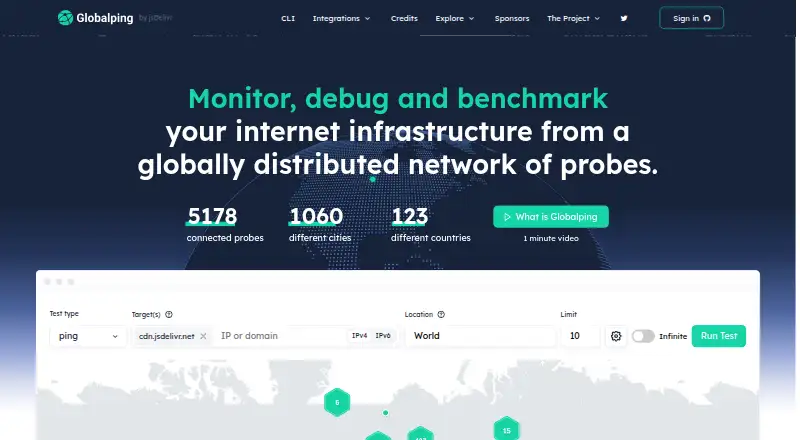
What Globalping is
Globalping runs network tests from globally distributed probes to help monitor, debug, and benchmark internet infrastructure. Available tests include ping, traceroute, DNS, MTR, and HTTP, and locations can be chosen by country, continent, city, US state, region, ASN, ISP, tag, or cloud region. It offers a web service, REST API, CLI, and integrations including Slack, Discord, Zapier, n8n, TypeScript and Go libraries, Helm, Visual Studio Code, and GitHub Bot. The CLI supports Linux, Mac, and Windows and can be used to script tests. The free plan gives unregistered users 50 probes per measurement and 250 free tests per hour; registered users can use up to 500 probes per measurement and receive 500 free tests per hour. A measurement can request up to 500 probes, and each additional test costs one credit. A Sponsor donation is listed at $10 a month, with a base reward of 4,000 credits per $1 donated and cumulative bonuses up to 1,500%. The maker describes the components as open source and says commercial use is supported within its terms.
Good
- Tests include ping, traceroute, DNS, MTR, and HTTP.
- Locations can be selected by city, ISP, ASN, and more.
- Free tests are available to registered and unregistered users.
- Offers REST API, CLI, and several integrations.
Watch out
- Additional tests cost one credit each.
- Unregistered users receive 250 free tests per hour.
- Measurements are limited to 500 probes.
- No free trial is listed.
Who it suits
Globalping suits solo developers through enterprise teams that need network checks from multiple locations. Its CLI and API integrations may suit users who want to script or automate measurements.
Verdict
Globalping provides network tests from selectable locations, with a free allowance and options for CLI, API, and integrations. Consider the free-test limits and credit use if you expect to run frequent measurements.
Plans and prices
From Globalping's own pricing page, checked 15 Oct 2026.
| Plan | Price | What it gives you |
|---|---|---|
| Free | Free | 250 free tests/hour · 50 probes/measurement unauthenticated; registered users get 500 tests/hour and 500 probes/measurement · No registration required |
| Sponsor donation | $10 a month | Base reward of 4,000 credits per $1 donated · cumulative bonus up to 1,500% · credits can fund additional tests · Monthly donation; the page also offers one-time donations |
| GitHub Sponsor | $25 a month | Credits for tests beyond free limits · $25/month example shown · hosting a probe adds 150 tests/probe/day · Donation |
The facts
Each one read from Globalping's own pages, with the date it was checked.
What it does
- API authentication
- API calls can be unauthenticated, use bearer tokens, or use OAuth2 for applications running measurements for end users.checked 15 Oct 2026
- Automation
- The integrations page describes using the API to build free or commercial tools and the CLI to script and automate tests from a terminal.checked 29 Sep 2026
- CLI
- The CLI runs on Linux, macOS and Windows and supports ping, HTTP, DNS, MTR, traceroute, JSON output, CI mode and probe limits.checked 15 Oct 2026
- Commercial use
- The credits FAQ says commercial use is supported within the limits of the terms of service.checked 29 Sep 2026
- Documentation depth
- The API specification documents endpoints, schemas, authentication, rate limits, client guidelines and asynchronous measurement behavior.checked 15 Oct 2026
- Hardware probe security
- The maker says hardware probes do not allow access to a user's LAN, block malicious and abusive endpoints, open no ports, and use open-source firmware.checked 29 Sep 2026
- Integrations
- Official integrations include Slack, Discord, Zapier, n8n, MCP Server, VS Code, GitHub Bot and Helm.checked 15 Oct 2026
- Intended users
- The about page says the platform is designed for solo developers through enterprise companies and aims to keep it useful to most users for free.checked 29 Sep 2026
- Licence
- The official globalping.io website repository is marked OSL-3.0 licensed.checked 15 Oct 2026
- Limit: high volume
- A single measurement is capped at 500 probes, so thousands of tests require multiple measurements and static location selection.checked 15 Oct 2026
- Limit: probe targeting
- Probes do not expose stable UUIDs for direct targeting; users must rely on location filters or prior measurement IDs.checked 15 Oct 2026
- Limit: rate limits
- Unauthenticated users are limited to 250 tests per hour and 50 probes per measurement; registered users receive 500 tests per hour and 500 probes per measurement.checked 15 Oct 2026
- Limit: result certainty
- Requested probe counts are best effort, so the API does not guarantee returning the exact number requested.checked 15 Oct 2026
- Limits
- Each credit equals one test, and a single measurement can request up to 500 probes.checked 29 Sep 2026
- Limit: security testing
- Terms prohibit vulnerability scanning, penetration testing and exploit validation when those activities are likely to trigger abuse complaints or blocking.checked 15 Oct 2026
- Location selection
- Locations can be selected with countries, continents, cities, regions, ASNs, ISP names, eyeball or datacenter tags and cloud regions.checked 15 Oct 2026
- Magic location API
- Globalping integrations use a magic location field that interprets natural location descriptions and selects suitable probes.checked 15 Oct 2026
- Monitoring integrations
- Uptime Kuma, Upptime, UptimeFlare, Doggo DNS, Checkmate and CraftCMS Cache Igniter use Globalping as a feature.checked 15 Oct 2026
- Notable news
- Globalping announced planned API limit changes on October 3, 2024, moving users toward account-based limits and 500 tests per hour for registered users.checked 15 Oct 2026
- Open source
- The maker describes every Globalping component as open source and actively developed on GitHub with its community and users.checked 29 Sep 2026
The company
- Company facts
- LinkedIn lists Globalping as privately held, founded in 2023, with 2–10 employees.checked 15 Oct 2026
- Headquarters
- The legal registered office is Suite 2a1, Northside House, Mount Pleasant, Barnet, England, EN4 9EB.checked 15 Oct 2026
- Legal maker
- The service is operated by Volentio JSD Limited, trading as Globalping, registered in England and Wales under company number 14984373.checked 15 Oct 2026
- Maker
- The homepage says the Globalping platform is developed by the jsDelivr team.checked 29 Sep 2026
The full review of Globalping
Overview
Globalping runs network tests from distributed probes, making it useful for developers and operators who need to compare connectivity or service behavior across locations. Its range of location filters and access methods is a strong fit for infrastructure troubleshooting; the hourly free-test caps matter if you plan to measure frequently.
Key features
Measurements across locations
Globalping supports ping, traceroute, DNS, MTR, and HTTP tests. You can select probes by country, continent, city, US state, region, ASN, ISP, tag, or cloud region, so measurements can target either broad geographic coverage or a particular network or cloud location. Each measurement can request up to 500 probes, though free-use probe caps vary by registration status.
This breadth makes Globalping useful when a problem appears only from certain networks or regions. It is less suited to diagnosing every kind of local network issue: its stated purpose is testing internet infrastructure from distributed probes.
Tools and automation
Use the web interface, REST API, or CLI; the CLI supports Linux, Mac, and Windows and includes DNS, HTTP, MTR, ping, and traceroute commands. The maker also lists Slack, Discord, Zapier, n8n, MCP Server, TypeScript and Go libraries, Helm, Visual Studio Code, and GitHub Bot integrations. The API can power free or commercial tools, while the CLI can be scripted from a terminal, giving teams several ways to fit tests into existing workflows.
Open development and security
The jsDelivr team develops Globalping, and describes its components as open source and developed with its community and users. The maker says it limits public information exposed by probes and blocks harmful domains and IPs. For hardware probes, it says there is no LAN access, no open ports, malicious endpoints are blocked, and the firmware is open source.
Commercial use is supported within the terms of service. For API or tool problems, the maker recommends GitHub issues and provides [email protected] for private contact.
Pricing
Globalping is freemium, with no free trial. Each credit funds one test, and one measurement can request up to 500 probes.
- Free — free: Unregistered users can request up to 50 probes per measurement and run 250 free tests per hour. Registered users can request up to 500 probes per measurement and run 500 free tests per hour; additional tests cost one credit each. Registration therefore matters for users who need larger measurements, while even the registered allowance imposes a meaningful ceiling on frequent testing.
- Sponsor donation — $10 a month, billed Monthly donation: Donations provide credits for additional tests, with a base reward of 4,000 credits per $1 donated and a cumulative bonus of up to 1,500%. One-time donations are also offered. This suits users who want to fund extra testing without a stated recurring subscription commitment; credit consumption still tracks one test per credit.
The free plan is a practical starting point for occasional diagnostics. Frequent automation may require donations to fund tests beyond the hourly allowance.
Platforms
Globalping is available on the web and through its API, with CLI support for Linux, macOS, and Windows. Supported deployment options also include Docker and Kubernetes, making it relevant to both individual terminal workflows and containerized environments.
Who it's for
The maker positions Globalping for users ranging from solo developers to enterprise companies and aims to keep it useful for most people at no cost. It is particularly well matched to teams investigating geographically or network-specific behavior, or developers who want to automate repeatable measurements through an API or CLI. Those who need only local network diagnostics or expect high test volume should weigh that focus and the credit limits before adopting it.
Pros and cons
- Pro: Many location filters, including ASNs, ISPs, tags, and cloud regions, help narrow tests to relevant vantage points rather than relying only on country-level selection.
- Pro: Five test types and up to 500 probes per measurement support broad comparisons of reachability, paths, DNS, and HTTP behavior.
- Pro: Web, API, CLI, and a wide set of integrations give both manual users and automation builders ways to run tests.
- Con: Unregistered measurements are capped at 50 probes, and free tests are limited to 250 per hour; registered users get higher caps but still face a 500-test hourly allowance.
- Con: Extra tests consume credits, so recurring high-volume use requires funding beyond the free allowance.
Alternatives
For a broader category view, browse Network Diagnostic Software.
- PingPlotter is worth considering if you want a freemium tool with an iOS option and a free edition limited to one connection, no remote collection, and 10-minute monitoring history; it also offers a free trial.
- Nmap is a free alternative for users who want its end-user license and can work within the restriction against redistribution inside commercial software or hardware products.
- RIPE Atlas is another free option: public data is freely available, while custom measurements require credits.
- DNSViz is a free, open-source option for web analysis, with a GPL-2.0 source license.
- NETworkManager is a free option for Windows users.
- iperf3 is a free option for Linux, macOS, and self-hosted use; its source distributions use a three-clause BSD license, and ESnet does not distribute binary packages.
- NetSpot is a freemium option for Android, iOS, macOS, and Windows, with a free edition for personal and evaluation use and a free trial.
- Angry IP Scanner is a free, open-source option under GPLv2 for Linux, macOS, and Windows.
Verdict
Choose Globalping if you need internet-facing network tests from specific geographic, provider, or cloud locations and value API, CLI, and integration options. Its free allowance makes occasional diagnostics accessible, but users running tests frequently should account for hourly caps and credit use. Look elsewhere if your main need is a different kind of network diagnostic or a workflow that cannot accommodate those limits.
Alternatives to Globalping
- 1

PingPlotter
Free planiOSWebAPILinux8.2From $6.99 a month - 2
nPerf
Free planAndroidiOSWebAPI8.0Free plan - 3

inSSIDer
Free planAndroidmacOSWindows7.6From $200 a year - 4
iperf2
Free planOpen sourceAndroidLinuxmacOSSelf-hosted7.4Free plan - 5

NetSpot
Free planAndroidiOSmacOSWindows7.4$199 one-time - 6

RIPE Atlas
Free planOpen sourceWebAPILinuxmacOS7.4Free plan