GitPLM
GitPLM manages product manufacturing information, including bills of materials and part numbers, alongside product designs in Git.
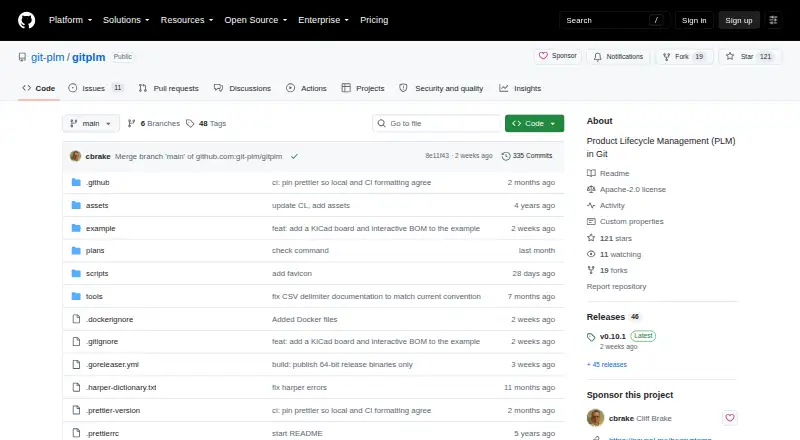
What GitPLM is
GitPLM manages product manufacturing information, including bills of materials and part numbers, alongside product designs in Git. It is designed for small teams building products and combines source BOMs with partmaster data, can assemble BOMs across subassemblies, and gathers release information for custom components. Its terminal interface supports searches across columns, parameter-based searches within columns, editing, and datasheet links. Partmaster and BOM records use CSV files, while release configuration uses YAML. For KiCad, GitPLM can provide a parts database through HTTP Libraries and reload it when CSV files change. Optional release hooks can run tools such as KiCad’s InteractiveHtmlBom generator, though those hooks are supported only on Linux and macOS. The KiCad HTTP server can use an optional authentication token. GitPLM is a self-contained Go binary with no dependencies, runs on Linux, macOS, and Windows, and is deployed on-premise. It is free and released under the Apache 2.0 license. The maker invites users to open an issue or discussion for help fitting it to their process.
Good
- Combines BOMs with partmaster data.
- Builds BOMs across subassemblies.
- Terminal interface supports search and editing.
- KiCad data can reload when CSV files change.
- Self-contained Go binary has no dependencies.
Watch out
- Release hooks are supported only on Linux and macOS.
- Partmaster and BOM data use CSV files.
- Release configuration uses YAML files.
Who it suits
GitPLM suits small teams building products who want to keep manufacturing data alongside designs in Git. It is particularly relevant to teams managing BOMs, part records, and manufacturing releases, including those using KiCad.
Verdict
GitPLM brings part and release data into a Git-oriented product workflow, with KiCad connectivity and BOM assembly. Its optional release hooks have narrower platform support than the main tool.
Plans and prices
From GitPLM's own pricing page, checked 8 Oct 2026.
| Plan | Price | What it gives you |
|---|---|---|
| GitPLM | Free | No paid plans or usage limits are stated on the opened maker pages. |
The facts
Each one read from GitPLM's own pages, with the date it was checked.
What it does
- Architecture
- The maker describes GitPLM as a single, self-contained Go binary with no dependencies.checked 8 Oct 2026
- BOMs and releases
- It combines source BOMs with partmaster data, creates combined BOMs across subassemblies, and gathers custom-component release data for manufacturing.checked 8 Oct 2026
- Data format
- Partmaster and BOM data use CSV files, and release configuration uses YAML files.checked 8 Oct 2026
- KiCad integration
- GitPLM can serve a parts database to KiCad through KiCad’s HTTP Libraries feature and reload the data when CSV files change.checked 8 Oct 2026
- Licensing
- The GitPLM tool is released under the Apache 2.0 license.checked 8 Oct 2026
- Limits
- Release hooks are documented as supported on Linux and macOS only.checked 8 Oct 2026
- Other integrations
- The maker documents optional release hooks that can run tools such as KiCad’s InteractiveHtmlBom generator.checked 8 Oct 2026
- Part management
- Its terminal UI supports quick search across columns, per-column parametric search, editing, and datasheet links.checked 8 Oct 2026
- Purpose
- GitPLM manages product manufacturing information, including BOMs and part numbers, alongside product designs in Git.checked 8 Oct 2026
- Security
- The KiCad HTTP server supports an optional authentication token.checked 8 Oct 2026
- Support
- The maker invites users to open an issue or discussion for help fitting GitPLM to their process.checked 8 Oct 2026
The company
- Target teams
- The maker says GitPLM is designed for small teams building products.checked 8 Oct 2026
The full review of GitPLM
GitPLM is a product manufacturing data tool that keeps parts and BOMs alongside designs in Git. It is best suited to small product teams that are comfortable with a terminal and file-based workflows. Its strength is a focused, self-hosted process linking design data to manufacturing records.
Overview
GitPLM brings part records and manufacturing BOMs into the same revision-controlled workflow as product designs. It combines source BOMs with partmaster data, rolls BOMs up across subassemblies, and gathers custom-component release data for manufacturing. Revision control, change management, BOM management, and API access support teams that want these tasks close to their design files.
The tool is a self-contained Go binary with no dependencies. Parts and BOMs use CSV files, while release settings use YAML. This makes the underlying data straightforward to keep with a Git-managed project, but it also puts structured files and Git at the center of everyday work.
Key features
Parts and BOMs
The terminal interface searches across columns, supports parametric searches within a column, allows editing, and links datasheets. That is a useful set of tools for maintaining parts directly in a compact workflow; teams that want to manage parts through a graphical catalog may find the terminal-first approach less suitable. Combining BOMs across subassemblies gives manufacturing a consolidated view of a product.
KiCad and release data
GitPLM can serve a parts database to KiCad through its HTTP Libraries feature and reload the data when CSV files change. For teams using KiCad, that connects managed part records to the design workflow without separating the data from its files. The HTTP server can use an authentication token.
Optional release hooks can run tools such as KiCad’s InteractiveHtmlBom generator, and GitPLM gathers custom-component release data for manufacturing. The hooks are supported on Linux and macOS only, so Windows users cannot rely on them as part of the same documented workflow.
Pricing
GitPLM is open source under the Apache 2.0 license and costs nothing. There is no free-trial period because the software is free, and no paid plans or usage limits are stated. The free plan therefore has no stated seat or quota cap, while on-premise deployment keeps the tool in the team’s own environment.
This suits small teams that can run and manage their own software and want to avoid a subscription. Support is offered through issues and discussions, where the maker invites users to ask for help fitting GitPLM to their process.
Platforms
GitPLM supports Linux, macOS, and Windows. Its single Go binary and lack of dependencies make the core tool portable across those platforms. The narrower platform constraint applies to release hooks, which are documented for Linux and macOS only.
Who it's for
GitPLM is a strong fit for small teams building products, especially those using KiCad and already keeping design work in Git. CSV-based parts and BOMs make the workflow legible to teams that prefer revision-controlled files and want manufacturing information near the designs. Teams looking for a graphical, managed PLM service or broad platform support for release automation should consider other options.
Pros and cons
Pros
- Combines partmaster data with source BOMs and can roll subassemblies into a product-level BOM, helping manufacturing work from a complete list.
- Connects to KiCad through HTTP Libraries and can reload records when CSV data changes, keeping part data close to the design workflow.
- Runs as a self-contained Go binary with no dependencies and supports on-premise deployment across Linux, macOS, and Windows.
- Open source under Apache 2.0, with no stated paid plans or usage limits.
Cons
- The terminal interface and CSV/YAML data model favor teams comfortable managing structured files over those who want a graphical PLM workspace.
- Release hooks are documented only for Linux and macOS, limiting the automation path for Windows teams.
- Help is offered through issues and discussions, which may not suit teams expecting a dedicated support channel.
Alternatives
Product Lifecycle Management Software is the broader category directory for comparing tools across PLM needs.
- Cascadia PLM is a better fit for teams that want a web or self-hosted PLM with unlimited editors and viewers on its free Self-Hosted Core plan.
- Dokuly suits teams seeking an open-source PLM delivered as a self-hosted Docker stack.
- PDXpert PLM is worth considering for Windows teams that want a fully functional three-week evaluation before choosing a paid plan.
- NETVIBES is a paid option with Android, iOS, web, and self-hosted platforms for readers comparing broader enterprise data science offerings.
- Oracle Fusion Cloud PLM is aimed at organizations prepared for a three-year standard subscription term and a minimum of 50 hosted named users.
- Centric PLM is another paid PLM option.
- Creo is a paid option with web, desktop, and mobile platforms.
- Aptean Industrial Manufacturing ERP Traverse Edition is a paid manufacturing ERP option with a free trial.
Verdict
Small teams that build products in Git, especially KiCad users, should choose GitPLM for its direct link between designs, parts, BOMs, and manufacturing release data. Its free, self-hosted, file-based workflow is compelling when the team is comfortable with a terminal and structured data. Look elsewhere if you need a graphical PLM workspace or release hooks that support Windows.
Getting started
- Visit the GitPLM GitHub project.
- Use the self-contained Go binary on Linux, macOS, or Windows.
- Deploy GitPLM on-premise.
- Store partmaster and BOM data in CSV files and release configuration in YAML files.
- For KiCad, configure the HTTP Libraries connection and optionally use an authentication token.
Limits worth knowing
No usage limits or paid plans are stated. Optional release hooks are supported on Linux and macOS only.
Questions
How much does GitPLM cost?
GitPLM is free; its plan is listed as free.
Which platforms does GitPLM support?
It runs on Linux, macOS, and Windows.
Is GitPLM open source?
Yes. It is released under the Apache 2.0 license.
Can GitPLM integrate with KiCad?
It can serve a parts database through KiCad’s HTTP Libraries feature and reload data when CSV files change.
Where is GitPLM deployed?
Its deployment model is on-premise.
What are GitPLM’s file formats?
Partmaster and BOM data use CSV files, while release configuration uses YAML files.
Alternatives to GitPLM
- 1

Cascadia PLM
Free planOpen sourceWebAPILinuxmacOS8.2Free plan - 2

Oracle Fusion Cloud PLM
AndroidiOSWebAPI7.2 - 3
Exenta
AndroidiOSWebAPI6.7 - 4

PDXpert PLM
Free planAPISelf-hostedWindows6.7From $3.50 a month - 5
Infor Public Sector
AndroidiOSWebAPI6.6 - 6
Centric PLM
AndroidiOSWebAPI6.5