
Dokuly
Dokuly is an open-source product lifecycle management system for engineering and operations teams.
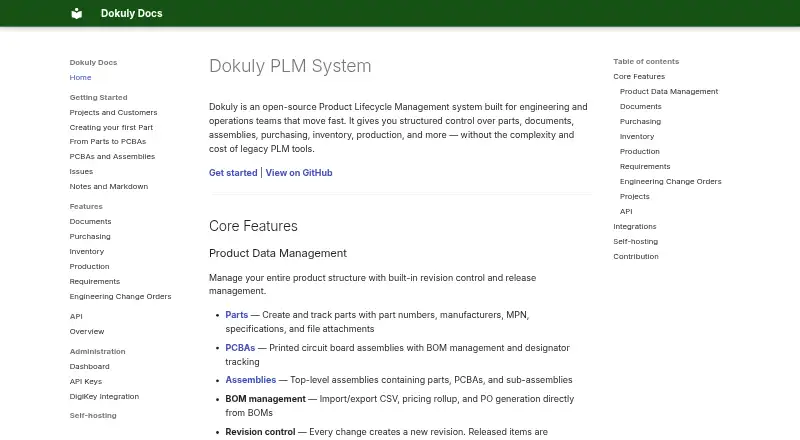
What Dokuly is
Dokuly is an open-source product lifecycle management system for engineering and operations teams. It brings product records, documents, purchasing, inventory, production, requirements, changes, and project work into one system. Teams can manage parts, PCB assemblies, bills of materials, revisions, releases, and alternate parts. Document tools include numbering, revision control, PDF front pages, a built-in viewer, and browser editing with OnlyOffice. Purchasing covers suppliers, price breaks, orders, and order tracking, including supplier selection for BOM orders. Inventory and production features track stock locations, transactions, lots, serial numbers, and assembly progress. Requirements can be related hierarchically or through derived and superseding links, with verification tracking; change orders record affected items for review. Projects include access control, time tracking, tasks, and Gantt charts. Dokuly is free to use and runs as a self-hosted Docker stack with PostgreSQL, Django, and nginx. Its REST API offers project-scoped keys with configurable expiry and Swagger and ReDoc documentation.
Good
- Manages multi-level product and BOM data.
- Tracks revisions, releases, and change workflows.
- Includes inventory and production tracking.
- Free, open-source software with a REST API.
Watch out
- Deployment requires a self-hosted Docker stack.
- No security certification is stated.
Who it suits
Dokuly suits engineering and operations teams that need to coordinate product data, document revisions, purchasing, inventory, requirements, and project work. It is a fit for teams prepared to run a self-hosted Docker stack.
Verdict
Dokuly combines product lifecycle records with purchasing, inventory, requirements, and project tools in a free, self-hosted system. Teams should account for operating the Docker stack and review its project-based API access controls.
Plans and prices
From Dokuly's own pricing page, checked 30 Sep 2026.
| Plan | Price | What it gives you |
|---|---|---|
| Dokuly PLM (open source) | Free | Open-source PLM · self-hosted Docker stack · Dokuly says it is free to use. |
The facts
Each one read from Dokuly's own pages, with the date it was checked.
What it does
- API
- The REST API supports project-scoped keys with configurable expiry and includes Swagger and ReDoc documentation.checked 30 Sep 2026
- Deployment
- Dokuly runs as a self-hosted Docker stack with PostgreSQL, Django, and nginx.checked 30 Sep 2026
- Documents
- Document management includes automatic numbering, revision control, PDF front-page generation, a built-in viewer, and browser editing with OnlyOffice.checked 30 Sep 2026
- Integrations
- Dokuly lists DigiKey API, Nexar API, and OnlyOffice integrations.checked 30 Sep 2026
- Inventory and production
- It supports configurable stock locations, transaction tracking, production lots, serial numbers, and assembly progress tracking.checked 30 Sep 2026
- Product
- Dokuly is an open-source Product Lifecycle Management system for engineering and operations teams.checked 30 Sep 2026
- Product data
- It manages parts, PCBAs, assemblies, bills of materials, revisions, releases, and alternate parts.checked 30 Sep 2026
- Projects and access
- Projects organize work with access control, time tracking, task management, and Gantt charts.checked 30 Sep 2026
- Purchasing
- The purchasing module manages suppliers, price breaks, purchase orders, and order tracking, and can select the cheapest supplier for BOM orders.checked 30 Sep 2026
- Requirements and changes
- Requirements support hierarchical, derived, and superseding relationships with verification tracking, while engineering change orders link affected items in a reviewable record.checked 30 Sep 2026
- Security controls
- The documentation describes project-scoped access control for API keys and says they inherit project-based access permissions; no security certification is stated on the pages reviewed.checked 30 Sep 2026
- Support and contributions
- The project welcomes contributions, bug reports, and feature requests on GitHub.checked 30 Sep 2026
The company
- Headquarters
- Norwaychecked 28 Sep 2026
The full review of Dokuly
Dokuly is open-source product lifecycle management software for engineering and operations teams. It is best suited to organizations willing to run their own deployment, rather than teams seeking a hosted service. Its appeal is the breadth of product, purchasing, inventory, and project workflows in one free system; the trade-off is owning the Docker stack.
Overview
Dokuly connects product records—from parts and PCBAs through assemblies, bills of materials, revisions, and releases—with documents, purchasing, inventory, requirements, and project work. That scope is useful when a product change needs to be considered alongside sourcing or production, not just recorded in an engineering tool. The self-hosted deployment is a real operational commitment: the Docker stack uses PostgreSQL, Django, and nginx, so Dokuly is a better fit for teams equipped to manage software infrastructure.
The project welcomes contributions, bug reports, and feature requests on GitHub. Its documented integrations include DigiKey API, Nexar API, and OnlyOffice.
Key features
Product records and documents
Dokuly handles multi-level bills of materials, alternate parts, revisions, and releases, with BOM comparison and revision control to help teams follow changes to product definitions. Document management adds automatic numbering, revision control, PDF front-page generation, and a built-in viewer. Browser editing through OnlyOffice keeps document work close to the related records, which can be useful when engineering and operations need a shared reference.
Purchasing, inventory, and production
The purchasing module tracks suppliers, price breaks, purchase orders, and orders, and can select the cheapest supplier for BOM orders. That gives teams a way to connect BOMs with purchasing decisions, though the stated capability is supplier-price selection rather than a broader claim about procurement automation. Configurable stock locations and transaction tracking support inventory control; production lots, serial numbers, and assembly progress tracking extend the system into production work.
Requirements, changes, and projects
Requirements can have hierarchical, derived, and superseding relationships, with verification tracking. Engineering change orders record affected items in a reviewable workflow, helping teams connect a change to its scope. Projects provide access control, time tracking, task management, and Gantt charts, so Dokuly can coordinate work as well as manage product records.
API and access
The REST API uses project-scoped keys with configurable expiry and includes Swagger and ReDoc documentation. The documentation says those keys inherit project-based access permissions, a useful boundary for teams exposing API access across projects. Teams should still review that model against their own access requirements; no security certification is stated.
Pricing
Dokuly PLM (open source): free. Dokuly says it is free to use and provides open-source PLM through a self-hosted Docker stack. There are no seat or quota limits specified for this plan, so a reader should not infer them. The key cost is operational rather than a stated subscription charge: the team must run the deployment.
Platforms
Dokuly supports API, Linux, macOS, self-hosted, web, and Windows environments. Its self-hosted Docker model makes the platform choice most relevant to teams that can operate a server deployment.
Who it's for
Dokuly is a strong candidate for engineering and operations teams that need product lifecycle records tied to purchasing, stock, requirements, change control, and project coordination—and have the capability to host the software. Teams looking for a managed service or unwilling to take responsibility for the Docker deployment should consider another option.
Pros and cons
Pros
- Broad connected workflow: Product records sit alongside purchasing, inventory, production, requirements, change orders, and projects.
- Useful BOM-to-purchasing link: Supplier price breaks and cheapest-supplier selection for BOM orders help connect product definitions to sourcing.
- Open-source and free: The stated plan costs nothing and includes self-hosted PLM.
- Document and API support: OnlyOffice browser editing, a built-in document viewer, and documented REST API tools broaden how teams can work with records.
Cons
- Self-hosting is required: Running the Docker stack makes infrastructure ownership part of adopting the free plan.
- Access controls are project-based: API keys inherit project permissions, so teams need to assess whether that model suits their access boundaries.
Alternatives
Cascadia PLM is worth considering for teams that want a free self-hosted PLM option with unlimited editors and viewers under its Self-Hosted Core plan.
PDXpert PLM may suit Windows-focused teams seeking a paid PLM product with a three-week fully functional evaluation; its listed plans include a read-only subscription tier.
NETVIBES is another paid option with web, mobile, and self-hosted platform support.
Oracle Fusion Cloud PLM may fit organizations already evaluating a cloud subscription with a stated three-year standard term and a 50-user minimum for the cited reviewer service.
Centric PLM is another paid PLM option.
Creo is a paid alternative with a floating license option for concurrent organizational users and support and maintenance included.
Aptean Industrial Manufacturing ERP Traverse Edition may be relevant to readers considering an industrial manufacturing ERP with a free trial.
Infor Public Sector is another paid option for readers comparing software in this space.
Readers comparing category options can also browse Product Lifecycle Management Software and Bill of Materials Software.
Verdict
Choose Dokuly if your engineering and operations teams want product lifecycle records connected to sourcing, stock, requirements, changes, and projects without a software subscription charge—and can operate the self-hosted stack. Its breadth is the reason to shortlist it; the main reason to look elsewhere is the infrastructure and access-control responsibility that comes with running it.
Getting started
- Visit the Dokuly website.
- Prepare a self-hosted Docker stack with PostgreSQL, Django, and nginx.
- Deploy Dokuly on Linux, macOS, or Windows, or use its web or API access.
- Configure project access and, if needed, project-scoped API keys.
Questions
How much does Dokuly cost?
The Dokuly PLM open-source plan is free. Dokuly says it is free to use.
Is Dokuly open source?
Yes. Dokuly is an open-source product lifecycle management system.
What platforms does Dokuly support?
Listed platforms are API, Linux, macOS, self-hosted, web, and Windows.
What integrations does Dokuly list?
Dokuly lists DigiKey API, Nexar API, and OnlyOffice integrations.
How is Dokuly deployed?
Dokuly runs as a self-hosted Docker stack with PostgreSQL, Django, and nginx.
Alternatives to Dokuly
- 1

Cascadia PLM
Free planOpen sourceWebAPILinuxmacOS8.2Free plan - 2

Oracle Fusion Cloud PLM
AndroidiOSWebAPI7.2 - 3
Exenta
AndroidiOSWebAPI6.7 - 4

PDXpert PLM
Free planAPISelf-hostedWindows6.7From $3.50 a month - 5
Infor Public Sector
AndroidiOSWebAPI6.6 - 6
Centric PLM
AndroidiOSWebAPI6.5