
Oracle Fusion Cloud PLM
- Android app
- Yes
- Free plan
- No
- Paid plans from
- $100/mo
- Runs on
- Android, iOS, Mac, Web, Windows
Summary
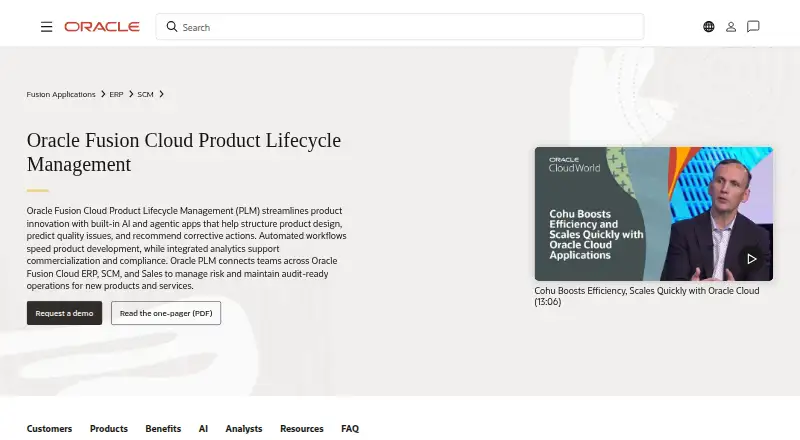
Oracle Fusion Cloud PLM is a cloud application for managing enterprise product data and lifecycle processes from idea and design through launch, commercialization, and post-launch work. Its core areas are Product Management, Innovation Management, Quality Management, and Configuration Modeling. It manages records such as items, bills of material, documents, requirements, changes, quality workflows, manufacturers, product variants, formulas, catalogs, and configuration models. Built-in AI and agentic applications assist with product data, compliance questions, manufacturer onboarding, workflow guidance, component replacement, product comparison, and design-to-source work. The Design-to-Source workspace can use uploaded CAD designs to create sourcing items and RFQs and assess suppliers; the specific tools and connectors depend on the environment. Oracle says PLM connects lifecycle activity with its SCM, CX, and ERP systems, though integration details vary by environment. Pricing is on request. Product Management Cloud Service includes Product Hub and PLM features; customers without that license have only basic item-management capabilities through other Oracle Cloud services.
Who it is for
Oracle identifies product development organizations and roles such as design engineers, product managers, quality, supply chain, sourcing, manufacturing, operations, and compliance teams as users. It fits organizations managing product records and lifecycle processes across those functions.
What is good
- Covers product, innovation, quality, and configuration management
- Manages bills of material, requirements, and changes
- AI assists with product data and workflow guidance
- CAD-based sourcing workspace can create items and RFQs
- Criteria-based access controls for lifecycle data
What to know first
- Pricing is on request
- Full PLM features require Product Management Cloud Service licensing
- Integration methods and configuration vary by environment
- CAD tools and connectors depend on the environment
Everything Xiaomi review
Oracle Fusion Cloud PLM: the full review
Oracle Fusion Cloud PLM brings broad product-data and lifecycle capabilities into a cloud application. Confirm licensing and environment-specific integrations and connectors against your organization’s requirements.
Overview
Oracle Fusion Cloud PLM is a cloud application for managing product data and lifecycle work from early ideas through launch and post-launch activity. It suits product development organizations that need lifecycle processes connected to Oracle’s supply chain, customer experience, and ERP applications. Its breadth is compelling for enterprise teams, but the named-user minimums, three-year subscription term, and environment-dependent integrations make fit and licensing important to settle up front.
Key features
Product Management, Innovation Management, Quality Management, and Configuration Modeling cover a wide span of product work. Teams can manage product records, items, bills of material, documents, requirements, changes, quality workflows, manufacturers, variants, formulas, catalogs, and configuration models in one cloud application. Requirements, revision, change, BOM, and workflow management are supported, alongside API access.
Built-in AI and agentic applications assist with product data, compliance questions, manufacturer onboarding, workflow guidance, component replacement, product comparisons, and design-to-source work. That can help teams move through information-heavy tasks, but Oracle positions AI as assistance: recommendations and generated content do not replace review and approval under configured workflows and change controls.
The Design-to-Source workspace can use uploaded CAD designs to create sourcing items and RFQs, identify suppliers, and assess risk, cost, lead time, and quality. This is useful for teams linking engineering decisions to sourcing, though the CAD tools and connectors depend on the organization’s environment. Oracle also connects PLM lifecycle activity with its SCM, CX, and ERP applications; exact integration methods and configuration vary by environment.
Criteria-based access control can use user context, team grouping, permissions, object and manufacturer criteria, creator attributes, components, and attachments. That degree of control is relevant when product data needs differentiated access across roles and organizations, but it also makes implementation choices consequential.
Pricing
Oracle Fusion Product Management Reviewer Cloud Service costs 100.00 USD per month, billed monthly, with a standard three-year subscription term and a 50-hosted-named-user minimum. It is the lower-cost option for reviewer access, but the high seat floor means it is not a small-team entry plan.
Oracle Fusion Product Management Cloud Service costs 500.00 USD per month, billed monthly, with a standard three-year subscription term and a 10-hosted-named-user minimum. This is the full Product Management Cloud Service option for teams needing the broader product-management capabilities. Oracle says the service includes Product Hub and PLM features; customers with other Oracle Cloud services but without this license have only basic item-management capabilities. Confirm the license scope and user fit before committing to the term.
Platforms
Oracle lists Android, iOS, macOS, web, and Windows support. Fusion Cloud Applications system requirements specify supported browsers for Windows and Mac, while mobile use requires a current browser, including Chrome on Android and Safari on iOS or iPadOS. Deployment is cloud-based.
Who it's for
Oracle identifies product development organizations and roles spanning design engineering, product management, quality, supply chain, sourcing, manufacturing, operations, and compliance. The broad product record and workflow coverage is best suited to organizations coordinating several of those functions, especially where Oracle Cloud applications are already part of the operating environment. Smaller teams seeking a short commitment or a low seat threshold should weigh the subscription minimums carefully.
Oracle lists 24/7 cloud-application support, in-application guidance, on-demand training, designated implementation support engineers, digital customer success resources, and a customer community. Those resources can matter for enterprise deployments, where rollout and adoption extend beyond selecting the software.
Pros and cons
- Pros: Broad coverage of product records, BOMs, requirements, changes, quality, variants, and configuration models supports multiple lifecycle stages in one application.
- Pros: Design-to-Source connects uploaded CAD designs to sourcing items, RFQs, supplier discovery, and supplier assessment, helping bridge product and sourcing work.
- Pros: Criteria-based access control provides several ways to tailor access to product lifecycle data.
- Cons: Integration methods and CAD connectors depend on the customer environment, so the intended workflows need validation before adoption.
- Cons: The three-year standard term and minimums of 50 reviewer users or 10 full-service users can be poor fits for small or uncertain deployments.
- Cons: AI assists rather than taking responsibility for lifecycle decisions; configured review, approval, and change controls remain necessary.
Alternatives
Browse Product Lifecycle Management Software for a broader category comparison. Cascadia PLM is worth considering if a free plan and self-hosted or Linux support are priorities. Centric PLM is another paid option, with Android, iOS, API, and web platforms. Aras Innovator may suit teams interested in a freemium option and a Community Edition for 50 named users.
PDXpert PLM is a possible fit for Windows or self-hosted environments, and it offers a three-week free evaluation. PTC Windchill is another paid, web-based alternative. Dassault Systèmes ENOVIA is also a paid web-based option. Dokuly may appeal to teams seeking free, open-source, self-hosted PLM. Duro Design PLM is worth comparing if a trial and design-focused Team plan are relevant.
Verdict
Choose Oracle Fusion Cloud PLM if your product organization needs broad lifecycle and product-data management, values Oracle application connections, and can support the named-user minimums and three-year term. Its strongest case is the span from product definition through quality and sourcing; its chief caveat is that integrations, connectors, and licensing must align with the organization’s specific environment. Look elsewhere if you need a low-commitment starting point, a free plan, or a deployment model outside the cloud.
Oracle Fusion Cloud PLM plans and pricing
All plansCompared on product lifecycle management software
- Requirements management
- Yesoracle.com
- Revision control
- Yesoracle.com
- Change management
- Yesoracle.com
- BOM management
- Yesoracle.com
- Workflow automation
- Yesoracle.com
- API access
- Yesoracle.com
- Deployment
- cloudoracle.com
Facts
- Purpose
- A cloud application for managing enterprise product data and lifecycle processes from idea and design through launch, commercialization, and post-launch activity.oracle.com · 2 Oct 2026
- Capabilities
- Product Management, Innovation Management, Quality Management, and Configuration Modeling are core application areas.oracle.com · 2 Oct 2026
- Product data
- It manages product records, items, bills of material, documents, requirements, changes, quality workflows, manufacturers, product variants, formulas, catalogs, and configuration models.oracle.com · 2 Oct 2026
- AI
- Built-in AI and agentic applications assist with product data, compliance questions, manufacturer onboarding, workflow guidance, component replacement, product comparison, and design-to-source work.oracle.com · 2 Oct 2026
- Integrations
- Oracle says PLM connects product lifecycle activity with Oracle SCM, CX, and ERP, while exact integration methods and configuration depend on each environment.oracle.com · 2 Oct 2026
- Security
- Product lifecycle data supports criteria-based access control using user context, team grouping, permissions, object and manufacturer criteria, created-by attributes, components, and attachments.oracle.com · 2 Oct 2026
- Governance limit
- Oracle describes its AI as assisting with recommendations and generated content; lifecycle decisions still require review and approval where configured workflows, approvals, and change controls apply.oracle.com · 2 Oct 2026
- License requirement
- Oracle says Product Management Cloud Service includes Product Hub and PLM features; customers with other Oracle Cloud services but without that license have only basic item-management capabilities.docs.oracle.com · 2 Oct 2026
- Support
- Oracle lists 24/7 cloud-application support, in-application guidance, on-demand training, designated implementation support engineers, digital customer success resources, and a customer community.oracle.com · 2 Oct 2026
- Browser and device support
- Oracle's Fusion Cloud Applications system requirements list supported browsers for Windows and Mac, and state that mobile support uses the latest browser, including Chrome on Android and Safari on iOS/iPadOS.docs.oracle.com · 2 Oct 2026
- Intended users
- Oracle identifies product development organizations and roles including design engineers, product managers, quality, supply chain, sourcing, manufacturing, operations, and compliance teams as users.oracle.com · 2 Oct 2026
Company
- Founded
- 1977oracle.com · 28 Sept 2026
Best Oracle Fusion Cloud PLM alternatives
See all 20



Where it ranks on Everything Xiaomi
Is Oracle Fusion Cloud PLM yours?
Claim it for free: prove the domain, then correct facts, plans and screenshots. An editor reviews every change.
Sources
- oracle.com/europe/scm/product-lifecycle-management· checked 2 Oct 2026
- docs.oracle.com/en/cloud/saas/supply-chain-and-manufact· checked 2 Oct 2026
- oracle.com/support/· checked 2 Oct 2026
- docs.oracle.com/en/cloud/saas/applications-common/26a/o· checked 2 Oct 2026
- oracle.com/sa/a/ocom/docs/corporate/pricing/oracle· checked 2 Oct 2026