
GDB
GDB is a free debugger for examining a program during execution or after a crash.
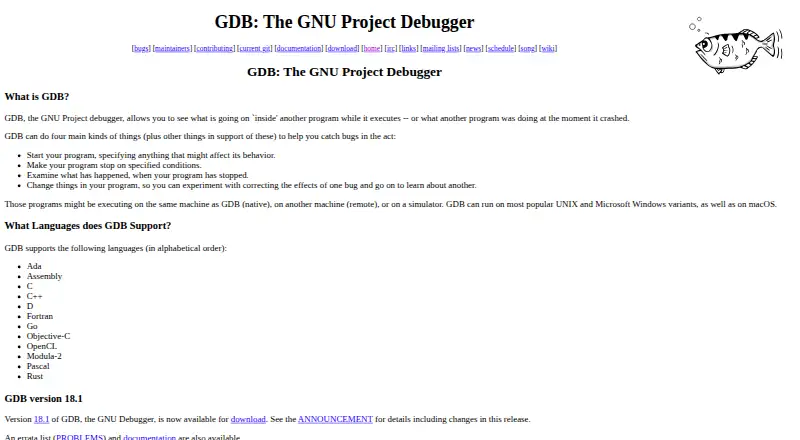
What GDB is
GDB is a free debugger for examining a program during execution or after a crash. It can start programs, stop them when specified conditions occur, inspect the paused state, and change program state for experimentation. A target can run on the same machine, on a remote machine, or in a simulator. GDB supports macOS, Microsoft Windows, and popular UNIX variants, along with languages including Ada, Assembly, C, C++, D, Fortran, Go, Objective-C, OpenCL, Modula-2, Pascal, and Rust. It supports conditional and exception breakpoints, as well as core dump debugging. On supported platforms, record-and-replay features allow forward and reverse execution. Remote debugging connects through gdbserver. GDB can be extended with Python when built with Python support; in that configuration it supports the Debugger Adapter Protocol in addition to its console and GDB/MI interfaces. Version 18.1 was released on September 25, 2026. GDB is part of the GNU Project and is distributed under the GNU General Public License. Official releases are available through GNU and Sourceware release sites, with signature verification through the GNU keyring.
Good
- Debugs local, remote, and simulator targets
- Supports a broad set of programming languages
- Includes conditional and exception breakpoints
- Offers record-and-replay on supported platforms
- Python configuration enables the Debugger Adapter Protocol
Watch out
- Record-and-replay is limited to supported platforms
- Debugger Adapter Protocol requires a Python-enabled build
Who it suits
GDB suits developers and others who need to inspect program execution or diagnose crashes across supported languages and targets. Its remote, simulator, and record-and-replay options may be useful for workflows that need those debugging modes.
Verdict
GDB provides core debugging functions across many languages and target types, with additional replay and protocol options depending on platform or build configuration. It is free software under the GNU General Public License.
Plans and prices
From GDB's own pricing page, checked 30 Sep 2026.
| Plan | Price | What it gives you |
|---|---|---|
| GDB | Free | GNU General Public License · source code available |
The facts
Each one read from GDB's own pages, with the date it was checked.
What it does
- Core debugging
- GDB can start programs, stop them under specified conditions, examine stopped execution, and change program state for experimentation.checked 30 Sep 2026
- Debugger protocols
- GDB supports the console interpreter, GDB/MI, and the Debugger Adapter Protocol when built with Python support.checked 30 Sep 2026
- Distribution
- Official releases are downloadable from GNU's HTTPS server and Sourceware's releases site, with signature verification through the GNU keyring.checked 30 Sep 2026
- Languages
- GDB supports Ada, Assembly, C, C++, D, Fortran, Go, Objective-C, OpenCL, Modula-2, Pascal, and Rust.checked 30 Sep 2026
- Latest release
- GDB version 18.1 was released on September 25, 2026.checked 30 Sep 2026
- License
- GDB is free software protected by the GNU General Public License, which permits copying, adapting, and redistributing copies with source access.checked 30 Sep 2026
- Operating systems
- GDB runs on popular UNIX and Microsoft Windows variants and on macOS.checked 30 Sep 2026
- Project identity
- GDB is a Free Software project that is part of the GNU Project.checked 30 Sep 2026
- Purpose
- GDB lets users inspect what another program is doing while it executes or after it crashes.checked 30 Sep 2026
- Python extension
- GDB can be extended with Python when configured with --with-python.checked 30 Sep 2026
- Record and replay
- On supported platforms, GDB records process execution and replays it with forward and reverse execution commands.checked 30 Sep 2026
- Remote debugging
- The gdbserver control program connects programs to a remote GDB through target remote or target extended-remote.checked 30 Sep 2026
- Security behavior
- On targets that support it, virtual address space randomization protects programs against certain security attacks.checked 30 Sep 2026
- Support
- The project provides mailing lists for announcements, discussion, patches, bug reports, and testing.checked 30 Sep 2026
- Targets
- Programs can run on the same machine, another machine remotely, or a simulator.checked 30 Sep 2026
The full review of GDB
GDB is a debugger for examining programs during execution or after a crash. It is best suited to developers who need execution control across a broad set of languages and local, remote, or simulator targets. Its range is a strength, though some capabilities depend on the platform or how GDB is built.
Overview
GDB can launch a program, pause it under specified conditions, inspect its stopped state, and change that state to explore different behavior. That makes it useful for investigating both reproducible problems and failures that require closer inspection than ordinary execution provides.
Targets can run on the same machine, on a remote machine, or in a simulator. This flexibility serves varied debugging setups, but does not mean every feature works identically across them. GDB is part of the GNU Project and is distributed under the GNU General Public License, which allows users to copy, adapt, and redistribute it with source access.
Key features
Execution control and crash investigation
Conditional and exception breakpoints let developers stop at relevant situations rather than inspecting execution indiscriminately. GDB can examine stopped execution and alter program state for experimentation; it can also debug core dumps, supporting investigation after a crash when a live session is no longer available.
Remote debugging and replay
For remote work, the gdbserver control program connects a target program to GDB using target remote or target extended-remote. That separation is valuable when the program runs on another machine. On supported platforms, GDB can record execution and replay it with forward and reverse commands, helping trace how a failure developed. Replay is conditional on platform support, so it should not be treated as a universal part of every setup.
Languages and extension
GDB supports Ada, Assembly, C, C++, D, Fortran, Go, Objective-C, OpenCL, Modula-2, Pascal, and Rust. That breadth makes it a strong candidate for projects spanning several of those languages. Python extensions are available when GDB is configured with --with-python; the GDB/MI and Debugger Adapter Protocol interfaces likewise depend on Python support in the build. The console interpreter is also supported.
Security and distribution
On targets that support it, virtual address space randomization protects programs against certain security attacks. Official releases are downloadable from GNU's HTTPS server and Sourceware's releases site, with signature verification through the GNU keyring. The project also provides mailing lists for announcements, discussion, patches, bug reports, and testing.
Pricing
GDB costs nothing under the GNU General Public License, with source code available. There are no paid tiers or seat-based plan distinctions in the stated offer, making it suitable for individuals and teams that need a capable debugger without a software fee. Its trade-offs are not subscription caps but platform- and build-dependent capabilities, plus the need to work with its debugger interfaces and target setup.
Platforms
GDB runs on UNIX variants, Microsoft Windows, and macOS. It supports native, remote, and simulator targets, but replay and some protocol options are conditional on platform support or Python-enabled builds. Choose it when those target choices and supported languages match the project; verify the relevant build and target requirements before relying on optional capabilities.
Who it's for
GDB is a sensible choice for developers who need to control execution, inspect crashes, or debug across local and remote systems in one debugger. Its language coverage and free, source-available license are particularly useful for varied projects and teams that want to adapt or redistribute the software. It is a less natural fit for someone seeking a debugger whose specialized workflow or platform-specific strengths matter more than GDB's broad target and language coverage.
Pros and cons
- Pros: Conditional and exception breakpoints, execution-state changes, and core-dump debugging support focused investigation during and after failures.
- Pros: Native, remote, and simulator targets, alongside support for numerous languages, suit diverse development setups.
- Pros: Free licensing with source access permits copying, adaptation, and redistribution.
- Cons: Record-and-replay is limited to supported platforms, so it cannot be assumed for every target.
- Cons: Python extensions and the Debugger Adapter Protocol require a Python-enabled build, making those options configuration-dependent.
Alternatives
Browse the Debuggers category to compare more options. Consider LLDB if you want another free, open-source debugger with support across Android, iOS, Linux, macOS, and Windows.
IDA Pro is worth considering for x86-32 and x86-64 disassembly and cloud-based decompilers: IDA Free includes two cloud-based decompilers, while IDA Pro Essential costs 1099.00 USD. RenderDoc is a free, open-source option for readers comparing debugger tools. Delve is another free debugger to consider.
Xdebug may suit readers looking for a freemium alternative; its Pro plan is £200 a year and covers one developer. FlowStorm is a free and open-source alternative for readers comparing no-cost tools. WinDbg is a free option for Windows users. dnSpyEx is a free GPLv3-licensed option for Linux and Windows.
Verdict
Choose GDB if you need a free debugger with broad language coverage, detailed execution control, and native, remote, or simulator targets. Its strongest case is the combination of post-crash investigation and flexible target support without a license fee. Look elsewhere if your workflow depends on replay or protocol features that your platform or build does not support, or if another debugger better matches your target environment.
Alternatives to GDB
- 1
LLDB
Free planAndroidiOSLinuxmacOS7.3Free plan - 2

IDA Pro
Free planLinuxmacOSWindows7.0From $1,099 a year - 3
PonyDebugger
Free planiOSWebmacOSSelf-hosted6.8Free plan - 4
pyOCD
Free planAPILinuxmacOSSelf-hosted6.8Free plan - 5
Perl Debugger
Free planLinuxmacOSWindows6.5Free plan - 6

Black Magic Debug
Free planLinuxmacOSWindows6.4Free plan