
Black Magic Debug
Black Magic Debug is a JTAG/SWD debugger for embedded microcontrollers, designed to work with compatible probe hardware and a suitable target toolchain.
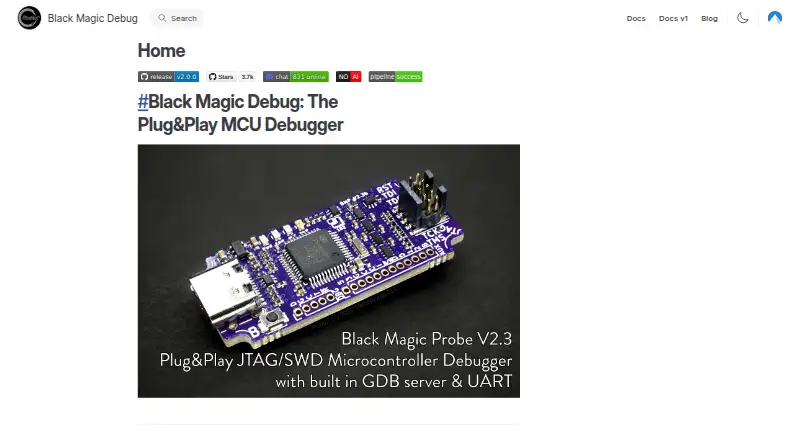
What Black Magic Debug is
Black Magic Debug is a JTAG/SWD debugger for embedded microcontrollers, designed to work with compatible probe hardware and a suitable target toolchain. Its firmware includes a GDB server that detects targets automatically, without target-specific configuration scripts. Debugging functions include watchpoints, flash memory breakpoints, memory and register examination, and flash programming. It supports ARM Cortex-M and Cortex-A microcontrollers, and the listed target platforms also include RISC-V; remote debugging is supported.
The probe presents itself to the host as a USB CDC ACM virtual serial device, which requires no special driver on Linux or macOS. The software also works with Windows and supports semihosting/host I/O, Serial Wire Output, and USB DFU firmware upgrades. Guides cover PlatformIO and STM32CubeIDE. A desktop-app build can use several probe adapters, including ST-Link and CMSIS-DAP, though programming is a little slower in that mode. The software is free; the probe itself and a suitable toolchain are required.
Good
- Automatic target detection without target-specific scripts
- Supports watchpoints and flash memory breakpoints
- Works with Windows, Linux, and macOS
- Includes PlatformIO and STM32CubeIDE guides
Watch out
- Requires compatible probe hardware and a suitable toolchain
- Desktop-app programming is a little slower
Who it suits
It suits embedded software developers who want control over build systems and test environments. Users need a compatible Black Magic Probe and a suitable toolchain for their target processor.
Verdict
Black Magic Debug offers a focused set of microcontroller debugging tools with automatic target detection and support for multiple host environments. Factor in the required probe and toolchain, and the slower programming speed in desktop-app mode.
Plans and prices
From Black Magic Debug's own pricing page, checked 8 Oct 2026.
| Plan | Price | What it gives you |
|---|---|---|
| Black Magic Debug software | Free | JTAG/SWD debugger for embedded microcontrollers · requires compatible probe hardware and a suitable toolchain |
The facts
Each one read from Black Magic Debug's own pages, with the date it was checked.
What it does
- Additional capabilities
- The GDB server supports semihosting/host I/O, Serial Wire Output, and USB DFU firmware upgrades.checked 8 Oct 2026
- Additional features
- The project lists Semihosting/Host IO, Serial Wire Output support, and USB DFU firmware upgrades.checked 8 Oct 2026
- Compatibility limit
- The documentation says programming speed is a little slower when using the desktop app, though BMP development may be faster because no firmware upload is needed.checked 8 Oct 2026
- Debug features
- It supports watchpoints, flash memory breakpoints, memory and register examination, and flash programming.checked 8 Oct 2026
- Debugging features
- It supports watchpoints, flash memory breakpoints, memory and register examination, and flash programming.checked 8 Oct 2026
- GDB server
- Black Magic Debug firmware implements a GDB server that supports automatic target detection and does not require target-specific configuration scripts.checked 8 Oct 2026
- Hardware requirement
- Getting started says users need a Black Magic Probe and a suitable toolchain for the target processor.checked 8 Oct 2026
- Hardware status
- The supported-hardware page marks Black Magic Probe V2.3 active and several older probe models as legacy and not in production.checked 8 Oct 2026
- Host support
- The debugger works with Windows, Linux, and Mac environments.checked 8 Oct 2026
- Integrations
- The documentation includes usage guides for PlatformIO and STM32CubeIDE.checked 8 Oct 2026
- Intended users
- The project focuses on professional embedded software developers who want control over their build systems and testing environments.checked 8 Oct 2026
- Purpose
- Black Magic Debug is a mostly plug-and-play JTAG/SWD debugger for embedded microcontrollers.checked 8 Oct 2026
- Security and trust
- The project describes Black Magic Probe as open source, saying users can inspect it, and its FAQ says automatically built firmware images are available for official hardware.checked 8 Oct 2026
- Support
- The site invites users with questions or suggestions to join the project chat and says its documentation aims to cover getting started with microcontroller development and debugging.checked 8 Oct 2026
- Supported environments
- The project states that it works with Windows, Linux, and Mac environments.checked 8 Oct 2026
- Supported processors
- The project describes support for ARM Cortex-M and Cortex-A based microcontrollers.checked 8 Oct 2026
- Target detection
- The GDB server provides automatic target detection and does not require target-specific configuration scripts.checked 8 Oct 2026
- Targets
- The site says the debugger targets ARM Cortex-M and Cortex-A microcontrollers.checked 8 Oct 2026
- USB interface
- The probe connects to the host as a standard USB CDC ACM virtual serial device, which the site says needs no special drivers on Linux or macOS.checked 8 Oct 2026
Where it runs
- Standalone app
- The project can be compiled as a desktop application and can use BMP, ST-Link, FTDI-MPSSE, SEGGER J-Link, and CMSIS-DAP adapters.checked 8 Oct 2026
- Standalone app limitation
- The site says programming is a little slower in the standalone app mode, though BMP development may be faster because firmware upload is not needed.checked 8 Oct 2026
The full review of Black Magic Debug
Black Magic Debug is a JTAG/SWD debugger for embedded microcontrollers, built for developers who want direct control of their build and test toolchains. It is most compelling for professional ARM- and RISC-V-focused embedded teams that already have, or are prepared to buy, compatible probe hardware. The software costs nothing, but the hardware and setup requirements make it a specialist tool rather than a universal debugger.
Overview
Black Magic Debug puts a GDB server in its firmware, so it can identify a connected target automatically without target-specific configuration scripts. In practice, that removes a common layer of board setup and leaves engineers to manage their own compiler, build system and testing environment. Remote debugging is supported, and the project describes processor support for ARM Cortex-M, ARM Cortex-A and RISC-V microcontrollers.
The usual probe appears to the host as a standard USB CDC ACM virtual serial device. Linux and macOS therefore need no special probe driver, while Windows, Linux and macOS are all supported host environments. Hardware availability deserves attention: Black Magic Probe V2.3 is active, whereas several older probe models are legacy and no longer in production.
Key features
Core debugging work is covered by watchpoints, flash-memory breakpoints, memory and register inspection, and flash programming. These tools are useful for isolating data changes, stopping execution around nonvolatile code and examining the processor when a firmware fault is difficult to reproduce. Automatic target detection makes those functions quicker to bring up on supported hardware than a workflow that depends on a separate configuration script for every target.
Semihosting and host I/O provide a route for target-side interaction with the host, while Serial Wire Output supports target tracing or output where the processor and board expose it. USB DFU firmware upgrades give compatible probes an update path without replacing the device. Documentation includes usage guidance for PlatformIO and STM32CubeIDE, so teams using either environment have a clearer starting point than those assembling an entirely undocumented integration.
The project can also be compiled as a desktop application. That mode can use BMP, ST-Link, FTDI-MPSSE, SEGGER J-Link and CMSIS-DAP adapters, which broadens the hardware choices and can speed BMP development because no firmware upload is needed. The trade-off is slower programming than with the dedicated probe-oriented setup, so it is less attractive when repeated flashing speed is central to the workflow.
Pricing
Black Magic Debug software — free. The free plan includes the JTAG/SWD debugger for embedded microcontrollers, with no paid tier or renewal commitment described. Free refers to the software; getting started still requires a Black Magic Probe and a suitable toolchain for the target processor. Budget for that probe and the surrounding development hardware before treating the zero software price as a complete solution.
Platforms
Host support covers Windows, Linux and macOS. The target side is aimed at ARM Cortex-M, ARM Cortex-A and RISC-V microcontrollers, with remote debugging available. Linux and macOS users benefit from the probe's CDC ACM interface without special drivers. The desktop application offers additional adapter compatibility, but its slower programming speed is a meaningful limitation for frequent firmware deployment.
Who it's for
This is a strong fit for professional embedded developers who want ownership of their build systems, toolchains and test environments, especially when working with supported Cortex-M, Cortex-A or RISC-V targets. It also suits teams that value an open-source probe workflow and need GDB-based remote debugging across multiple desktop operating systems.
It is a poor match for someone seeking a purely software debugger, because a compatible probe and target toolchain are prerequisites. Buyers looking at older second-hand probes should verify the model carefully, since legacy hardware is no longer in production. If rapid, repeated programming matters more than adapter flexibility, the desktop-app mode's slower flashing is another reason to choose a different arrangement.
Pros and cons
- Pros: automatic target detection avoids target-specific scripts; watchpoints, flash breakpoints, memory/register inspection and programming cover the main embedded-debug cycle; semihosting, Serial Wire Output and DFU upgrades extend the workflow; Windows, Linux and macOS support is broad; the software is free and open source.
- Cons: a compatible Black Magic Probe and target toolchain are still required; older probe models are legacy and out of production; programming is a little slower in standalone desktop-app mode; the feature set is focused on embedded microcontrollers rather than general desktop debugging.
Alternatives
Choose LLDB when you need a free, open-source debugger spanning Android, iOS, Linux, macOS and Windows without this probe-centered requirement. IDA Pro is the better choice for disassembly and decompilation: its free edition includes x86-32/x86-64 disassembly and two cloud decompilers, while IDA Pro Essential costs $1,099.00.
Pick Perl Debugger for Perl programs that already compile correctly, or PonyDebugger for an iOS client and gateway server under the Apache License 2.0. pyOCD is a free, Apache 2.0 open-source project for its supported host environments. GDB is the straightforward free GNU-licensed debugger when you want the debugger itself rather than an integrated probe workflow.
FlowStorm is a free and open-source option for its supported environments. Choose OpenOCD when an open-source debugger distributed through operating-system packages or source code better fits your setup. For a wider category view, browse Debuggers.
Verdict
Choose Black Magic Debug if you are an embedded developer who wants a free, GDB-based JTAG/SWD workflow with automatic target detection and broad host support. Its main reason to choose it is the focused combination of probe debugging, programming and output features without target scripts. Look elsewhere if you do not already have compatible hardware, need a general-purpose or reverse-engineering debugger, or cannot accept slower programming in standalone-app mode.
Alternatives to Black Magic Debug
- 1
LLDB
Free planAndroidiOSLinuxmacOS7.3Free plan - 2

IDA Pro
Free planLinuxmacOSWindows7.0From $1,099 a year - 3
PonyDebugger
Free planiOSWebmacOSSelf-hosted6.8Free plan - 4
pyOCD
Free planAPILinuxmacOSSelf-hosted6.8Free plan - 5
Perl Debugger
Free planLinuxmacOSWindows6.5Free plan - 6
FLEX
Free planiOS6.4Free plan