Gatus
Gatus monitors services at configured intervals and evaluates conditions to determine endpoint health.
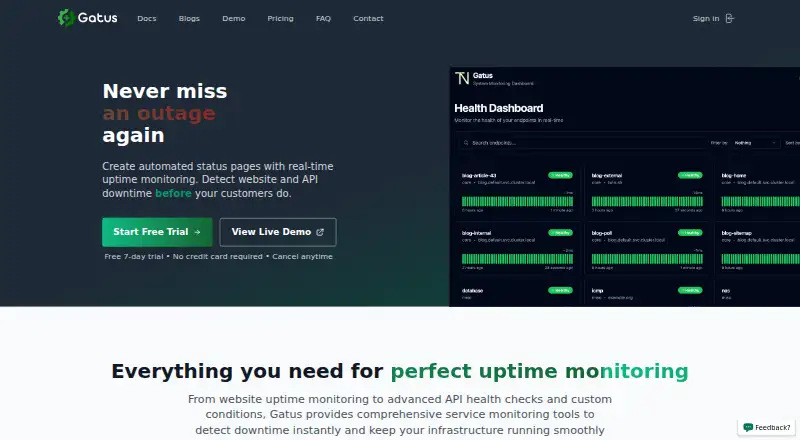
What Gatus is
Gatus monitors services at configured intervals and evaluates conditions to determine endpoint health. Its documented checks include HTTP, ICMP, TCP, UDP, DNS, TLS, STARTTLS, SCTP, and external push-based monitoring. Conditions can examine status, response bodies, certificate or domain expiration, response time, connection success, and IP. The project describes itself as completely open source and lists API, self-hosted, and web platforms. The free offering has a stated limit of 30 monitors and includes server monitoring, keyword monitoring, and SSL expiry alerts. Paid plans include status pages, with private pages and custom hostnames listed as features; endpoint and status-page limits vary by plan. Alert integrations include Slack, Teams, Telegram, Discord, Google Chat, Matrix, GitHub, GitLab, and other channels, with availability varying by plan. A beta API supports status-page configuration and endpoint management using authenticated requests. The documentation labels test suites alpha; they run endpoints sequentially with shared context. Gatus says it does not retain metrics indefinitely and documents scraping its metrics endpoint for storage elsewhere.
Good
- Open-source project with self-hosted option
- Supports multiple endpoint check types
- Checks certificate and domain expiration
- Broad list of alert integrations
Watch out
- Free offering is limited to 30 monitors
- Test suites are marked alpha
- Metrics are not retained indefinitely
Who it suits
Gatus suits teams seeking open-source service monitoring through web, API, or self-hosted options. Its check types and alert integrations may fit teams that need to monitor endpoints and share status pages.
Verdict
Gatus provides configurable endpoint checks, alerting, and status pages, with self-hosting also listed. Check plan-specific limits and integration availability, and note that its test suites are still labeled alpha.
Plans and prices
From Gatus's own pricing page, checked 8 Oct 2026.
| Plan | Price | What it gives you |
|---|---|---|
| Standard | $10 a month | 1 status page · 30 endpoints per page · 2m minimum check interval · 1 team member · Monthly billing |
| Premium | $20 a month | 2 status pages · 50 endpoints per page · 1m minimum check interval · 5 team members · Monthly billing |
| Business | $50 a month | 3 status pages · 100 endpoints per page · 30s minimum check interval · 25 team members · Monthly billing |
| Enterprise | $500 a month | 30 status pages · 1,000 endpoints per page · 30s minimum check interval · Unlimited conditions, alerts, and team members · Monthly billing |
The facts
Each one read from Gatus's own pages, with the date it was checked.
What it does
- Alert channels
- Slack,Microsoft Teams,Telegram,Discord,Google Chat,Gotify,Matrix,Mattermost,n8n,Ntfy,Opsgenie,Email,Gitea,GitHub,GitLabchecked 19 Sep 2026
- Alerting integrations
- The pricing page lists integrations including Slack, Teams, Telegram, Discord, Google Chat, Matrix, GitHub, GitLab, and PagerDuty, with availability varying by plan.checked 8 Oct 2026
- API
- The beta API supports retrieving status page configuration and creating, updating, and deleting endpoints using authenticated requests.checked 8 Oct 2026
- API access control
- Status page tokens can be scoped as READ or WRITE, while user API keys provide access to all status pages and are valid for one hour.checked 8 Oct 2026
- Conditions
- Conditions can evaluate status, response bodies, certificate or domain expiration, response time, connection success, and IP.checked 8 Oct 2026
- Keyword monitoring
- Yeschecked 19 Sep 2026
- Metrics
- Gatus says it does not retain metrics forever and documents scraping its metrics endpoint for storage in systems such as Prometheus or InfluxDB.checked 8 Oct 2026
- Monitoring types
- Documented endpoint types include HTTP, ICMP, TCP, UDP, DNS, TLS, STARTTLS, SCTP, and external push-based checks.checked 8 Oct 2026
- Monitor limit
- 30checked 19 Sep 2026
- Open source
- Gatus describes its project as completely open source.checked 8 Oct 2026
- Privacy
- The privacy policy says payment information is stored in Stripe for managing Gatus.io subscriptions.checked 8 Oct 2026
- Purpose
- Gatus monitors services at configured intervals and uses conditions to determine endpoint health.checked 8 Oct 2026
- Server monitoring
- Yeschecked 19 Sep 2026
- SSL expiry alerts
- Yeschecked 19 Sep 2026
- Status pages
- Plans include status pages, with private pages and custom hostnames listed as included features.checked 8 Oct 2026
- Support
- The contact page directs bug reports and suggestions for the open source project to its repository and reserves its contact form for managed-service inquiries.checked 8 Oct 2026
- Test suites
- Suites execute endpoints sequentially with shared context for workflows such as authentication and CRUD sequences; the documentation marks suites as alpha.checked 8 Oct 2026
Money
- Free plan
- Yeschecked 19 Sep 2026
Alternatives to Gatus
- 1

Dotcom-Monitor
Free planAndroidiOSWebAPI8.9From $13.33 a month - 2

UptimeRobot
Free planAndroidiOS8.5From $9 a month - 3

Pingdom
AndroidiOSWebAPI8.4From $16.50 a month - 4

SolidPing
Free planWebAPILinuxSelf-hosted8.2From €5 a month - 5

Uptimia
Free planWeb8.2From $9 a month - 6
HetrixTools
Free planLinuxmacOSWindows8.2From $9.95 a month