Gameplay.Science
Gameplay.Science is a free, open-source web platform that helps independent researchers study video games with player-donated behavior data.
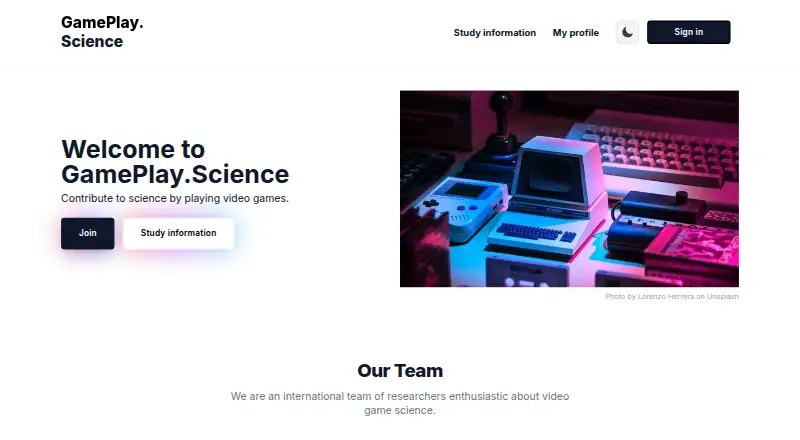
What Gameplay.Science is
Gameplay.Science is a free, open-source web platform that helps independent researchers study video games with player-donated behavior data. It is designed to support investigations without requiring direct participation from game platforms. Players can contribute digital trace data through Steam, Discord, or GDPR requests, and can link accounts such as Steam or Xbox to authorize automatic access. UK and EU players may request data held by a gaming company under GDPR and share it with researchers. The project aims to support analysis of how long people play, what they do in games, and who they interact with. In one study, participants authenticated Steam IDs through Steam’s official OpenID API and had to make their Steam gameplay details public. That study describes collecting each game’s incremental playtime hourly, representing the previous hour, with data stored on encrypted servers accessible only to the research team. Steam and Xbox are listed as supported ecosystems.
Good
- Free, open-source research platform
- Supports Steam and Xbox ecosystems
- Automatic account-based data donation
- GDPR request pathway for UK and EU players
- Encrypted research-data storage described
Watch out
- Requires players to authorize gameplay-data access
- A study required public Steam gameplay details
- Participation involves donating digital trace data
- No plan or trial terms are stated
Who it suits
It suits independent researchers studying gameplay behavior and players willing to donate digital trace data. Web access and supported Steam or Xbox integrations are central to participation.
Verdict
Gameplay.Science connects player-contributed data with independent video-game research through account integrations and GDPR requests. Prospective participants should understand the access permissions and public-profile requirement described for the study.
The facts
Each one read from Gameplay.Science's own pages, with the date it was checked.
What it does
- Account integrations
- Players can sign in to gaming accounts such as Xbox or Steam and grant permission for a service to access and store gameplay data.checked 8 Oct 2026
- Account linking
- The project describes account integrations in which players sign in to accounts such as Xbox or Steam and authorize automatic access to gameplay data.checked 4 Oct 2026
- Data access
- The project describes GDPR requests as a way for players in the UK and EU to request data held by gaming companies and share it with researchers.checked 8 Oct 2026
- Data collected
- The study describes Gameplay.Science collecting incremental playtime per Steam game, totaling the previous hour's playtime each hour.checked 4 Oct 2026
- Data donation
- Players can donate digital trace data to independent scientific investigations via Steam, Discord, or GDPR requests.checked 4 Oct 2026
- GDPR requests
- The project describes GDPR requests as a way for UK and EU players to obtain data held by a gaming company and share it with researchers.checked 4 Oct 2026
- Intended users
- The platform is intended to help independent researchers study video games using player-donated data.checked 8 Oct 2026
- Notable data requirement
- The study says participants had to make their Steam gameplay details publicly available.checked 4 Oct 2026
- Open source
- The project describes Gameplay.Science as an open-source platform.checked 8 Oct 2026
- Pricing
- The opened project page does not state plan prices or whether a free plan or trial is available.checked 8 Oct 2026
- Project contact
- The project page lists Professor Andrew Przybylski as the contact.checked 8 Oct 2026
- Project dates
- The Oxford Internet Institute lists the project dates as July 2024 to June 2026.checked 8 Oct 2026
- Purpose
- Gameplay.Science is an open-source internet platform that enables researchers to study the effects of video games using player-donated behavior data.checked 8 Oct 2026
- Research audience
- The platform is designed to help independent researchers access gameplay data without requiring direct participation by game platforms.checked 4 Oct 2026
- Research data
- The project aims to support data on both how much people play and what they do in games, including who they interact with.checked 8 Oct 2026
- Security and access
- The study says the data was stored on encrypted servers accessible only to the research team.checked 4 Oct 2026
The company
- Headquarters
- Oxford, UKchecked 28 Sep 2026
- Steam authentication
- A study using Gameplay.Science says participants authenticate their Steam ID through the official Steam authentication API using OpenID.checked 4 Oct 2026
Where it runs
- Platform participation
- The platform is designed to enable research without requiring direct participation from game platforms.checked 8 Oct 2026
- Web platform
- A 2026 comparison page lists Gameplay.Science as web-based and lists Steam and Xbox as supported gaming ecosystems.checked 4 Oct 2026
Alternatives to Gameplay.Science
- 1

GamePal
Free planiOS7.3From $29.99 a year - 2

PlayTracker
Free planAndroidiOSWebWindows7.3From €12 a month - 3
Game Time Manager
Free planOpen sourceWindows7.0Free plan - 4
Actually Played
Free planLinuxmacOSWindows6.6Free plan - 5
Arknights: Endfield Playtime Tracker
Free planWebWindows6.3Free plan - 6

Pyroblast
Free planWeb6.2Free plan