Gambit
Gambit is a free, open-source mutation testing tool for Solidity.
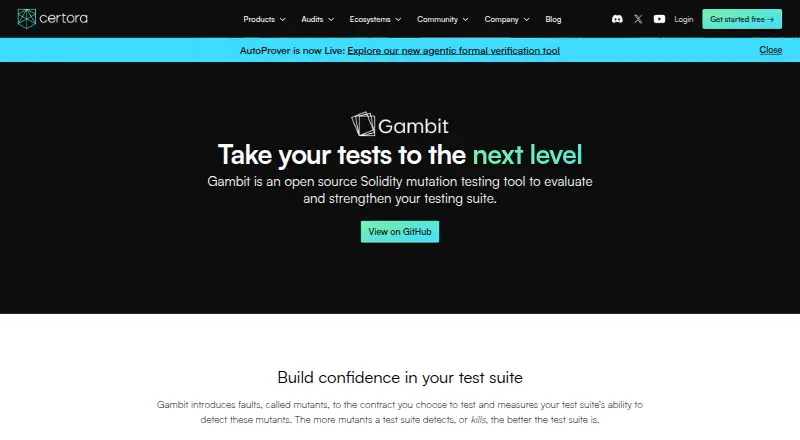
What Gambit is
Gambit is a free, open-source mutation testing tool for Solidity. It alters selected contracts to create mutants, then measures how well a test suite or formal verification specification detects those faults. It finds mutation points by traversing a Solidity program’s abstract syntax tree and applies predefined syntax transformations. A declarative configuration language lets users select and tailor mutations for particular parts of a program. Results can be reviewed in a dashboard that summarizes mutant verification and calculates a specification score. Gambit also integrates with the Certora Prover to assess formal specifications; that workflow creates mutants and submits a verification job for each to Certora’s server. Its command line provides `mutate` to generate variants and `summary` to present them. Gambit requires a compatible `solc` compiler binary for the project. It supports Linux, macOS, and Windows, though Windows and Linux ARM users must build from source. Function-call and swap-arguments-function mutation operators are disabled.
Good
- Free and open source under the MIT license.
- Evaluates tests and formal specifications.
- Users can target mutations to selected program parts.
- Dashboard summarizes results and scores specifications.
- Includes `mutate` and `summary` commands.
Watch out
- Requires a compatible `solc` binary.
- Windows and Linux ARM users must build from source.
- Function-call and swap-arguments-function mutations are disabled.
Who it suits
Gambit suits developers working on Solidity projects who want to evaluate tests or formal specifications by checking which generated mutations they catch. It can be used with Solidity testing and verification tools generally, as well as the Certora Prover.
Verdict
Gambit offers a focused way to assess Solidity tests and specifications using generated contract variants. Check compiler compatibility and build requirements for your platform before adopting it.
The facts
Each one read from Gambit's own pages, with the date it was checked.
What it does
- Certora Prover integration
- Gambit mutations can be used with the Certora Prover to evaluate formal specifications as well as tests.checked 7 Oct 2026
- Command line
- Gambit provides `mutate` to generate mutants and `summary` to summarize generated mutants.checked 7 Oct 2026
- Commands
- Gambit provides mutate for generating mutants and summary for presenting generated mutants in a human-readable format.checked 7 Oct 2026
- Compiler requirement
- Gambit uses the Solidity compiler `solc` and requires a compatible binary for the project being mutated.checked 7 Oct 2026
- Dashboard
- Gambit results can be viewed in a dashboard that summarizes mutant verification results and computes a specification score.checked 7 Oct 2026
- Formal specifications
- Gambit mutants can be used to evaluate both tests and formal specifications.checked 7 Oct 2026
- How it works
- Gambit introduces faults called mutants into selected contracts and measures whether a test suite detects them.checked 7 Oct 2026
- Installation
- Prebuilt binaries are available for Linux x86-64 and Mac; Windows and Linux ARM users must build from source.checked 7 Oct 2026
- Intended users
- The maker describes Gambit as usable on any Solidity project.checked 7 Oct 2026
- License
- The Gambit GitHub repository identifies its license as MIT.checked 7 Oct 2026
- Mutant detection
- Gambit measures how well a test suite detects generated mutants, with more detected mutants indicating a stronger suite.checked 7 Oct 2026
- Mutant generation
- Gambit applies predefined syntax transformations to Solidity source code to generate program variants called mutants.checked 7 Oct 2026
- Mutation generation
- Gambit traverses a Solidity program’s abstract syntax tree to identify valid mutation points and generate variable mutants.checked 7 Oct 2026
- Mutation limits
- The README lists function-call mutation and swap-arguments-function mutation as disabled operators.checked 7 Oct 2026
- Mutation points
- Gambit traverses a Solidity program's abstract syntax tree to identify valid mutation points.checked 7 Oct 2026
- Mutation selection
- Users can customize and localize mutations to specific program parts using a declarative configuration language.checked 7 Oct 2026
- Other tools
- The maker describes Gambit as usable with Solidity testing and verification tools generally, and with any Solidity project.checked 7 Oct 2026
- Prover integration
- Gambit is integrated with Certora Prover for evaluating the strength of verification rules.checked 7 Oct 2026
- Prover workflow
- Using the mutation verifier generates mutants and submits a verification job for each mutant to Certora's server.checked 7 Oct 2026
- Purpose
- Gambit is an open source Solidity mutation testing tool that evaluates and strengthens a testing suite.checked 7 Oct 2026
- Results
- The Gambit dashboard summarizes mutant verification results and computes a score to evaluate a specification.checked 7 Oct 2026
- Support
- Certora's documentation says product questions can be directed to its Help Desk channel on Discord.checked 7 Oct 2026
The company
- Maker
- Gambit is built and maintained as an open-source project by the Certora team.checked 7 Oct 2026
Where it runs
- Platforms
- Prebuilt binaries are available for Linux x86-64 and Mac; Windows and Linux ARM users must build from source.checked 7 Oct 2026
Alternatives to Gambit
- 1
Mutatest
Free planOpen sourceAPILinuxmacOSSelf-hosted7.2Free plan - 2

ArcMutate
Free planLinuxmacOSSelf-hostedWindows6.7From $8 a month - 3
Mutant
Free planLinuxmacOS6.7From $250 a year - 4
MuJava
Free planLinuxmacOSWindows6.3Free plan - 5
pymute
Free planLinux6.3Free plan - 6
go-mutesting
Free planLinuxSelf-hosted6.2Free plan