pymute
pymute is a free mutation-testing tool for Python and pytest, written in Rust.
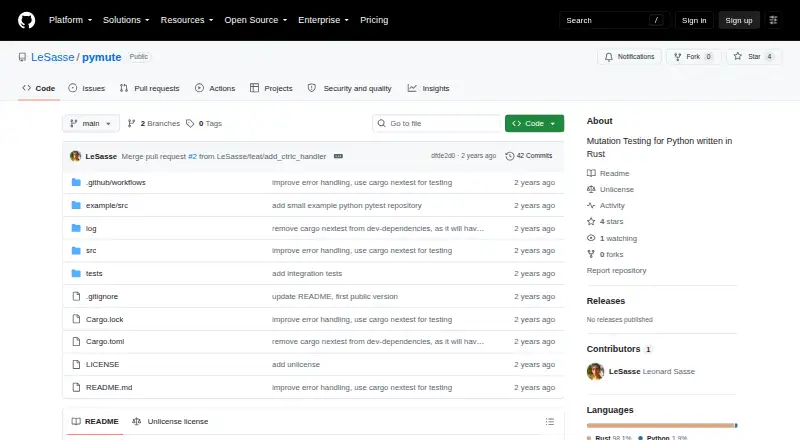
What pymute is
pymute is a free mutation-testing tool for Python and pytest, written in Rust. It creates a temporary directory for each mutant and changes Python file text rather than operating on the abstract syntax tree. Pytest is the default test runner, and tox is also supported. Documented mutation types include math operators, conjunctions, booleans, control flow, comparison operators, and numbers. By default, pymute reports mutants that survive because tests pass; other output levels can show caught mutants or underlying process output. Users can limit files with a module glob, select tests and mutation types, set the number of threads, and cap the mutant count. That cap runs a randomly sampled subset. With pytest, tests need to run from the project root in independent copies and target the local copy rather than an installed package. Tox creates a separate virtual environment and installs the package for each mutant, which the project says is considerably slower. Installation uses Cargo from crates.io or GitHub and requires Rust and Cargo. Parallel threads each need temporary disk space, and runs may fail if /tmp runs out.
Good
- Supports pytest and tox.
- Offers several mutation types and output levels.
- Can run mutants in parallel.
- Allows test, module, and mutant-count selection.
Watch out
- Requires Rust and Cargo.
- Parallel threads consume temporary disk space.
- tox setup is considerably slower.
- Pytest must test local copies from the project root.
Who it suits
pymute suits Python developers who want to check whether pytest or tox tests catch common code mutations. It is a fit for users comfortable installing Rust and Cargo and running tests on independent project copies.
Verdict
pymute provides configurable mutation testing for Python projects, with pytest as its default and tox as an alternative. Account for the Rust installation requirement and the test-layout constraints before adopting it.
Plans and prices
From pymute's own pricing page, checked 8 Oct 2026.
| Plan | Price | What it gives you |
|---|---|---|
| Free/open-source | Free | Install with Cargo; requires Rust and Cargo |
The facts
Each one read from pymute's own pages, with the date it was checked.
What it does
- Configuration
- Users can restrict mutations by module glob, select tests, choose mutation types, set thread count, and cap the number of mutants.checked 7 Oct 2026
- Distribution
- The README says to install pymute using Cargo from crates.io or directly from GitHub, and requires Rust and Cargo.checked 8 Oct 2026
- How it works
- It creates a temporary directory for each mutant and inserts mutations by manipulating text in Python files rather than operating on the AST.checked 7 Oct 2026
- Installation
- The README says to install pymute with Cargo from crates.io or directly from GitHub, and requires Rust and Cargo.checked 7 Oct 2026
- License
- The repository identifies its license as Unlicense.checked 8 Oct 2026
- Mutation types
- Its listed mutation types include math operators, conjunctions, booleans, control flow, comparison operators, and numbers.checked 8 Oct 2026
- Output
- By default, it displays mutants that tests missed, with optional caught and process output levels.checked 8 Oct 2026
- Parallelism
- The --num-threads option controls how many mutants run in parallel, and each thread uses temporary disk space.checked 8 Oct 2026
- Project layout constraint
- With pytest, the project’s tests need to run from the project root in independent copies and test the local copy rather than an installed package.checked 7 Oct 2026
- Purpose
- Pymute is a mutation testing tool for Python and Pytest written in Rust.checked 8 Oct 2026
- Pytest requirement
- With pytest, tests should run from the project root in independent project copies and test the local copy rather than an installed package.checked 8 Oct 2026
- Resource use
- The README notes that each parallel thread needs temporary disk space and may fail if /tmp runs out of space.checked 7 Oct 2026
- Sampling
- The --max-mutants option runs a randomly sampled subset of mutants.checked 8 Oct 2026
- Scoping
- The --modules option filters files using a glob, and files named test_* or ending in *_test.py are automatically excluded.checked 8 Oct 2026
- Test runners
- It supports pytest as the default runner and tox as an alternative.checked 8 Oct 2026
- Test selection
- The --tests option runs selected tests, which the README recommends for quicker iteration on specific modules.checked 8 Oct 2026
- Tox limitation
- Tox sets up a virtual environment and installs the package for each mutant, which the README says is considerably slower.checked 8 Oct 2026
- tox tradeoff
- The README says tox creates a separate virtual environment and installs the package for each mutant, but is considerably slower because environments must be set up.checked 7 Oct 2026
- Version
- The repository Cargo manifest lists version 0.2.1 and author Leonard Sasse.checked 7 Oct 2026
The company
- Maker
- The Cargo manifest names Leonard Sasse as the author.checked 8 Oct 2026
Where it runs
- Mutation approach
- It creates a temporary directory for each mutant and inserts mutations by editing Python file text rather than operating on the AST.checked 8 Oct 2026
The full review of pymute
pymute is a free mutation-testing utility for Python projects built around pytest or tox. It best suits developers comfortable installing Rust tooling and arranging tests to run against temporary project copies. Its focused reports and run controls are useful, but packaging and disk-space constraints make it a poor fit for some test layouts.
Overview
Mutation testing deliberately changes source code and checks whether a test suite detects the change. pymute creates a separate temporary directory for each mutant and edits Python file text to insert mutations instead of working on the abstract syntax tree. That approach keeps the tool centered on source-level changes, while making its project-copy workflow an important part of adoption.
The default report shows mutants that survived because tests passed. Those survivors are the most actionable signal for finding weak assertions or untested behavior. Higher output levels can also show caught mutants and the underlying process output when a run needs more diagnostic context.
Key features
Mutation operators and scope
Supported operators cover mathematical operators, conjunctions, booleans, control flow, comparison operators, and numbers. The --modules option filters files with a glob, and files named test_* or ending in *_test.py are excluded automatically. You can choose mutation types to keep a run relevant to the code under review.
Targeted and parallel runs
The --tests option selects tests, which is practical when iterating on a particular module instead of running an entire suite. --max-mutants limits work to a randomly sampled subset, trading complete coverage of possible mutations for shorter feedback cycles. --num-threads controls parallel execution, so larger machines can process mutants concurrently.
Parallelism has a concrete cost: every thread needs temporary disk space. Runs can fail when /tmp is exhausted, making storage capacity part of planning rather than an incidental operational detail.
Test runners
Pytest is the default runner, with tox available as an alternative. With pytest, tests must run from the project root in independent copies and test the local copy rather than an installed package. Projects whose tests assume an installed distribution or a different working-directory model will need restructuring.
Tox provides a more installation-like environment, but it creates a separate virtual environment and installs the package for every mutant. The resulting setup work is considerably slower, so tox is better reserved for projects that need that isolation and can accept long mutation runs.
Pricing
| Plan | Price | What it includes |
|---|---|---|
| Free/open-source | free | Install with Cargo; requires Rust and Cargo |
There are no paid tiers, seat charges, quotas, trial periods, or renewal terms. The tradeoff is operational rather than financial: users supply the Rust and Cargo toolchain and accommodate temporary-copy execution themselves.
Platforms
pymute supports Linux and targets Python projects using pytest or tox. Distribution is through Cargo from crates.io or directly from GitHub, and installation therefore requires Rust and Cargo. The repository identifies version 0.2.1 and the author as Leonard Sasse, and uses the Unlicense.
Who it's for
Choose pymute if you maintain Python tests, want a no-cost way to measure whether they catch common code changes, and can run a Rust-installed command against disposable project directories. Its module and test selection, random mutant cap, and parallel threads suit focused development runs as well as broader checks.
Look elsewhere if your pytest suite only works against an installed package, cannot run from the project root, or lacks temporary disk headroom for concurrent copies. Tox users should also budget for substantially slower execution caused by per-mutant environment creation.
Pros and cons
Pros
- Free distribution: There is a single 0.00 USD plan with no paid-tier restrictions.
- Actionable default report: Surviving mutants put test-suite gaps first, while extra output levels provide caught-mutant and process detail when needed.
- Useful run controls: Module globs, test selection, operator selection, random sampling, and configurable parallelism help contain large jobs.
- Broad core operators: Mathematical, boolean, conjunction, control-flow, comparison, and numeric mutations cover several common defect patterns.
Cons
- Rust prerequisite: Installation through Cargo requires Rust and Cargo, adding a toolchain dependency to a Python workflow.
- Pytest layout restriction: Tests must run from the root in independent copies and exercise the local copy, excluding some packaging arrangements.
- Tox performance cost: A fresh environment and package installation for each mutant makes tox considerably slower.
- Temporary-storage risk: Parallel threads consume disk space and can fail when /tmp fills.
- Text-based mutation: Editing source text rather than an AST can be less accommodating of source-structure edge cases.
Alternatives
Mutation Testing Tools is the broader category starting point when you want to compare mutation-testing options.
- ArcMutate is the better choice when you need macOS or Windows support, self-hosting, or a freemium model with an $8.00-per-month Base plan; its Open Source plan is free for open-source projects.
- MuJava suits Java users who want a free Apache-licensed option across Linux, macOS, and Windows.
- Mutant is worth choosing for public repositories on its free full-feature plan, or for commercial teams needing any number of repositories at $30.00 per developer per month.
- Mutatest is a free, MIT-licensed alternative for users who prefer a cross-platform Python option.
- go-mutesting is for Go projects needing a free MIT-licensed framework on Linux or self-hosted systems.
- LittleDarwin is a free Linux Java mutation-analysis framework supported through donations.
- MutPy is a free Linux or self-hosted option with no paid plans or usage limits stated.
- pytest-gremlins is a free MIT-licensed Python package for Linux that requires Python 3.11 or newer.
Verdict
pymute is a strong fit for Linux-based Python teams that can install Rust, keep tests local to temporary project copies, and value configurable pytest mutation runs at no cost. Choose it for survivor-focused feedback and practical scoping controls; look elsewhere when your packaging model conflicts with pytest’s layout rules, tox’s per-mutant setup is too slow, or your environment cannot spare temporary disk space.
Alternatives to pymute
- 1
Mutatest
Free planOpen sourceAPILinuxmacOSSelf-hosted7.2Free plan - 2

ArcMutate
Free planLinuxmacOSSelf-hostedWindows6.7From $8 a month - 3
Mutant
Free planLinuxmacOS6.7From $250 a year - 4
MuJava
Free planLinuxmacOSWindows6.3Free plan - 5
go-mutesting
Free planLinuxSelf-hosted6.2Free plan - 6
LittleDarwin
Free planLinux6.2Free plan