Mutant
Mutant is mutation testing software for Ruby.
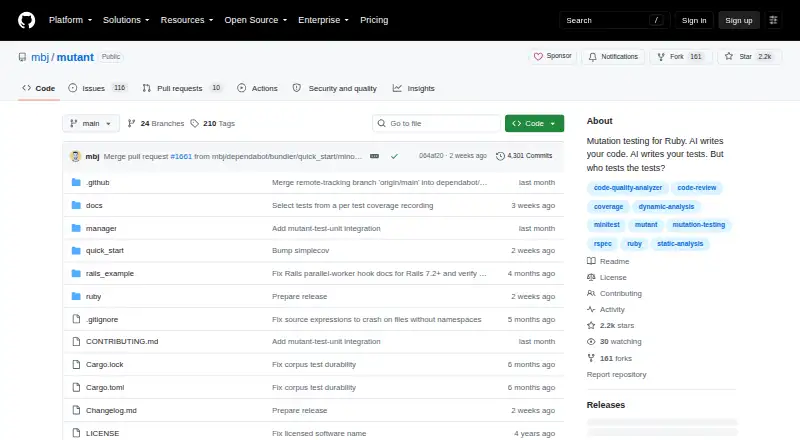
What Mutant is
Mutant is mutation testing software for Ruby. It makes systematic code changes, such as altering arithmetic, logical, or bitwise operators, removing statements, and changing return values, then checks whether tests catch them. It integrates with RSpec, Minitest, and Test::Unit, and supports incremental mode for CI workflows. Mutant supports Ruby 3.2, 3.3, 3.4, and 4.0 for runtime, syntax, and mutations. Its Rails integration is verified for Rails 7.2, 8.0, and 8.1, with parallel-worker database isolation for PostgreSQL and SQLite. One limitation is that it cannot emit mutations for methods defined within closures, including methods created with module_eval, class_eval, define_method, or define_singleton_method. Mutant runs on developers' machines or in CI. The open-source plan is free for public repositories with the full feature set. Commercial subscriptions cost $30 a month or $250 a year per developer; CI use requires no additional subscription.
Good
- Integrates with RSpec, Minitest, and Test::Unit.
- Supports incremental mode for CI.
- Supports Ruby 3.2, 3.3, 3.4, and 4.0.
- CI use requires no additional commercial subscription.
- Open-source plan includes the full feature set for public repositories.
Watch out
- Cannot emit mutations for methods defined within closures.
- Commercial subscriptions are required per developer using Mutant on commercial code.
- Commercial monthly plan costs $30 a month per developer.
Who it suits
Mutant suits Ruby developers who want to check whether their tests detect code changes, including teams using the listed test frameworks or supported Rails versions. Its open-source plan is for public repositories; commercial use requires a per-developer subscription.
Verdict
Mutant offers Ruby mutation testing with integrations for three test frameworks and incremental CI support. Check the closure-related limitation and commercial licensing terms before adopting it for commercial code.
Plans and prices
From Mutant's own pricing page, checked 1 Oct 2026.
| Plan | Price | What it gives you |
|---|---|---|
| Open source | Free | public repositories · full feature set |
| Commercial monthly | $30 a month | any number of repositories · CI use requires no additional subscriptions · per developer |
| Commercial yearly | $250 a year | any number of repositories · CI use requires no additional subscriptions · per developer |
| Enterprise | Priced on request | volume subscriptions · custom plans |
The facts
Each one read from Mutant's own pages, with the date it was checked.
What it does
- CI workflow
- Mutant supports incremental mode for running mutation testing in CI.checked 1 Oct 2026
- Commercial licensing
- Commercial subscriptions are required per developer using Mutant on commercial code, while CI execution requires no additional subscriptions.checked 1 Oct 2026
- Creator
- Mutant was created and is developed by Markus Schirp and is cited as subject of IEEE-published research.checked 1 Oct 2026
- Data sharing
- Customer information is never shared or sold to anyone.checked 1 Oct 2026
- Execution model
- Mutant runs exclusively on developers’ machines or in CI.checked 1 Oct 2026
- Mutation operators
- Mutant mutates arithmetic, logical and bitwise operators, removes statements, and modifies return values.checked 1 Oct 2026
- Purpose
- Mutant is mutation testing for Ruby that systematically modifies code and verifies that tests catch each change.checked 1 Oct 2026
- Rails integration
- Mutant supports Rails applications with parallel-worker database isolation for PostgreSQL and SQLite.checked 1 Oct 2026
- Rails versions
- The Rails integration is verified for Rails 7.2, 8.0, and 8.1.checked 1 Oct 2026
- Ruby support
- Mutant supports Ruby versions 3.2, 3.3, 3.4, and 4.0 for runtime, syntax, and mutations.checked 1 Oct 2026
- Source-code privacy
- Schirp DSO LTD states that it does not get access to customers’ source code, customer data, or other sensitive material.checked 1 Oct 2026
- Subject limitation
- Mutant cannot emit mutations for methods defined within closures such as module_eval, class_eval, define_method, or define_singleton_method.checked 1 Oct 2026
- Support channels
- Mutant provides Discord, GitHub Issues, and release announcements as communication channels.checked 1 Oct 2026
- Test integrations
- Mutant integrates with RSpec, Minitest, and Test::Unit.checked 1 Oct 2026
The company
- Headquarters
- Naxxar, Maltachecked 28 Sep 2026
The full review of Mutant
Mutant is a Ruby mutation-testing tool for developers who want to find gaps in their automated tests. It is best suited to Ruby teams using RSpec, Minitest, or Test::Unit who can work within its licensing terms and closure-related limit.
Overview
Mutation testing checks test suites by changing code and seeing whether tests catch those changes. Mutant alters arithmetic, logical, and bitwise operators, removes statements, and changes return values. A surviving mutation can reveal behavior that the suite does not protect, making this a useful complement to ordinary pass-or-fail test runs.
Mutant runs on developers’ machines or in CI, not as a hosted service. That keeps execution within the team’s development and build environments. Schirp DSO LTD says it does not access customer source code, customer data, or other sensitive material, and does not share or sell customer information. Discord, GitHub Issues, and release announcements are its communication channels.
Key features
Ruby test coverage
RSpec, Minitest, and Test::Unit integrations make Mutant practical for teams already using any of those frameworks. It supports Ruby 3.2, 3.3, 3.4, and 4.0 for runtime, syntax, and mutations. Reports of surviving mutants help direct attention to tests that may be missing meaningful assertions.
Incremental and parallel execution
Incremental mode supports mutation testing in CI, while parallel execution can help teams run the analysis as part of a development or build workflow. CI use does not require additional subscriptions, an important distinction for teams licensing individual developers.
Rails and a defined coverage boundary
Mutant supports Rails applications with parallel-worker database isolation for PostgreSQL and SQLite; its Rails integration is verified for Rails 7.2, 8.0, and 8.1. It cannot emit mutations for methods defined inside closures, including methods created with module_eval, class_eval, define_method, or define_singleton_method. Teams that rely on those patterns should treat the resulting coverage as incomplete rather than assume every relevant method is checked.
Pricing
The free plan is limited to public repositories, while paid subscriptions cover any number of repositories. Commercial subscriptions are required for each developer using Mutant on commercial code; CI execution needs no additional subscriptions.
- Open source: free, with the full feature set for public repositories. This suits open-source projects, but does not cover private repositories or commercial code.
- Commercial monthly: $30 a month, billed per developer, for any number of repositories. A fit for teams that prefer monthly billing; each developer using Mutant on commercial code needs a subscription.
- Commercial yearly: $250 a year, billed per developer, for any number of repositories. This is the annual option for teams comfortable with yearly billing; the per-developer requirement still applies.
- Enterprise: custom pricing for volume subscriptions and custom plans.
There is no free trial. The choice is between a public-repository free plan and paid commercial licensing, rather than a time-limited evaluation period.
Platforms
Mutant supports Linux and macOS. Its supported language is Ruby, and its execution model is local machines or CI.
Who it's for
Mutant is a strong fit for Ruby developers who want to assess whether tests catch behavioral changes, especially teams already using one of its three supported frameworks or incorporating checks into CI. Rails teams can also use it with the stated PostgreSQL and SQLite worker isolation support. It is less suitable for teams whose important methods are defined within closures, or commercial teams unwilling to license each developer using the tool.
Pros and cons
- Pro: Three established Ruby test-framework integrations let teams add mutation analysis without changing their testing framework.
- Pro: Incremental CI support and no extra CI subscription make it easier to include automated runs while keeping developer licensing explicit.
- Pro: Public repositories get the full feature set free, and paid plans allow any number of repositories.
- Con: Closure-defined methods receive no mutations, leaving a specific blind spot in coverage.
- Con: Commercial subscriptions are per developer, so costs scale with the number of developers using Mutant on commercial code.
- Con: There is no free trial, and the free plan is restricted to public repositories.
- Con: Linux and macOS are the supported platforms; Windows is not included.
Alternatives
Mutation Testing Tools is the broader category directory for comparing options. Consider ArcMutate if its free plan and listed $8 monthly Base plan better fit your budget or platform needs. Mutatest is a free, open-source alternative with Windows support. Infection is another free mutation-testing option. Stryker Mutator is free and targets JavaScript/TypeScript, C#, and Scala, so it is the relevant choice when your codebase uses those languages rather than Ruby. muttest, PIT, Cosmic Ray, and Dextool Mutate are also free alternatives.
Verdict
Choose Mutant if you maintain Ruby code and want mutation analysis across established test frameworks, with incremental CI support and a full-featured free option for public repositories. Its practical appeal is tempered by the closure-defined-method blind spot and per-developer commercial licensing; teams constrained by either should look to another option.
Getting started
- Open the Mutant website or GitHub project
- Choose the Open source plan for public repositories or a commercial plan
- Use Mutant on a Linux or macOS developer machine or in CI
- Connect it with RSpec, Minitest, or Test::Unit
- For Rails, configure PostgreSQL or SQLite parallel-worker isolation
Limits worth knowing
The free Open source plan applies to public repositories. Commercial subscriptions are billed per developer using Mutant on commercial code; CI execution requires no additional subscription. Mutant cannot emit mutations for methods defined within closures such as module_eval, class_eval, define_method, or define_singleton_method.
Questions
What languages does Mutant support?
Mutant supports Ruby, including versions 3.2, 3.3, 3.4, and 4.0.
Which test frameworks integrate with Mutant?
It integrates with RSpec, Minitest, and Test::Unit.
Is Mutant free?
The Open source plan is free for public repositories with the full feature set. Commercial plans cost $30 a month or $250 a year per developer.
Does CI use require another subscription?
No. CI execution requires no additional subscription.
Where does Mutant run?
Mutant runs on developers’ machines or in CI, on Linux and macOS.
Alternatives to Mutant
- 1
Mutatest
Free planOpen sourceAPILinuxmacOSSelf-hosted7.2Free plan - 2

ArcMutate
Free planLinuxmacOSSelf-hostedWindows6.7From $8 a month - 3
MuJava
Free planLinuxmacOSWindows6.3Free plan - 4
pymute
Free planLinux6.3Free plan - 5
go-mutesting
Free planLinuxSelf-hosted6.2Free plan - 6
LittleDarwin
Free planLinux6.2Free plan