
Galley
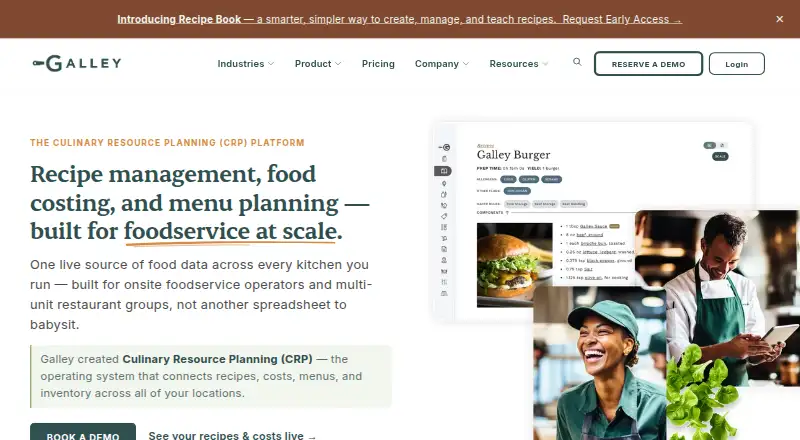
Galley is a culinary resource planning platform that connects kitchen planning with operational and financial data.
What Galley is
Galley is a culinary resource planning platform that connects kitchen planning with operational and financial data. It calculates recipe costs from ingredients, sub-recipes, yields, and vendor prices, then updates those costs when prices change. Teams can plan multi-week menu cycles across locations and turn menus into scheduled production plans based on demand. The platform provides USDA-backed nutrition analysis, FDA-compliant labels, and allergen tracking that changes with recipes. Galley Assist can import recipes from files, URLs, or prompts, and the platform connects with external AI tools through MCP. Listed integrations include Square, Snowflake, HubSpot, Nutrislice, DateCodeGenie, and others; EDI supplier connections include Sysco, US Foods, Performance Food Group, and others. An open API exposes recipes, ingredients, costs, menus, and nutrition data to other systems. Galley is a web application optimized for desktop and tablet screens; smartphones are not supported or recommended. Full platform pricing is quoted based on operation size and locations.
Good
- Recipe costs update when vendor prices change.
- Supports multi-week menu cycles across locations.
- Nutrition analysis and allergen tracking reflect recipe changes.
- Offers an open API for recipes, costs, menus, and nutrition data.
Watch out
- Smartphones are not supported or recommended.
- Full platform pricing depends on operation size and locations.
Who it suits
Galley is intended for high-volume onsite and contract foodservice operators, including corporate dining, campuses, healthcare, and multi-unit restaurant groups. It is best suited to teams planning menus, production, and recipe costs on desktop or tablet.
Verdict
Galley brings recipe costing, menu and production planning, and nutrition information together for foodservice operations. Its desktop- and tablet-focused web app is not intended for smartphone use.
Plans and prices
From Galley's own pricing page, checked 4 Oct 2026.
| Plan | Price | What it gives you |
|---|---|---|
| SMB Accelerator | $99 a month | Recipes · Menus · Costing · simplified onboarding · no long contracts · Starting at $99/month |
| Galley platform | Priced on request | Pricing scoped to volume and locations · Pricing scales with operation and number of locations; contact Galley for a quote |
The facts
Each one read from Galley's own pages, with the date it was checked.
What it does
- AI recipe imports
- Galley Assist can import recipes from files, URLs, or prompts, and the platform connects to external AI tools through MCP.checked 4 Oct 2026
- API
- Galley provides an open API that exposes recipes, ingredients, costs, menus, and nutrition data to other systems.checked 4 Oct 2026
- Distributor connections
- Galley lists EDI supplier connections with Sysco, US Foods, Performance Food Group, Gordon Food Service, Shamrock Foods, Cheney Brothers, FreshPoint, and Greenleaf.checked 4 Oct 2026
- Integrations
- Listed integrations include Square, Snowflake, HubSpot, Nutrislice, DateCodeGenie, NiceLabel, Leanpath, Topanga, Caterease, Total Party Planner, Curate, ChouxBox, and MarketPro.checked 4 Oct 2026
- Menus and production
- Galley supports multi-week menu cycles across locations and turns menus into scheduled, demand-based production plans.checked 4 Oct 2026
- Nutrition
- Galley says it provides USDA-backed nutrition analysis, FDA-compliant labels, and allergen tracking that updates when recipes change.checked 4 Oct 2026
- Security
- Galley describes its platform as having enterprise-grade administration and security, but the page does not specify certifications or compliance standards.checked 4 Oct 2026
- Support
- Galley offers a Help Center with product tutorials, release notes, and advice from its team.checked 4 Oct 2026
- What it does
- Galley describes its product as a culinary resource planning platform that connects kitchen creativity with operational and financial data.checked 4 Oct 2026
- Who it is for
- Galley says it is built for high-volume onsite and contract foodservice operators, including corporate dining, campuses, healthcare, and multi-unit restaurant groups.checked 4 Oct 2026
The company
- Company origin
- Galley says it was co-founded by Benji Koltai, but its own About page does not state a founding year or headquarters.checked 4 Oct 2026
Where it runs
- Device support
- Galley is a web application optimized for desktop and tablet screens; its support page says smartphones are not supported or recommended.checked 4 Oct 2026
Money
- Recipe costing
- The platform derives recipe costs from ingredients, sub-recipes, yields, and vendor prices, and updates costs when prices change.checked 4 Oct 2026
The full review of Galley
Galley is a planning system for operators who need recipes, costs, menus, and production to work together. It is strongest for multi-location foodservice teams; smaller operations may find its broad operational scope more than they need.
Overview
Recipe costs draw on ingredients, sub-recipes, yields, and vendor prices, with updates when prices change. That can keep menu decisions aligned with purchasing economics, provided those inputs stay accurate. Multi-week menu cycles can span locations and feed scheduled, demand-based production plans, bringing planning closer to day-to-day kitchen requirements.
Nutrition tools include USDA-backed analysis, FDA-compliant labels, and allergen tracking that changes with recipes. Galley Assist imports recipes from files, URLs, or prompts, and the platform connects to external AI tools through MCP. Waste tracking, purchase orders, and POS integrations broaden its operational reach beyond recipe management.
Key features
- Costing: Including sub-recipes and yields helps reflect the real cost of a finished recipe, while price updates matter to operators whose supplier costs shift. Cost accuracy still depends on current recipe and vendor-price inputs.
- Menus and production: Multi-week cycles across locations can become demand-based production schedules, a useful link for teams coordinating menus and kitchen output at scale.
- Nutrition and allergens: USDA-backed analysis and FDA-compliant labels support nutrition workflows; recipe-linked allergen updates reduce the risk of relying on outdated recipe information.
- Recipe imports and connections: Imports from files, URLs, or prompts can reduce manual entry. Listed integrations include Square, Snowflake, HubSpot, Nutrislice, DateCodeGenie, NiceLabel, Leanpath, Topanga, Caterease, Total Party Planner, Curate, ChouxBox, and MarketPro. EDI supplier connections include Sysco, US Foods, Performance Food Group, Gordon Food Service, Shamrock Foods, Cheney Brothers, FreshPoint, and Greenleaf.
- API: An open API exposes recipes, ingredients, costs, menus, and nutrition data to other systems, giving operators a route to connect those records with their wider software environment.
- Administration and support: Galley describes enterprise-grade administration and security, and provides a Help Center with tutorials, release notes, and team advice.
Pricing
The freemium model starts with a free plan, though its limits are not defined. SMB Accelerator starts at $99/month and includes recipes, menus, costing, simplified onboarding, and no long contracts. It is the clearer fit for smaller operators seeking those core tools without a long commitment, but the starting price does not establish the final cost for every operation.
The Galley platform has custom pricing, scaled to operation size and number of locations. That structure may suit larger organizations whose requirements vary by volume and footprint, but teams need a quote to assess the cost.
Platforms
Galley runs as a web application optimized for desktop and tablet screens. Despite Android and iOS appearing among its platform listings, smartphones are not supported or recommended, so it is a poor fit for teams that need phone-first access. Linux, macOS, and Windows are also listed. The API provides connections for other systems.
Who it's for
Galley is built for high-volume onsite and contract foodservice, including corporate dining, campuses, healthcare, and multi-unit restaurant groups. Those operators are most likely to benefit from connecting recipe economics, menu cycles, nutrition, and production. Individual cooks or small teams seeking a simple, smartphone-friendly recipe tool should look elsewhere.
Pros and cons
- Pro: Costs update when vendor prices change, helping keep recipe economics current.
- Pro: Menu cycles feed demand-based production plans across locations, connecting planning to kitchen output.
- Pro: Recipe-linked allergen tracking and nutrition labeling support foodservice workflows.
- Con: Smartphone use is not supported or recommended, limiting mobile access for kitchen teams.
- Con: Larger operations face quote-based pricing, while the free plan's limits are unclear.
- Con: Enterprise-grade security is described, but no certifications or compliance standards are specified.
Alternatives
For a lower-cost inventory-oriented option, OrderNow Inventory has a free plan and a Pro plan at $44 a month for one location, with unlimited menu items, ordering and KOT, and standard chat and email support. Choose it when those inventory and ordering needs matter more than Galley's menu-cycle, costing, and production-planning scope.
growyze offers a free plan, a free trial, and web, Android, and iOS access. Its free tier has capped quantities for stocktakes, supplier orders, suppliers, delivery notes, invoice validations, recipes, and dishes; consider it when those stock and purchasing workflows or smartphone access are the priority.
Spec has a free plan and trial, with monthly free-tier caps of 30 recipe ingredient costings, 30 recipe labor costings, 30 sub-recipes, and 10 menus, and no stock counts. It is worth considering for a smaller recipe-costing and menu workflow, particularly if those limits are sufficient.
Marji offers a free QR Menu plan for one location, with a hosted menu, downloadable QR code, live price edits, and sold-out controls. Choose it for customer-facing menu publishing rather than Galley's broader kitchen planning.
ScanOrbit is free during launch, with infrastructure and hosting included; its page says paid plans will come later. It is an option for readers who want a free web service during that launch period.
Craftable is a paid alternative with Android, iOS, and web access.
MarketMan is a paid option without a free plan. Its Starter plan costs $249 a month and includes one vendor EDI integration and 50 AI-powered invoice scans per month; consider it if those invoice and vendor workflows fit better than Galley's planning focus.
Nory is a paid alternative with pricing available by contacting the company for a chat.
For category comparisons, browse Restaurant Inventory Management Software, Restaurant Recipe Management Software, and Restaurant Recipe Costing Software.
Verdict
Galley is a strong fit for high-volume foodservice operators that need recipe costing, multi-location menus, production planning, and nutrition workflows connected in one system. Choose it for that operational breadth and its supplier and software connections; look elsewhere if smartphone support, clearly bounded free-plan limits, or straightforward public pricing is essential.
Getting started
- Open the Galley website
- Choose the free plan or review the SMB Accelerator option
- Contact Galley for a quote for the full platform
- Use Galley on a desktop or tablet
- Connect listed integrations, distributors, or external systems through the API
Questions
Is Galley free?
Yes.
What does the $99/mo plan include?
The SMB Accelerator plan lists recipes, menus, costing, and simplified onboarding, with no long contracts.
What devices support Galley?
Galley is a web application optimized for desktop and tablet screens. Android, iOS, Linux, macOS, Windows, web, and API platforms are listed, while smartphones are not supported or recommended.
Does Galley connect to other systems?
Yes. Listed connections include Square, Snowflake, HubSpot, multiple foodservice tools, EDI distributors, external AI tools through MCP, and an open API.
Who founded Galley?
Galley says it was co-founded by Benji Koltai.
Alternatives to Galley
- 1
reciProfity
AndroidiOSWebAPI7.7From $30 a month - 2

MarketMan
AndroidiOSWebAPI6.9From $249 a month - 3

MarginEdge
AndroidiOSWeb6.8From $350 a month - 4
PlateSense
AndroidiOSWeb6.8From $59 a month - 5
ChefMod
AndroidiOSWeb6.7From $199 a month - 6
FoodNotify
AndroidiOSWeb6.7From €174.90 a month