
FreeBalance Accountability Suite
FreeBalance Accountability Suite is a commercial Government Resource Planning solution built for public financial management.
What FreeBalance Accountability Suite is
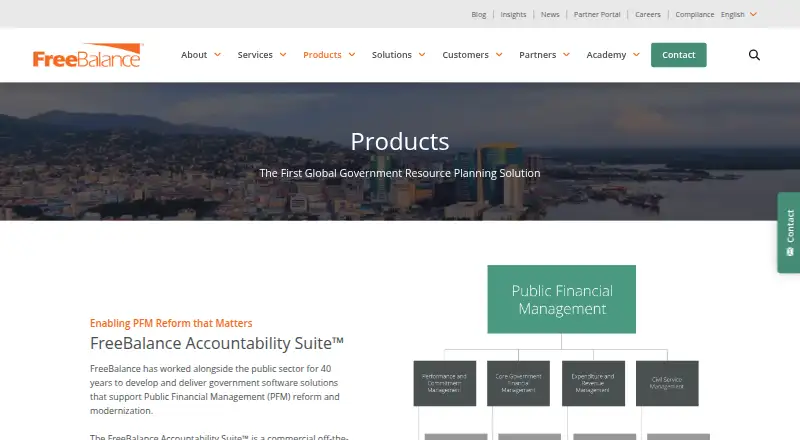
FreeBalance Accountability Suite is a commercial Government Resource Planning solution built for public financial management. It covers the budget cycle and related government fiscal systems, with six base configurations for performance management, public financials, public expenditure, treasury, receipts, and civil service management. Financial tools include budget and commitment accounting, appropriations, a Chart of Accounts, and real-time ledger balancing. Spending functions cover purchasing, procurement, grants, social programs, and the purchase cycle. Governments can combine modules, implement them separately or together, and add functions as their reform programs progress. The web-based, Java-powered platform supports centralized, decentralized, or hybrid deployment, including on-premises and private, public, community, and shared-services environments. It can integrate with government information systems, including financial and HR systems, and supports fiscal and accounting standards from the United Nations, IMF, World Bank, IFRS, and Millennium Challenge Corporation. FreeBalance also lists training and support services. Pricing is available on request.
Good
- Covers the budget cycle and key government fiscal systems.
- Includes budget and commitment accounting controls.
- Supports grants, procurement, and purchasing workflows.
- Modules can be activated progressively.
- Offers several deployment models and integration support.
Watch out
- Pricing is available on request.
- Designed specifically for government and public sector use.
- Java-powered platform.
Who it suits
It suits governments and public sector organizations managing public finances, budgets, and related fiscal processes. Its modular approach may fit organizations that want to add functions over time.
Verdict
FreeBalance Accountability Suite brings budgeting, spending, treasury, and related public financial functions into a government-focused system. Organizations considering it will need to contact FreeBalance for pricing details.
Plans and prices
From FreeBalance Accountability Suite's own pricing page, checked 3 Oct 2026.
| Plan | Price | What it gives you |
|---|---|---|
| FreeBalance Accountability Suite | Priced on request | Six base configurations; modular suite for government and public sector organizations |
The facts
Each one read from FreeBalance Accountability Suite's own pages, with the date it was checked.
What it does
- Budget controls
- Public Financials Management includes budget and commitment accounting, appropriations, a Chart of Accounts, and real-time ledger balancing.checked 2 Oct 2026
- Configurable modules
- Modules can be combined and configured, implemented individually or as a unified solution, and progressively activated as a reform program advances.checked 2 Oct 2026
- Core areas
- Its six base configurations cover government performance management, public financials, public expenditure, treasury, receipts, and civil service management.checked 2 Oct 2026
- Deployment
- The platform supports centralized, decentralized, and hybrid deployment models, as well as on-premises, private cloud, public cloud, and community cloud deployments.checked 3 Oct 2026
- Deployment options
- The platform describes support for on-premises, private cloud, public cloud, community cloud, and shared services.checked 2 Oct 2026
- Extensibility
- The platform uses a service-oriented architecture and component reuse to support additional functions and custom development.checked 2 Oct 2026
- Financial management
- The suite includes budget and commitment accounting, assets and inventory, expenditures, purchasing, procurement, grants, social programs, treasury, revenue, and civil service management.checked 3 Oct 2026
- Integration
- FreeBalance describes the platform as open and extensible, with integration support and shared components across applications.checked 3 Oct 2026
- Integrations
- The platform supports integration with government information systems, and the vendor describes data integration with government financial and HR systems.checked 2 Oct 2026
- Intended customers
- The product is aimed at governments and public sector organizations managing public finances and budget processes.checked 2 Oct 2026
- Intended users
- FreeBalance says it works exclusively with governments and designs its PFM solution for government use.checked 3 Oct 2026
- Modularity
- Modules can be added over time to implement functions based on a government's context.checked 3 Oct 2026
- Performance management
- Government Performance Management ties performance data directly to budgeting to help governments pursue improved outcomes.checked 3 Oct 2026
- Pricing availability
- The product page directs prospective customers to contact FreeBalance for more information and does not display a price.checked 3 Oct 2026
- Product
- FreeBalance Accountability Suite is a commercial off-the-shelf Government Resource Planning solution covering the budget cycle and critical government fiscal systems.checked 2 Oct 2026
- Product type
- The suite is a commercial off-the-shelf Government Resource Planning solution covering the full budget cycle and critical government fiscal systems.checked 3 Oct 2026
- Public sector focus
- The Suite is designed specifically for public financial management and government use.checked 2 Oct 2026
- Spending and procurement
- Public Expenditure Management covers purchasing, procurement, grants, social programs, and the purchase cycle.checked 2 Oct 2026
- Standards
- The suite supports fiscal management and accounting standards from the UN, IMF, World Bank, IFRS, and Millennium Challenge Corporation.checked 3 Oct 2026
- Support
- FreeBalance describes global second- and third-line help-desk support from staff with public financial management and government resource planning expertise.checked 3 Oct 2026
The company
- Company history
- FreeBalance says it has worked alongside the public sector for 40 years.checked 3 Oct 2026
- Founded
- 1984checked 28 Sep 2026
- Headquarters
- FreeBalance lists its corporate headquarters at 343 Preston Street, Suite 400, Ottawa, Ontario, Canada.checked 3 Oct 2026
Where it runs
- Platform
- The portfolio runs on a web-based, Java-powered platform designed for government financial management.checked 3 Oct 2026
The full review of FreeBalance Accountability Suite
Overview
FreeBalance Accountability Suite is a government resource-planning system for managing public finances across the budget cycle. It is best suited to governments and public-sector organizations that need multiple fiscal functions in one configurable platform. Its breadth and deployment flexibility are persuasive, but organizations wanting a focused accounting tool or a published price should look elsewhere.
Key features
The suite’s six base configurations cover performance management, public financials, public expenditure, treasury, receipts, and civil service management. Public Financials Management combines budget and commitment accounting, appropriations, a Chart of Accounts, and real-time ledger balancing. Budget controls and encumbrance tracking help organizations manage commitments against appropriations, not merely record spending after it occurs.
Public Expenditure Management covers purchasing, procurement, grants, social programs, and the purchase cycle. The broader suite also includes assets and inventory, revenue, and treasury functions. Grant management and purchasing workflows make it more than a ledger; that breadth is useful for public bodies seeking connected processes, but may be unnecessary for teams that need only one finance function.
Government Performance Management connects performance data with budgeting, giving agencies a way to relate spending decisions to intended outcomes. Modules can be combined, implemented individually, or activated progressively as reform work advances. That modular approach can accommodate changing priorities, though it still calls for an implementation shaped around the organization’s context.
The web-based, Java-powered platform supports centralized, decentralized, or hybrid operating models. Deployment options include on-premises, private cloud, public cloud, community cloud, and shared services. Its service-oriented architecture, component reuse, and integration support are intended to connect government information systems, including financial and HR systems, and allow additional functions or custom development.
The suite supports fiscal management and accounting standards from the United Nations, IMF, World Bank, IFRS, and Millennium Challenge Corporation. FreeBalance also provides training and support, including global second- and third-line help-desk services from staff with public financial management and government resource planning expertise. This specialist orientation suits government customers; it does not make the product a natural choice for businesses outside the public sector.
Pricing
FreeBalance Accountability Suite: custom pricing. The paid suite includes six base configurations and a modular set of functions for government and public-sector organizations. Prospective customers need to contact FreeBalance for pricing, so there is no published figure for budgeting against or entry-level plan to compare. The ability to implement modules separately may help organizations phase their scope, but pricing is still on request.
Platforms
The suite is web-based and supports API integration as well as self-hosted deployment. Organizations can choose on-premises, private-cloud, public-cloud, community-cloud, or shared-services arrangements, with centralized, decentralized, or hybrid operating models. This range serves governments with varied infrastructure requirements, but the platform’s Java foundation and implementation choices make it a specialized system rather than a simple consumer-facing app.
Who it's for
FreeBalance is aimed at governments and public-sector organizations managing budgets, spending, treasury, revenue, grants, procurement, and related fiscal processes. It is a strong candidate when an organization wants a government-focused system that can expand across functions and connect with existing government systems. It is less appropriate for private businesses, small teams looking for a single-purpose ledger, or buyers who require transparent upfront pricing.
Pros and cons
- Broad public-finance coverage: budgeting, commitment accounting, procurement, grants, treasury, receipts, and civil service management can sit within one suite.
- Phased modular scope: functions can be implemented separately and added as reform priorities change, rather than requiring every module to go live at once.
- Flexible deployment and integration: multiple hosting models and support for government system integration suit varied public-sector environments.
- Government-specific expertise: training and specialist second- and third-line support align with the product’s public financial management focus.
- Custom pricing only: buyers must contact FreeBalance to establish cost, making early budget comparisons harder.
- Specialized scope: the breadth and government orientation are a poor match for organizations seeking a narrow accounting product or software for general commercial use.
Alternatives
Consider Government Accounting Software to compare other products in the category. Oracle NetSuite for Government is a paid option with Android, API, iOS, and web platforms; its listed hosted Standard Edition includes one general user, one system administrator, and five self-service users, making it worth comparing when those access terms fit.
Sage Intacct for Government is a paid, web-based alternative. Tyler New World ERP is another paid option. BS&A General Ledger is paid and web-based. FundFigure is a paid web option with a free trial and custom estimates based on organization profile and selected modules; migration, onboarding, and training are included. Tyler School ERP Pro Financial Management is a paid web-based alternative. Enhanced Fund Accounting runs on Windows and offers a full suite or individual modules by personalized quote.
Verdict
FreeBalance Accountability Suite is best for governments and public-sector organizations that need a configurable system spanning budget controls, expenditure, treasury, grants, and related functions. Its government focus, modular implementation, and deployment choices are the strongest reasons to choose it. Look elsewhere if you need a narrow finance tool, serve a non-government business, or need to evaluate a published price before engaging a vendor.
Alternatives to FreeBalance Accountability Suite
- 1

Infor ERP
AndroidiOSWebAPI6.7 - 2

Oracle NetSuite for Government
AndroidiOSWebAPI6.6 - 3

CGI Advantage
AndroidiOSWeb6.4 - 4
FundFigure
Web6.4 - 5
Unit4 ERP
WebAPI6.1 - 6
OpenGov Accounts Payable
WebAPI6.0