
Flashpoint Ignite
Flashpoint Ignite is a cloud platform for helping security teams identify and respond to cyber, fraud, vulnerability, physical security, and national securit…
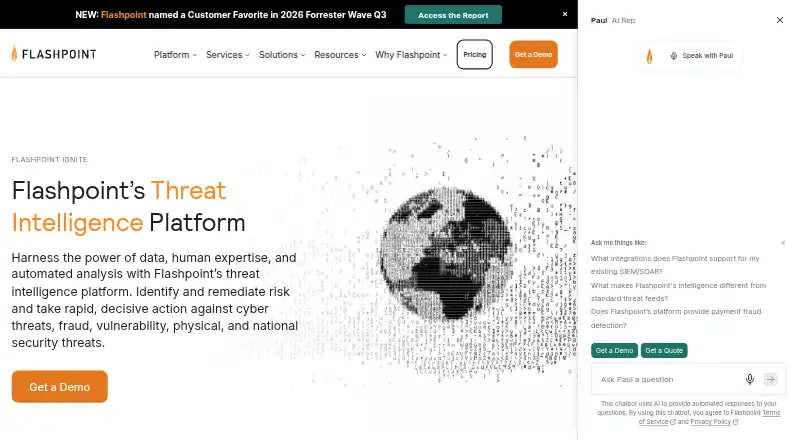
What Flashpoint Ignite is
Flashpoint Ignite is a cloud platform for helping security teams identify and respond to cyber, fraud, vulnerability, physical security, and national security risks. It combines threat data, automated analysis, and human expertise, with intelligence that also covers external attack surfaces. Users can search more than 3.6 petabytes of text and image data and explore results through charts, graphs, and maps. Alerts can be tailored with keywords, filters, collection scope, and user roles. The platform includes analyst-written reports on technical analysis, geopolitical events, and threat actors, as well as AI-generated summaries and research guidance. Its vulnerability intelligence includes more than 100,000 vulnerabilities not found in the CVE database, and Flashpoint says it identifies some vulnerabilities about two weeks before NVD. Ignite integrates with tools including Splunk Phantom, Microsoft Sentinel, Slack, MISP, and STIX/TAXII 2.1. Users can request bespoke analysis from Flashpoint analysts. Pricing is available by request; no numeric price is listed.
Good
- Searches more than 3.6 petabytes of text and image data
- Provides analyst-written reports and AI research guidance
- Offers customizable alerts and dashboards
- Includes case management and workflow automation
- Supports MISP and STIX/TAXII 2.1
Watch out
- Pricing is available only by request
- Cloud deployment only
Who it suits
Ignite suits security teams working across cyber threat intelligence, vulnerability, physical security, national security, or fraud. It may also fit teams that need analyst reports, tailored alerts, and integrations with security tools.
Verdict
Flashpoint Ignite combines broad threat intelligence, search and analysis tools, and analyst support for security teams. Prospective customers need to request pricing rather than compare published plan prices.
Plans and prices
From Flashpoint Ignite's own pricing page, checked 4 Oct 2026.
| Plan | Price | What it gives you |
|---|---|---|
| Flashpoint Ignite | Priced on request | Pricing by request |
The facts
Each one read from Flashpoint Ignite's own pages, with the date it was checked.
What it does
- Accuracy
- Flashpoint says it verifies intelligence findings through multiple sources and expert analysis.checked 3 Oct 2026
- AI
- Integrated AI provides instant summaries and research guidance.checked 3 Oct 2026
- Alerts and reports
- Users can configure alerts based on keywords, filters, collection scope, and user roles, and access finished intelligence reports.checked 4 Oct 2026
- Analyst support
- Users can submit direct requests to Flashpoint analysts for bespoke intelligence and analysis.checked 4 Oct 2026
- API
- Flashpoint says its Technical Indicators API provides MISP endpoints and STIX/TAXII 2.1 endpoints for automated information sharing.checked 3 Oct 2026
- Compliance
- Flashpoint's About page displays GDPR Compliant and SOC2 Compliant badges.checked 3 Oct 2026
- Integrations
- Flashpoint describes API access, pre-built integrations for SIEM, TIP, and SOAR tools, and support for STIX and TAXII data formats.checked 4 Oct 2026
- Intelligence areas
- The platform covers cyber threat, physical security, vulnerability, national security, and fraud intelligence, as well as external attack surface management.checked 4 Oct 2026
- Intended users
- Flashpoint says its customers include businesses and governments, and identifies financial services, technology, public sector, retail, and healthcare among the industries it serves.checked 4 Oct 2026
- Named integrations
- The integrations page lists connections including Anomali ThreatStream, ThreatConnect, ServiceNow, Splunk Phantom, Microsoft Sentinel, Slack, MISP, and STIX/TAXII 2.1.checked 4 Oct 2026
- Pricing
- The pricing page offers a get-pricing form and lists use cases but does not show plan prices.checked 3 Oct 2026
- Product
- Flashpoint Ignite combines threat data, human expertise, and automated analysis to help identify and respond to cyber, fraud, vulnerability, physical, and national security threats.checked 4 Oct 2026
- Purchase details
- The pricing page provides a Get Pricing form and does not display a numeric price.checked 4 Oct 2026
- Purpose
- Flashpoint Ignite combines data, human expertise, and automated analysis to help organizations identify and remediate cyber, fraud, vulnerability, physical security, and national security risks.checked 3 Oct 2026
- Search and analysis
- Ignite supports search across more than 3.6 petabytes of text and image data, interactive dashboards, and AI-generated summaries and research guidance.checked 4 Oct 2026
- Security and compliance
- Flashpoint's About page displays GDPR Compliant and SOC2 Compliant badges.checked 4 Oct 2026
- Security controls
- Flashpoint says Ignite users can tailor dashboards and workspaces to priority intelligence requirements, manage access with granular controls, and set custom alerts.checked 3 Oct 2026
- Support
- Ignite users can submit direct requests to Flashpoint analysts for bespoke intelligence and analysis.checked 3 Oct 2026
- Vulnerability coverage
- Flashpoint says it identifies vulnerabilities about two weeks earlier than NVD and includes more than 100,000 vulnerabilities missed by the CVE database.checked 4 Oct 2026
The company
- Founded
- 2010checked 28 Sep 2026
- Headquarters
- Washington, DC, United Stateschecked 28 Sep 2026
The full review of Flashpoint Ignite
Flashpoint Ignite is a cloud threat-intelligence platform that brings together data, automated analysis, and analyst support for organizational security teams. It suits teams working across cyber, vulnerability, fraud, physical-security, or national-security risks. Its breadth and analyst access are compelling, but custom pricing makes it harder to assess against a fixed budget.
Overview
Ignite combines intelligence feeds and research tools with a route to request bespoke analysis from Flashpoint analysts. Its scope reaches beyond cyber threat intelligence to vulnerability, fraud, physical security, and national security, alongside external attack surface management. That range can help teams investigate overlapping risks in one platform; organizations focused on a narrower use case may not need such breadth.
Flashpoint says it verifies findings through multiple sources and expert analysis. It also displays GDPR and SOC2 compliance badges. Those are relevant signals for organizations assessing intelligence quality and compliance posture, though they do not replace a buyer’s own review of security and procurement requirements.
Key features
Search, analysis, and reporting
Users can search more than 3.6 petabytes of text and image data, then examine results through interactive charts, graphs, and maps. That scale and range of visual analysis suit teams that need to investigate varied material rather than rely on a single indicator feed. Analyst-written reports cover technical analysis, geopolitical events, and threat actors, adding human interpretation to the search experience.
Integrated AI provides instant summaries and research guidance. This can help analysts get oriented in a large body of material, while direct requests to Flashpoint analysts offer a path to bespoke intelligence when automated summaries are not enough.
Alerts and vulnerability intelligence
Alerts can be configured around keywords, filters, collection scope, and user roles. Those controls let teams tune monitoring to their priorities and audiences, rather than send every alert to every user. Flashpoint says its vulnerability intelligence identifies some vulnerabilities about two weeks earlier than NVD and includes more than 100,000 vulnerabilities missed by the CVE database. Teams concerned with early vulnerability awareness may find that coverage valuable, but should weigh it against their own requirements for validation and remediation workflows.
Integrations and controls
Ignite supports indicator enrichment, report management, workflow automation, and case management. Flashpoint lists integrations for SIEM, SOAR, threat-intelligence platforms, analysis tools, Slack, MISP, and STIX/TAXII 2.1, including Anomali ThreatStream, ThreatConnect, ServiceNow, Splunk Phantom, and Microsoft Sentinel. Its Technical Indicators API provides MISP and STIX/TAXII 2.1 endpoints for automated information sharing.
Users can tailor dashboards and workspaces to priority intelligence requirements, manage access with granular controls, and set custom alerts. This combination is useful for teams connecting intelligence work to established operational tools; the practical fit depends on whether their particular systems and processes align with the supported connections.
Pricing
Flashpoint Ignite is paid software with custom pricing. The pricing page offers a get-pricing form and lists use cases, but no numeric price or tier structure is provided. Buyers need to request a quote, so it is not possible to compare plan costs or identify a cheaper tier with reduced capabilities.
The single named plan, Flashpoint Ignite, is priced by request. No seat count, quota, trial length, or renewal term is stated. Teams should clarify those commercial terms along with the scope of analyst support and any deployment requirements during the sales process. With no published entry price, Ignite is a harder fit for buyers who need to screen options against a firm budget before engaging a vendor.
Platforms
Ignite is a cloud product available through web and API platforms. The web experience supports search, analysis, dashboards, and alerts; the API enables automated information sharing through MISP and STIX/TAXII 2.1 endpoints. Teams seeking a self-hosted deployment should consider products that explicitly support it instead.
Who it's for
Ignite is aimed at security teams handling cyber threat intelligence, vulnerability, physical security, national security, or fraud use cases. Its varied intelligence areas, broad search corpus, configurable alerts, reporting, and analyst access favor teams that need both technical data and contextual analysis. Organizations with established SIEM, SOAR, or threat-intelligence workflows may also benefit from its integration options.
It is less compelling for a small team seeking a transparent, low-cost starting point or for buyers who require a self-hosted platform. Custom pricing and the absence of public seat or quota terms mean budget-sensitive teams cannot judge the full commitment in advance.
Pros and cons
- Pros: Intelligence spans cyber, vulnerability, fraud, physical security, national security, and external attack surface management, which suits teams facing risks across multiple domains.
- Pros: Search across more than 3.6 petabytes of text and image data, with charts, graphs, and maps, supports broad investigations and analysis.
- Pros: Analyst-written reports and direct requests for bespoke analysis pair automated capabilities with human expertise.
- Pros: MISP and STIX/TAXII 2.1 API support, alongside SIEM, SOAR, and named integrations, helps connect intelligence to operational workflows.
- Cons: Custom pricing and no public plan structure make cost and tier comparisons difficult before contacting sales.
- Cons: No public seat, quota, trial, or renewal terms make it harder to estimate the commitment for a team.
- Cons: Cloud deployment may rule it out for organizations that require self-hosted software.
Alternatives
For a wider comparison, see Threat Intelligence Platforms.
Anomali Platform is another paid web and API option, with pricing by contact rather than a published price. EclecticIQ Platform may suit buyers seeking a choice of cloud or self-hosted deployment; it is paid and has no free plan. Its listed Foundation and Enterprise plans have custom pricing.
SOCRadar Extended Threat Intelligence Platform is worth considering when a free plan or trial and published monthly prices are priorities. Its listed Essential plan costs $600 a month for one domain and one seat, while its Business plan costs $1,145 a month. Cyware Intelligence Exchange is another paid option.
ThreatQ is a paid web option. Security Vision TIP may suit buyers looking for Linux, Windows, or self-hosted platform support in addition to web and API access; pricing is individually calculated through sales. OODA Intelligence is another paid web option. Intel 471 Verity471 is a paid web and API option with pricing and product information available through sales.
Verdict
Flashpoint Ignite is a strong candidate for security teams that need intelligence across several risk domains, extensive search and analysis, and access to analyst support. Its broad coverage, workflow connections, and mix of automated and human analysis are the main reasons to choose it. Look elsewhere if you need published prices, clear public seat or usage limits, or self-hosted deployment.
Alternatives to Flashpoint Ignite
- 1

MISP
Free planOpen sourceWebAPILinuxSelf-hosted7.9From €7.31 a year - 2
Pulse Intelligence
Free planWebAPILinuxmacOS6.8Free plan - 3
Google Cloud Secret Manager
Free planWeb6.5From $0.02 a month - 4
Kaspersky Threat Intelligence Portal
Free planWebAPI6.5Free plan - 56.5From $4,550 a year
- 6
IBM X-Force Exchange
Free planWebAPI6.3Free plan