
FieldOpt
FieldOpt is an open-source field service management console for dispatching jobs, routing work, and managing technicians.
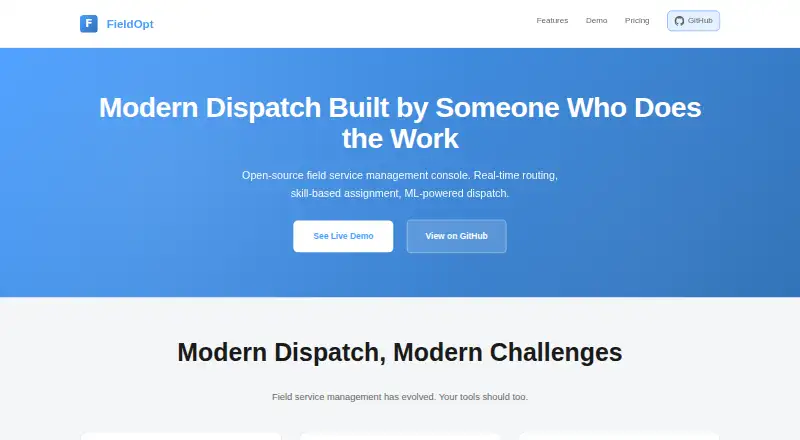
What FieldOpt is
FieldOpt is an open-source field service management console for dispatching jobs, routing work, and managing technicians. Dispatchers can assign jobs by drag-and-drop or in batches, while the console shows technician workload, capacity, and daily timelines. Skill-based routing matches jobs with qualified technicians; map and search views provide job locations and allow filtering by skill, location, availability, and capacity.
Its auto-router evaluates skills, geographic management areas, shift time, capacity, distance, and job priority. Capacity management tracks workload to prevent overbooking. FieldOpt says it can learn from dispatch history to build a machine-learning model using a company's data. The API includes endpoints for technicians, jobs, assignments, and automatic routing. The software is available as a web console, API, or self-hosted deployment. Community is free, self-hosted, and licensed under AGPL-3.0, with GitHub community support, for up to 25 technicians. Starter costs $99 a month and Pro costs $399 a month; Enterprise pricing is custom.
Good
- Drag-and-drop and batch job assignment
- Routing evaluates skills, shifts, distance, and priority
- Map and filters show job and technician context
- API covers jobs, technicians, assignments, and routing
- Free Community plan supports up to 25 technicians
Watch out
- Community requires self-hosting
- Starter is $99 a month
- Pro is $399 a month
Who it suits
FieldOpt suits service teams that need to assign jobs and manage technician capacity, whether through a web console, API, or self-hosted deployment. Community is for teams with up to 25 technicians; larger plans support more technicians.
Verdict
FieldOpt combines dispatch workflows with technician capacity tracking and routing criteria. The free Community plan requires self-hosting, while managed cloud plans start at $99 a month.
Plans and prices
From FieldOpt's own pricing page, checked 15 Oct 2026.
| Plan | Price | What it gives you |
|---|---|---|
| Community | Free | Up to 25 technicians · self-hosted · full features · AGPL-3.0 licensed · GitHub community · Free |
| Starter | $99 a month | Up to 50 technicians · managed cloud hosting · priority email support · custom branding · API access · $99/month |
| Pro | $399 a month | Up to 200 technicians · everything in Starter · ML autodrip dispatch · custom integrations · dedicated support · $399/month |
| Enterprise | Priced on request | Unlimited technicians · everything in Pro · on-premise deployment · custom development · SLA guarantees · Custom |
The facts
Each one read from FieldOpt's own pages, with the date it was checked.
What it does
- API
- The repository lists API endpoints for technicians, jobs, assignments, and automatic routing.checked 4 Oct 2026
- API examples
- Documented RPCs include tech_list, job_table, map_markers, qualified_techs, assign, job_action and auto_route.checked 15 Oct 2026
- Architecture
- PostgreSQL stores routing, simulation and screen-rendering logic; PostgREST exposes functions over HTTP and nginx serves static files.checked 15 Oct 2026
- Assignment
- Dispatchers can assign jobs to technicians using drag-and-drop and batch operations.checked 4 Oct 2026
- Automatic routing
- The auto-router assigns pending jobs to the closest technician who meets the qualification checks.checked 15 Oct 2026
- Auto-router
- The repository describes an auto-router that assigns jobs to qualified technicians and capacity management that tracks workload to prevent overbooking.checked 4 Oct 2026
- Capacity management
- The system tracks technician workload to avoid overbooking.checked 15 Oct 2026
- Changelog event
- Version 0.0.9 moved the runtime from a FastAPI/Python application to PostgreSQL functions exposed through PostgREST with nginx and pg_cron.checked 15 Oct 2026
- Changelog limitation
- The changelog says the previous WebSocket event stream was removed and the console now polls fragments every three seconds.checked 15 Oct 2026
- Deployment
- The site lists self-hosting for Community and on-premise deployment for Enterprise.checked 4 Oct 2026
- Dispatch learning
- The site says FieldOpt learns from dispatch history to create a machine-learning model trained on a company's data.checked 4 Oct 2026
- Documentation depth
- The repository README documents architecture, installation, routing logic, keyboard shortcuts, RPC endpoints and simulation functions.checked 15 Oct 2026
- Drag-and-drop dispatch
- Dispatchers can drag jobs onto technicians and perform multi-select batch assignments.checked 15 Oct 2026
- Geographic routing
- Jobs carry route criteria and technicians are assigned management areas so dispatch can enforce geographic compatibility.checked 15 Oct 2026
- Keyboard controls
- Keyboard shortcuts include D, S, C, H and U for job actions plus slash, F and P for search, filters and personnel.checked 15 Oct 2026
- License
- The Community offering and repository are licensed under GNU AGPL-3.0.checked 15 Oct 2026
- Limit: integrations
- The opened product pages name custom integrations as a Pro feature but do not identify any ready-made third-party connectors.checked 15 Oct 2026
- Maps and search
- An interactive map shows job locations and routing context, and search can filter by skill, location, availability, and capacity.checked 4 Oct 2026
- Map view
- A detachable map window displays jobs, technicians and technician routes for a second monitor.checked 15 Oct 2026
- Offline demo
- Release assets include a browser demo bundle that runs the same SQL through PGlite, a WebAssembly PostgreSQL implementation.checked 15 Oct 2026
- Priority routing
- Pending jobs are processed in priority order after skill, area, shift-time and distance checks.checked 15 Oct 2026
The company
- Limit: company disclosure
- The site identifies the maker only as a Systems Architecture Engineering project and gives no headquarters or founding year.checked 15 Oct 2026
Where it runs
- Limit: mobile apps
- The opened pages describe responsive phone browser behavior but do not provide native iOS or Android applications.checked 15 Oct 2026
- Mobile browser
- The web console switches to tabs, cards and bottom-sheet menus below tablet width and is stated to work on phones.checked 15 Oct 2026
The full review of FieldOpt
FieldOpt is an open-source console for coordinating field-service jobs, technician capacity, and routing rules. It is most compelling for teams that need skills-aware dispatch, an API, and control over deployment. The central decision is whether a 25-technician self-hosted allowance is sufficient or whether managed hosting and higher limits justify a monthly fee.
Overview
FieldOpt puts assignment, workload visibility, routing, and operational APIs in one dispatch workspace. Dispatchers can move individual jobs by drag-and-drop or process groups with batch operations. A daily timeline shows how each technician’s existing workload and capacity affect a proposed assignment, making it easier to spot an overloaded schedule before adding work.
The product is open source, with the Community edition under AGPL-3.0. That makes it a practical option for organizations able to operate their own service, while teams that want a vendor-managed environment must move to a paid plan. The API covers technicians, jobs, assignments, and automatic routing, so it can serve as a dispatch layer inside a broader system rather than a standalone interface only.
Key features
Dispatch and capacity control
Workload, capacity, and timeline views give dispatchers context instead of treating every technician as equally available. The auto-router assigns jobs to qualified technicians and tracks workload to reduce overbooking. These controls are valuable when jobs compete for limited people and time, but their usefulness depends on maintaining accurate technician skills, shifts, capacities, and job records.
Routing and search
Skill-based routing matches jobs to technicians with the required abilities. Routing criteria include geographic management areas, shift time, capacity, distance, and job priority, allowing organizations to express operational constraints beyond simple proximity. Interactive maps provide location and route context, while search can filter by skill, location, availability, and capacity. This is a stronger fit for structured service territories than for teams that only need a basic map or manual list.
Learning and integration
FieldOpt says it can learn from dispatch history by training a machine-learning model on a company’s data. The Pro plan adds ML autodrip dispatch, while the repository describes automatic routing and capacity management. Treat this as an advanced option for organizations with enough historical dispatch data to support that approach, not as a replacement for sound routing rules. API endpoints for technicians, jobs, assignments, and automatic routing support custom workflows and integrations.
Pricing
| Plan | Price and limits | Best fit |
|---|---|---|
| Community | free; up to 25 technicians; self-hosted; full features; AGPL-3.0; GitHub community support | Teams able to run their own infrastructure and stay within 25 technicians. |
| Starter | $99 a month; up to 50 technicians; managed cloud hosting; priority email support; custom branding; API access | Growing teams that want hosted operations without building their own deployment. |
| Pro | $399 a month; up to 200 technicians; everything in Starter; ML autodrip dispatch; custom integrations; dedicated support | Larger operations that need advanced dispatch automation and integration help. |
| Enterprise | Custom pricing; unlimited technicians; everything in Pro; on-premise deployment; custom development; SLA guarantees | Organizations requiring unlimited scale, on-premise control, or contractual service commitments. |
Community supplies the broadest feature set at no license cost, but self-hosting and the 25-technician ceiling shift infrastructure work to the customer. Starter removes that hosting burden and raises the limit to 50, while Pro costs substantially more for a 200-technician ceiling, ML autodrip dispatch, custom integrations, and dedicated support. Enterprise is the route for unlimited technicians and on-premise requirements, with pricing negotiated rather than published.
Platforms
FieldOpt is offered through a web interface and API, with self-hosted deployment for Community. Enterprise supports on-premise deployment. Starter and Pro provide managed cloud hosting, making them the practical choices for teams that do not want to operate the service themselves.
Who it's for
FieldOpt suits field-service organizations dispatching work across technicians with differing skills, territories, shifts, and capacity. It is particularly appropriate for technical teams that value an API, open-source licensing, or deployment control. Community fits smaller groups with infrastructure expertise; Starter fits teams wanting hosted simplicity; Pro and Enterprise address larger or more integration-heavy operations. It is less suitable when a team cannot self-host and needs more than 50 technicians without committing to Pro, or when its dispatch process does not require structured routing criteria.
Pros and cons
- Pros: Full-featured Community plan avoids license fees; drag-and-drop and batch assignment support both individual and bulk dispatch; routing considers skills, territories, shifts, capacity, distance, and priority; API endpoints cover core dispatch entities; deployment ranges from self-hosted to managed cloud and on-premise.
- Cons: Community is capped at 25 technicians and requires self-hosting; Starter is capped at 50 technicians; ML autodrip dispatch is reserved for the $399 a month Pro plan; Community support is GitHub-based rather than priority or dedicated; Enterprise requires custom pricing.
Alternatives
For a broader category comparison, see Dispatch Software and Route Optimization Software.
- Resgrid is a freemium, multi-platform option with a free plan for up to 10 entities and push notifications and email, but no SMS.
- Onro is worth considering when a customizable demo provides all features, unlimited orders, users, and drivers without a credit card.
- Fieldified is a fit when scheduling, invoicing, CRM, and reporting are priorities, with a free tier subject to usage limits and a $49 a month Basic plan for five users.
- Super Dispatch offers a free Carrier TMS Lite tier with a driver app and limited dashboard, but without advanced reporting or automated invoicing.
- Shipday suits delivery teams needing a free-forever tier capped at 300 orders per month and 10 driver accounts, plus a 14-day full-platform trial.
- ServicePower is an alternative for workforce scheduling, mobile access, customer self-service, work orders, analytics, and Vision AI.
- DispatchTrack is a paid alternative available on Android, iOS, and the web.
- Haul-IT is a paid option for Android, iOS, and Windows, with pricing handled through a demo.
Verdict
Choose FieldOpt if your service operation needs capacity-aware, skills-based dispatch and you value an API or deployment flexibility. Community is an unusually capable starting point for a team that can self-host, while Starter buys managed hosting and Pro adds ML dispatch and custom integration support. Look elsewhere if self-hosting is unacceptable, your technician count quickly exceeds the lower tiers, or you need a simpler delivery-focused product without FieldOpt’s routing and operational complexity.
Alternatives to FieldOpt
- 1

Resgrid
Free planOpen sourceAndroidiOSWebAPI8.6From $95 a month - 2

Fieldified
Free planAndroidiOSWebAPI8.2From $49 a month - 3
Super Dispatch
Free planAndroidiOSWebAPI8.1From $55 a month - 4
Onro
Free planAndroidiOSWebAPI8.0From $239 a month - 5
TruckingOffice
AndroidiOSWebAPI7.8From $240 a year - 6

Odyssee Field Service
AndroidiOSWebAPI7.7From €22 a month