Fastly Image Optimizer
Fastly Image Optimizer automates image processing and delivery for image-heavy sites and apps.
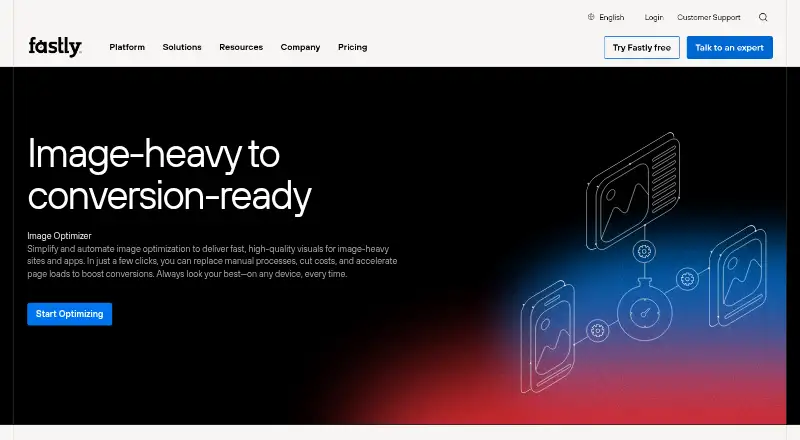
What Fastly Image Optimizer is
Fastly Image Optimizer automates image processing and delivery for image-heavy sites and apps. It transforms images at the edge in response to request parameters, with options to resize, crop or trim, adjust quality and orientation, and convert formats. That lets teams request needed variants without pre-generating and storing each one. The service caches optimized images for reuse and supports WebP, AVIF, JPEG, and PNG. Developers set resizing, quality, format, and cropping through query parameters and configuration, and can keep their current image sources while integrating with existing asset pipelines and CMS platforms. Image Optimizer can be enabled in the Fastly control panel or by API; Compute SDK access is available through a beta program. A free plan covers 100,000 image requests per month. Every request sent to the service, including through the SDK, counts as billable.
Good
- Transforms images on demand at the edge.
- Caches optimized images for reuse.
- Supports WebP, AVIF, JPEG, and PNG.
- Works with existing asset pipelines and CMS platforms.
Watch out
- Every request sent counts as billable.
- Compute SDK access is through a beta program.
- Pricing beyond the free plan is listed by request volume.
Who it suits
It suits teams running image-heavy media sites, ecommerce platforms, or SaaS applications that need on-demand image transformations. Developers can control processing through query parameters and configuration.
Verdict
Fastly Image Optimizer combines configurable, on-demand image transformations with caching and support for four image formats. Check the request-volume pricing and billing rule against your expected usage.
Plans and prices
From Fastly Image Optimizer's own pricing page, checked 1 Oct 2026.
| Plan | Price | What it gives you |
|---|---|---|
| Image Optimizer — 0–100,000 image requests | Free | 100,000 image requests per month |
| Image Optimizer — Beyond 5 Billion image requests | $0.01 a month | Beyond 5 Billion image requests per month · per 10,000 Image Requests |
| Image Optimizer — 1 Billion–5 Billion image requests | $0.02 a month | 1 Billion–5 Billion image requests per month · per 10,000 Image Requests |
| Image Optimizer — 500 Million–1 Billion image requests | $0.02 a month | 500 Million–1 Billion image requests per month · per 10,000 Image Requests |
| Image Optimizer — 150 Million–500 Million image requests | $0.03 a month | 150 Million–500 Million image requests per month · per 10,000 Image Requests |
| Image Optimizer — 50 Million–150 Million image requests | $0.07 a month | 50 Million–150 Million image requests per month · per 10,000 Image Requests |
| Image Optimizer — 10 Million–50 Million image requests | $0.15 a month | 10 Million–50 Million image requests per month · per 10,000 Image Requests |
| Image Optimizer — 100,000–10 Million image requests | $0.50 a month | 100,000–10 Million image requests per month · per 10,000 Image Requests |
The facts
Each one read from Fastly Image Optimizer's own pages, with the date it was checked.
What it does
- API and Compute
- Image Optimizer can be enabled in the Fastly control panel or through the API, and Compute SDK access is available through a beta program.checked 1 Oct 2026
- Caching
- Optimized images are cached and reused so subsequent requests are served with minimal latency.checked 1 Oct 2026
- Default settings
- Fastly provides configurable defaults for WebP and JPEG quality, resizing filters, upscaling, animated GIF to video, and processed file types.checked 1 Oct 2026
- Developer controls
- Developers control resizing, quality, format, and cropping through query parameters and configuration.checked 1 Oct 2026
- Dynamic processing
- Images are transformed in real time from request parameters, eliminating the need to pre-generate and store multiple image variants.checked 1 Oct 2026
- Edge transformations
- It resizes, adjusts quality, crops or trims, changes orientation, converts formats, caches, and delivers images on demand at the edge.checked 1 Oct 2026
- Formats
- Fastly Image Optimizer supports WebP, AVIF, JPEG, and PNG formats.checked 1 Oct 2026
- Purpose
- Fastly Image Optimizer automates image optimization for image-heavy sites and apps.checked 1 Oct 2026
- Security and compliance
- Fastly states that it is ISO/IEC 27001:2022 certified, audited against SOC 2 Type 2, audited against key GDPR requirements, PCI DSS Level 1 compliant, and audited against relevant HIPAA sections.checked 1 Oct 2026
- Target customers
- Fastly says its global edge network is designed for high-throughput image delivery for media sites, ecommerce platforms, and SaaS applications.checked 1 Oct 2026
- Workflow integration
- The product integrates with existing asset pipelines and CMS platforms while teams continue using their current image sources.checked 1 Oct 2026
Money
- Billing limit
- Any request sent to Image Optimizer, including through the SDK, counts as a billable image request.checked 1 Oct 2026
The company
- Founded
- 2011checked 28 Sep 2026
- Headquarters
- San Francisco, CAchecked 28 Sep 2026
The full review of Fastly Image Optimizer
Overview
Fastly Image Optimizer is a cloud service for transforming and delivering images through Fastly’s edge network. It best suits teams running image-heavy sites or apps that need on-demand variants without maintaining a separate stored copy for every size or format.
Its strongest case is configurable processing paired with cached delivery; the trade-off is a request-based meter that makes traffic volume central to the cost decision.
Key features
Image Optimizer can resize, crop or trim, adjust quality, change orientation and convert images when a request arrives. Developers set those choices through query parameters and configuration, rather than creating each variant in advance. That can simplify variant management for teams with many placements, while leaving teams that need fixed, pre-generated assets with less reason to add a request-time processing layer.
Processed images are cached and reused, so later requests can be served with minimal latency. Supported formats are WebP, AVIF, JPEG and PNG. Configurable defaults cover WebP and JPEG quality, resizing filters, upscaling, animated GIF-to-video handling and which file types are processed, giving teams control over common behaviors without making every choice ad hoc.
The service works with existing asset pipelines and CMS platforms, so teams can keep their current image sources. It can be enabled in the Fastly control panel or through the API; Compute SDK access is available through a beta program. Every request sent to Image Optimizer, including one through the SDK, counts as a billable image request, so using a different integration path does not avoid the usage meter.
Fastly says its global edge network is designed for high-throughput image delivery to media sites, ecommerce platforms and SaaS applications. Its stated security and compliance credentials include ISO/IEC 27001:2022 certification, SOC 2 Type 2 audit, audits against key GDPR requirements and relevant HIPAA sections, and PCI DSS Level 1 compliance. Fastly was founded in 2011 and is headquartered in San Francisco.
Pricing
There is a free allowance of 100,000 image requests per month at no cost. It gives smaller projects a way to use the service without an initial paid request tier, but the allowance is a monthly request cap, not an unlimited free plan.
Above that, the listed usage rates are billed per 10,000 Image Requests per month: 0.50 USD for 100,000–10 Million image requests; 0.15 USD for 10 Million–50 Million; 0.07 USD for 50 Million–150 Million; 0.03 USD for 150 Million–500 Million; 0.02 USD for 500 Million–1 Billion; 0.02 USD for 1 Billion–5 Billion; and 0.01 USD for Beyond 5 Billion image requests. These are most relevant to teams able to estimate monthly image-request volume: the per-unit rate falls at larger tiers, while the total bill still depends on the number of billable requests. The listed paid-from amount is 1500 /mo, so buyers should reconcile that figure with the request-volume tiers before budgeting. Pricing is also described as on request.
Platforms
Fastly Image Optimizer supports API, Linux and web environments. It is deployed in the cloud. Teams can deploy through the Fastly CLI, control panel, GitHub Actions, Terraform or APIs; API access is supported. The broader runtime offering names Rust, JavaScript, Go, C++, Python and other WASI-supporting languages, though Compute SDK access for Image Optimizer is in beta.
Who it's for
This is a strong fit for media publishers, ecommerce platforms and SaaS teams serving many image variants, particularly when they want to keep existing sources and let request parameters control output. Caching helps when optimized versions are requested repeatedly. It is less compelling for low-volume projects that do not need dynamic variants or for teams that need predictable costs without tracking request counts.
Pros and cons
- Pro: Request-time resizing, cropping, quality changes and format conversion avoid maintaining a separate pre-generated variant for each use.
- Pro: Cached optimized images are reused, supporting low-latency delivery on repeat requests.
- Pro: Existing asset pipelines and CMS platforms can remain in place, with control through query parameters, configuration or the API.
- Con: Every request, including SDK requests, is billable, so broad use can increase costs with traffic.
- Con: The free allowance stops at 100,000 image requests per month, and the stated paid-from amount of 1500 /mo warrants careful budgeting against the usage tiers.
- Con: Compute SDK access is still in beta, which may not suit teams seeking a fully established SDK workflow.
Alternatives
For teams whose priority is image compression software rather than edge delivery and request-time transformations, compare options in the Image Compression Software category. For broader delivery infrastructure, the CDN Software category is a more relevant starting point.
BunkerWeb is worth considering when a free, self-hosted option is preferable: its open-source plan is free under an AGPLv3 license. Wallarm API Security may fit teams looking for API security with a free tier, which allows up to 500,000 requests per month and three users per company, but excludes vulnerability assessment and API Abuse Prevention. Gcore WAAP offers a free tier for one domain and 0.5M requests, plus a Start plan at €25 a month for five domains and 1M requests; choose it when those stated domain and request allowances suit the need. Cloudflare WAF is a more relevant comparison for teams shopping for a WAF: its free tier includes one rate-limiting rule, while its Pro plan is $20 a month, billed annually. F5 BIG-IP APM is another alternative to compare for access management. Oracle Cloud Infrastructure Secret Management, BitNinja and OWASP Coraza WAF are additional options to assess for other infrastructure or security needs.
Verdict
Choose Fastly Image Optimizer if your site or app serves many image variants and you want configurable edge transformations with cached reuse, while keeping your existing asset pipeline. Its key drawback is the billable-request model: the free monthly cap is limited, and higher traffic demands close attention to tier pricing and the stated paid-from amount.
Getting started
- Open Fastly Image Optimizer on the Fastly website.
- Enable Image Optimizer in the Fastly control panel or through the API.
- Set resizing, quality, format, and cropping options with query parameters and configuration.
- Use the Compute SDK through its beta program if needed.
Limits worth knowing
The free plan covers 100,000 image requests per month. Every request sent to Image Optimizer, including through the SDK, counts as billable; paid rates vary by monthly request volume.
Questions
Is Fastly Image Optimizer free?
Yes. Its free plan includes 100,000 image requests per month.
How is paid usage priced?
Paid rates are listed per 10,000 image requests and depend on monthly volume.
Which image formats does it support?
It supports WebP, AVIF, JPEG, and PNG.
How can I enable it?
Enable it in the Fastly control panel or through the API. Compute SDK access is available through a beta program.
Which platforms are listed?
The listed platforms are API, Linux, and web.
Does every request count toward billing?
Yes. Any request sent to Image Optimizer, including through the SDK, counts as a billable image request.
Alternatives to Fastly Image Optimizer
- 1
imgproxy
Free planOpen sourceAndroidiOSWebAPI9.3Free plan - 2
Hive
Free planOpen sourceAndroidiOSWebAPI8.6From $5 a month - 3

Kraken.io
Free planWebAPIExtensionLinux8.4From $50 a year - 4
JPEGmini
Free planWebAPILinuxmacOS8.3From $199 a year - 5
Optimizilla
Free planWeb7.9From $9 a month - 6
Compressify
Free planAndroidiOSWebExtension7.9From $4.99 a month