
Eventvisor
Eventvisor is an open-source, vendor-agnostic system for governing and routing application logs and analytics events through remote configuration.
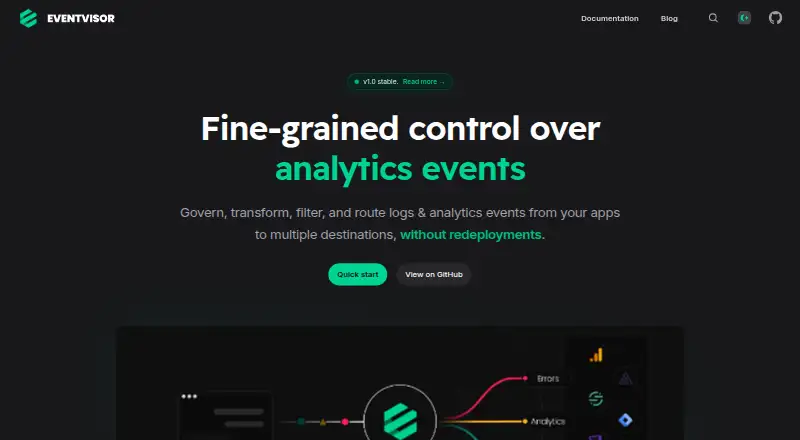
What Eventvisor is
Eventvisor is an open-source, vendor-agnostic system for governing and routing application logs and analytics events through remote configuration. Teams define structured events and attributes in a project, providing a shared reference for event data. Rules can validate payloads, filter which events reach each destination, transform data before transport, and send a selected percentage through sampling. Runtime warnings flag incorrect event data, and definitions can be tested before deployment. The current JavaScript SDK supports browser and Node.js applications. Listed integrations include Amplitude, Datadog, Google Analytics 4, Google Tag Manager, Mixpanel, New Relic, Segment, and Sentry; teams can also use their own backend or create transport modules. The recommended workflow updates a project through pull requests, then builds and uploads static JSON datafiles through CI/CD. Files can be hosted on a user-managed server or CDN, or deployed with application code, so configuration can be updated separately from the application. The CLI requires Node.js v20 or later, though the SDKs do not require Node.js. Additional SDKs are planned.
Good
- Open source and vendor agnostic.
- Rules can filter, transform, and sample events.
- Runtime warnings flag incorrect event data.
- Supports browser and Node.js through its current SDK.
- Datafiles can be served from a server or CDN.
Watch out
- The CLI requires Node.js v20 or later.
- Current SDK support is JavaScript for browser and Node.js.
- More SDKs are planned.
Who it suits
Eventvisor is especially suited to medium and large product engineering organisations that need shared event definitions and controlled routing. It also fits teams prepared to manage a project repository and deployment workflow.
Verdict
Eventvisor gives engineering teams control over event definitions, validation, and destination routing without requiring application redeployments for configuration changes. Its current SDK coverage and CLI requirement are important considerations for teams evaluating fit.
The facts
Each one read from Eventvisor's own pages, with the date it was checked.
What it does
- Bundle size
- The homepage advertises an approximate bundle size of 8 kB.checked 7 Oct 2026
- Conditional routing
- Destination conditions can filter which tracked events are sent to each destination.checked 7 Oct 2026
- Custom destinations
- Destinations can include a user's own custom backend service, and users can create their own transports as modules.checked 7 Oct 2026
- Deployment
- Generated static JSON datafiles can be served from a user's own server, a CDN, or deployed with application code.checked 7 Oct 2026
- Environments and deployment
- Eventvisor generates static JSON datafiles that teams can serve from their own server or a CDN, allowing configuration deployment separately from application code.checked 7 Oct 2026
- Event definitions
- Teams define structured events and attributes in a project, with event payloads validated against schemas.checked 7 Oct 2026
- Event management
- Teams can define events and attributes in one project as a shared source of truth.checked 7 Oct 2026
- Integrations
- The documentation lists Amplitude, Datadog, Google Analytics 4, Google Tag Manager, Mixpanel, New Relic, Segment, and Sentry as third-party integrations.checked 7 Oct 2026
- Intended users
- The repository describes Eventvisor as especially useful for medium to large product engineering organizations.checked 7 Oct 2026
- Open source
- The project repository identifies Eventvisor as MIT licensed.checked 7 Oct 2026
- Payload transforms
- Destination transforms can manipulate event payloads before they are transported.checked 7 Oct 2026
- Project setup
- The CLI requires Node.js v20 or later, while the SDKs are described as platform agnostic.checked 7 Oct 2026
- Purpose
- Eventvisor governs, transforms, filters, and routes application logs and analytics events to multiple destinations through remote configuration, without redeployments.checked 7 Oct 2026
- Requirements
- The quick start requires Node.js v20 or later for the CLI; it says Node.js is not required by the SDKs themselves.checked 7 Oct 2026
- Routing and transforms
- Event definitions can conditionally route events to destinations and transform payloads before transport.checked 7 Oct 2026
- Sampling
- Sampling rules can send a selected percentage of tracked events to a destination.checked 7 Oct 2026
- SDK support
- The quick start says the current SDK supports browser and Node.js applications, with more SDKs planned.checked 7 Oct 2026
- Security
- The project repository links to a security policy.checked 7 Oct 2026
- Support and contributions
- The project uses GitHub Issues to track bugs and feature requests and accepts pull requests targeting its main branch.checked 7 Oct 2026
- Supported runtimes
- The SDK documentation lists JavaScript for browser and Node.js runtimes, and says more SDKs are planned.checked 7 Oct 2026
- Validation and testing
- Eventvisor provides runtime validation warnings for incorrect event data and supports testing definitions before deployment.checked 7 Oct 2026
- Workflow
- The recommended workflow uses pull requests to update a project repository, then builds and uploads datafiles through CI/CD.checked 7 Oct 2026
The company
- Maker
- The homepage credits Fahad Heylaal as the builder.checked 7 Oct 2026
Alternatives to Eventvisor
- 1

RudderStack Customer Data Platform
Free planOpen sourceAndroidiOSWebAPI8.5From $265 a month - 2

Jitsu
Free planOpen sourceAndroidiOSWebAPI8.4From $99 a month - 3

Hightouch
Free planAndroidiOSWebAPI8.2From $350 a month - 4

Stape
Free planAndroidiOSWebAPI8.0From $17 a month - 5

CustomerLabs CDP
AndroidiOSWebAPI6.9From $129 a month - 6
Keen Product Analytics
AndroidiOSWebAPI6.9From $149 a month