Errbit
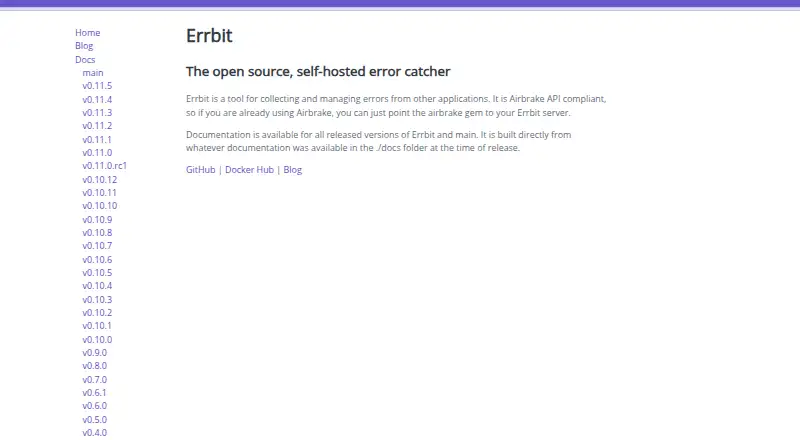
Errbit is an open-source, self-hosted service for collecting and managing errors from other applications.
What Errbit is
Errbit is an open-source, self-hosted service for collecting and managing errors from other applications. Its Airbrake API compatibility allows Airbrake clients to send reports to an Errbit server. Incoming notices are grouped by a configurable fingerprint that, by default, uses the error class, message, complete backtrace, component, action, and environment. When reports include user information, Errbit can display details about the affected person. JavaScript errors can be reported through the airbrake-js library, and the product includes frontend monitoring and release tracking. The only officially supported issue-tracker plugin is for GitHub. Optional authentication configuration covers GitHub, Google, and LDAP. Current installation requirements list Ruby 4.0 and MongoDB 7.0 or newer. Deployment documentation officially supports Heroku, with additional notes for Docker and Dokku and experimental guidance for Kubernetes. HTTPS can be provided through a reverse proxy or configured directly in Puma. Errbit is released under the MIT License. The documentation says it is intended for people experienced in deploying and maintaining Rails applications and directs support questions to Stack Overflow using the errbit tag.
Good
- Open-source MIT-licensed software
- Airbrake API compatibility
- Configurable notice grouping
- Frontend monitoring and release tracking
- Self-hosted data control
Watch out
- Requires Ruby 4.0 and MongoDB 7.0+
- Deployment expertise is expected
- Only GitHub issue tracking officially supported
- Kubernetes support is experimental
Who it suits
Errbit suits operators who can deploy and maintain Rails applications and want to host application error data themselves. It also fits teams sending reports through Airbrake-compatible clients.
Verdict
Errbit combines Airbrake-compatible intake with self-hosted error management, grouping, authentication options, and JavaScript reporting. Its infrastructure requirements and Rails deployment expectations make operator experience an important consideration.
The facts
Each one read from Errbit's own pages, with the date it was checked.
What it does
- Airbrake compatibility
- Errbit is Airbrake API compliant, so an application using the Airbrake gem can send errors to an Errbit server.checked 10 Oct 2026
- API compatibility
- Errbit is Airbrake API compliant, so Airbrake clients can send reports to an Errbit server.checked 4 Oct 2026
- Authentication
- The documentation describes GitHub, Google, and LDAP authentication configuration.checked 10 Oct 2026
- Deployment expertise
- Errbit's documentation says the app is intended for people experienced in deploying and maintaining Rails applications.checked 10 Oct 2026
- Deployment requirements
- The current installation documentation lists Ruby 4.0 and MongoDB 7.0 or newer as requirements.checked 10 Oct 2026
- Deployment support
- The deployment notes say official support is limited to Heroku, with Docker, Dokku, and experimental Kubernetes deployment notes also available.checked 4 Oct 2026
- Error grouping
- By default, Errbit groups notices using error class, message, full backtrace, component, action, and environment.checked 4 Oct 2026
- Error views
- The documentation lists apps, errors, error summaries, and error backtraces as Errbit views.checked 10 Oct 2026
- Hosting
- Errbit is an open-source error catcher that you host yourself.checked 4 Oct 2026
- Integrations
- Errbit can be extended with Ruby gems and plugins, and its documentation identifies errbit_github_plugin as the only officially supported issue tracker plugin.checked 10 Oct 2026
- Intended operator
- The documentation says Errbit is intended for people experienced in deploying and maintaining Rails applications.checked 4 Oct 2026
- Issue tracker
- The only officially supported issue tracker plugin is the GitHub plugin.checked 4 Oct 2026
- JavaScript reporting
- JavaScript errors can be logged using the airbrake-js library configured with the Errbit project and host.checked 10 Oct 2026
- License
- Errbit is available under the MIT License.checked 10 Oct 2026
- Maintainer
- A June 2026 release announcement identifies Igor (Ihor) Zubkov as Errbit's new maintainer.checked 10 Oct 2026
- Notice grouping
- Errbit groups notices by a configurable fingerprint that by default uses error class, message, complete backtrace, component, action, and environment name.checked 10 Oct 2026
- Purpose
- Errbit is an open source, self-hosted tool for collecting and managing errors from other applications.checked 10 Oct 2026
- Requirements
- The listed installation requirements are Ruby 4.0 and MongoDB 7.0 or later.checked 4 Oct 2026
- Security and data control
- Errbit is self-hosted, and its older documentation describes it as a fit for users who do not want exception data stored on someone else's server.checked 10 Oct 2026
- Security configuration
- The deployment notes describe serving HTTPS through a reverse proxy or configuring Puma to serve HTTPS directly.checked 4 Oct 2026
- Support
- Errbit's documentation directs users who need help to Stack Overflow with the errbit tag and links to a Google Group for updates and notifications.checked 10 Oct 2026
- User details
- Errbit can display information about the user associated with an error report when that information is received.checked 10 Oct 2026
Alternatives to Errbit
- 1

BugSplat
Free planAndroidiOSWebAPI8.1From $37 a month - 2

Embrace
Free planAndroidiOSWebAPI8.1$0.80 usage-based - 3

BugSnag
Free planAndroidiOSWebAPI7.8Free plan - 4

Backtrace
Free planAndroidiOSWebLinux7.7From $600 a year - 5

Airbrake
Free planAndroidiOSWebAPI7.6From $17 a month - 6

Better Stack
Free planAndroidiOSWebAPI7.6From $29 a month