EPFL Physics Simulations
The facts below are what the maker publishes about EPFL Physics Simulations, checked and dated. Our editors have not written about it yet.
The facts
Each one read from EPFL Physics Simulations's own pages, with the date it was checked.
What it does
- Activities
- The activities are goal-oriented tasks intended to test knowledge and develop deeper understanding.checked 11 Oct 2026
- Assessment tools
- Nochecked 20 Sep 2026
- Authoring tools
- Nochecked 20 Sep 2026
- Code license
- The site says the code carries an Academic Non-Commercial Software License.checked 11 Oct 2026
- Delivery mode
- webchecked 20 Sep 2026
- Developers
- The site names Dr Austin Peel for development, concept, and design, and Dr Sylvain Bréchet for concept and design.checked 11 Oct 2026
- Educational license
- The apps are Open Educational Resources licensed under Creative Commons Attribution-NonCommercial 4.0 International.checked 11 Oct 2026
- Educational resource
- The project describes its apps as Open Educational Resources licensed under Creative Commons Attribution-NonCommercial 4.0 International.checked 11 Oct 2026
- Institutional support
- The project acknowledges support from EPFL’s vice presidency for education and the Digital Resources for Instruction and Learning fund.checked 11 Oct 2026
- Intended users
- The apps are developed to accompany EPFL’s introductory physics mechanics courses, and the site describes uses for teachers and students.checked 11 Oct 2026
- Learning modules
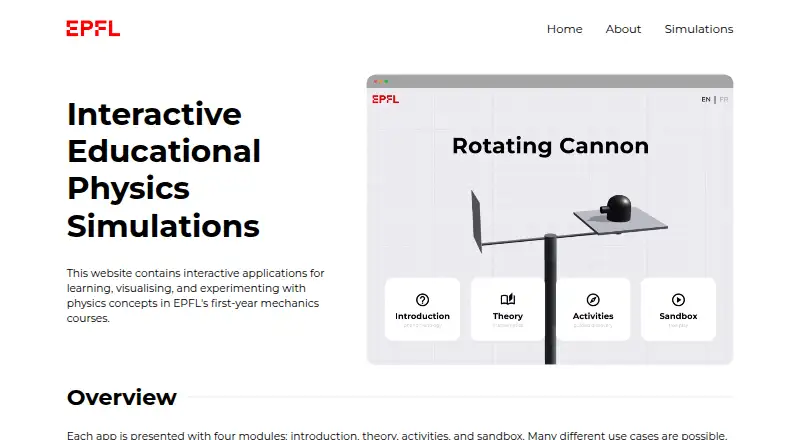
- Each app has four modules: introduction, theory, activities, and sandbox.checked 11 Oct 2026
- Lesson library
- Yeschecked 20 Sep 2026
- Purpose
- The website provides interactive applications for learning, visualising, and experimenting with physics concepts in EPFL’s first-year mechanics courses.checked 11 Oct 2026
- Sandbox
- The sandbox lets users freely set parameters to test hypotheses and run virtual experiments.checked 11 Oct 2026
- Simulations
- Listed simulations cover drone kinematics, rotating reference frames, coupled oscillations, and spinning-top dynamics.checked 11 Oct 2026
- Support
- The site invites users who find the apps useful to share them with fellow teachers and students.checked 11 Oct 2026
- Teaching use
- Teachers can use the theory module to manipulate dynamically drawn graphs, vectors, and other mathematical quantities during lectures.checked 11 Oct 2026
- Theory
- The theory module visualises the mathematics governing each physical system, with equation variables colour-coded to match their physical or mathematical counterparts.checked 11 Oct 2026
Where it runs
- App structure
- Each app has introduction, theory, activities, and sandbox modules.checked 11 Oct 2026
The company
- Development team
- The site credits Dr Austin Peel for development, concept, and design, and Dr Sylvain Bréchet for concept and design.checked 11 Oct 2026
Money
- Free plan
- Yeschecked 20 Sep 2026
Alternatives to EPFL Physics Simulations
- 1

SimFlow
Free planWebLinuxmacOSWindows8.2From €8,000 a year - 2

COMSOL Multiphysics
WebAPILinuxmacOS7.7 - 3
FeenoX
Free planWebAPILinuxSelf-hosted7.5Free plan - 4
myPhysicsLab
Free planWebLinuxmacOSSelf-hosted7.5Free plan - 5

OpenFOAM
Free planLinuxmacOSSelf-hostedWindows7.3Free plan - 6
MPTRAC
Free planWebLinuxSelf-hosted7.2Free plan