Envoy AI Gateway
Envoy AI Gateway, now named Agent Router, is an open-source control plane for managing AI and agent traffic using Envoy.
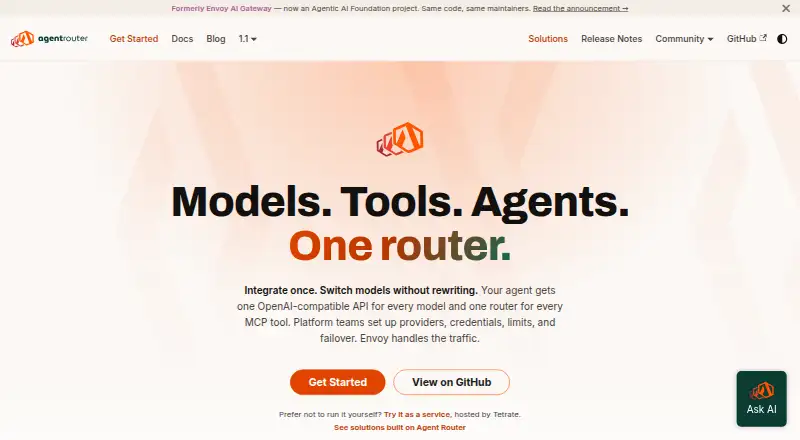
What Envoy AI Gateway is
Envoy AI Gateway, now named Agent Router, is an open-source control plane for managing AI and agent traffic using Envoy. It offers an OpenAI-compatible API for hosted and self-hosted models and MCP servers, with integrations spanning providers such as OpenAI, Azure OpenAI, Google Gemini, AWS Bedrock, Mistral, and Anthropic. Traffic controls include model virtualization, provider failover, token quotas, and usage-based rate limiting. Its MCP gateway supports server multiplexing, tool routing, OAuth authentication, and observability; InferencePool support adds routing and load balancing for inference endpoints. Credentials can be managed centrally, and the project describes metrics collection and workload monitoring. The local CLI runs on Linux and macOS, while production Kubernetes deployments use Envoy Gateway and must meet listed compatibility requirements: Agent Router v1.2.x, Kubernetes v1.32 or later, Envoy Gateway v1.9.2 or later, and Gateway API v1.6.1. The project uses the Apache 2.0 license and points users to Discord and GitHub issues for help. The project says its code, maintainers, and APIs stayed the same after the rename.
Good
- OpenAI-compatible API covers hosted and self-hosted models
- Includes provider failover and token quotas
- MCP gateway supports tool routing and OAuth
- Central credential management is available
- Apache 2.0 licensed open-source project
Watch out
- Local CLI supports Linux and macOS only
- Kubernetes deployment requires compatible dependencies
Who it suits
Agent Router may suit teams that share AI models or tools and want centralized credentials, quotas, usage attribution, or failover. It is also relevant to teams deploying AI traffic management locally or on compatible Kubernetes infrastructure.
Verdict
Agent Router brings traffic controls, credential management, and MCP gateway functions into an Envoy-based project. Teams planning Kubernetes deployment should check the listed dependency requirements.
Plans and prices
From Envoy AI Gateway's own pricing page, checked 9 Oct 2026.
| Plan | Price | What it gives you |
|---|---|---|
| Open-source project | Free | Self-managed; local CLI supports Linux and macOS · Kubernetes deployments require compatible dependencies |
The facts
Each one read from Envoy AI Gateway's own pages, with the date it was checked.
What it does
- Credential security
- Upstream credentials can be centrally managed; supported providers include short-lived credential flows for AWS Bedrock, Azure OpenAI, and GCP Vertex AI.checked 9 Oct 2026
- Deployment
- The CLI can run locally on Linux and macOS, and production deployment uses Kubernetes with Envoy Gateway.checked 9 Oct 2026
- Deployment options
- The project can run locally as a standalone proxy or deploy to Kubernetes; the site also links to hosted services offered by other providers.checked 9 Oct 2026
- Inference routing
- InferencePool support provides intelligent routing and load balancing for inference endpoints.checked 9 Oct 2026
- Intended users
- The documentation identifies teams sharing models or tools, seeking centralized credentials, quotas, usage attribution, or failover as likely users.checked 9 Oct 2026
- Kubernetes compatibility
- The compatibility matrix lists Agent Router v1.2.x with Kubernetes v1.32 or later, Envoy Gateway v1.9.2 or later, and Gateway API v1.6.1.checked 9 Oct 2026
- License
- The project uses the Apache 2.0 license.checked 9 Oct 2026
- MCP gateway
- The MCP gateway aggregates tools from multiple servers and supports tool routing, security policies, and observability.checked 9 Oct 2026
- Observability
- The CLI supports OpenTelemetry tracing and can record request and response details; the documentation describes configuration to hide input and output content.checked 9 Oct 2026
- Provider integrations
- The project lists integrations including OpenAI, Azure OpenAI, Google Gemini, Vertex AI, AWS Bedrock, Mistral, Cohere, Groq, Together AI, DeepInfra, DeepSeek, Hunyuan, SambaNova, Grok, and Anthropic.checked 9 Oct 2026
- Purpose
- The open-source project routes and manages generative AI traffic between applications and AI services, with rate limiting and policy control.checked 9 Oct 2026
- Renamed project
- Envoy AI Gateway is now Agent Router, an Agentic AI Foundation project; the site says the code, maintainers, and APIs remain the same.checked 9 Oct 2026
- Security
- The project describes upstream authentication for securing connections to AI services and says provider credentials can be kept out of application workloads.checked 9 Oct 2026
- Support
- The project directs users to its community Discord and GitHub issues for help.checked 9 Oct 2026
- Traffic controls
- Capabilities include model virtualization, provider failover, token quotas, and usage-based rate limiting.checked 9 Oct 2026
- Unified API
- It provides an OpenAI-compatible API for routing requests across model providers and lets applications switch models by changing the model name.checked 9 Oct 2026
The company
- Founded
- 2024checked 28 Sep 2026
Where it runs
- Local platform support
- The `aigw run` CLI currently supports Linux and macOS.checked 9 Oct 2026
The full review of Envoy AI Gateway
Agent Router is an open-source Envoy-based control plane for AI models, agents, and MCP tools. It fits teams that share providers or tools and need one place for credentials, routing, quotas, and attribution. The strongest reason to choose it is broad, self-managed governance; the main trade-off is that serious production operation is tied to a Kubernetes and Envoy Gateway stack.
Overview
The project exposes an OpenAI-compatible API for both hosted and self-hosted models, plus MCP servers. Its integrations cover OpenAI, Azure OpenAI, Google Gemini, Vertex AI, AWS Bedrock, Mistral, Cohere, Groq, Together AI, DeepInfra, DeepSeek, Hunyuan, SambaNova, Grok, and Anthropic. That makes it a practical common front door for mixed-provider estates, rather than an inference runtime or model marketplace.
Founded in 2024, it is now an Agentic AI Foundation project under the Agent Router name. The rename leaves the code, maintainers, and APIs unchanged. Apache 2.0 licensing permits self-managed use, while support is handled through community Discord and GitHub issues.
Key features
Traffic and budget controls
Model virtualization lets applications address models through a consistent interface, while provider failover can keep traffic moving when an upstream is unavailable. Token quotas and usage-based rate limits help prevent one workload from consuming a shared allocation. Usage analytics, usage attribution, and budget controls give administrators a way to understand and constrain consumption. Those controls are valuable for organizations with multiple teams; a small application needing a thin forwarding proxy may find the wider policy surface unnecessary.
MCP gateway
The MCP gateway multiplexes servers, routes tools, supports OAuth authentication, and provides observability. It is designed for teams exposing several tool back ends through one managed entry point, with routing and identity handled centrally instead of separately in every agent.
Inference routing
InferencePool support adds intelligent routing and load balancing for inference endpoints. This is a better fit for fleets of endpoints than for a single local model, where the added control layer may not justify itself.
Credential security and monitoring
Upstream authentication protects connections to AI services while keeping provider secrets out of application workloads. Central management includes short-lived credential flows for AWS Bedrock, Azure OpenAI, and GCP Vertex AI. Metrics collection and workload monitoring support operational oversight, particularly when several providers and teams share the gateway.
Pricing
| Plan | Price | What it includes |
|---|---|---|
| Open-source project | free | Self-managed software; local CLI on Linux and macOS; Kubernetes deployment with compatible dependencies |
There is no paid tier or hosted seat allowance in this plan. The cost is zero, but infrastructure, deployment, and operations remain your responsibility. Local use is available through the aigw run CLI; production Kubernetes operation requires Agent Router v1.2.x with Kubernetes v1.32 or later, Envoy Gateway v1.9.2 or later, and Gateway API v1.6.1.
Platforms
Agent Router supports API access, Linux, macOS, and self-hosted deployment. The local CLI currently runs on Linux and macOS. It can operate as a standalone local proxy or be deployed to Kubernetes with Envoy Gateway; the project also points to hosted services supplied by other providers.
Who it's for
This is aimed at teams sharing models or MCP tools that need centralized credentials, quotas, usage attribution, failover, analytics, or spending controls. Platform and infrastructure groups running several inference endpoints will benefit most from InferencePool routing and shared policy. It is less suitable for users who want a managed, vendor-operated gateway or a simple single-provider API with no Kubernetes operations.
Pros and cons
Pros
- Broad provider coverage: one OpenAI-compatible surface spans major commercial and self-hosted options.
- Strong governance: quotas, rate limits, budgets, analytics, and attribution address shared-use accountability.
- MCP-aware gateway: multiplexing, tool routing, OAuth, and observability target agent workloads directly.
- Credential isolation: centralized and short-lived provider credentials reduce the need to place secrets in applications.
- Open-source economics: Apache 2.0 software is free to run and can be self-hosted.
Cons
- Production dependency chain: Kubernetes, Envoy Gateway, and Gateway API versions must align for the documented deployment.
- Operational burden: self-hosting shifts infrastructure, upgrades, and reliability work to your team.
- Narrow local OS range: the CLI currently supports Linux and macOS, not a broader desktop set.
- Community-based support: assistance comes through Discord and GitHub issues rather than a stated commercial support tier.
Alternatives
Bifrost is the better comparison for teams wanting a freemium gateway with web and Windows support alongside self-hosting, including a free Apache 2.0 OSS plan.
Routerly suits users seeking a free self-hosted option with no markup on API calls and an AGPL-3.0 license.
YoloRouter is an alternative free self-hosted single binary with SQLite included and optional PostgreSQL.
Kong Gateway is worth considering when a paid gateway with a 30-day, no-card trial and web support is preferable.
TensorZero offers a free, fully self-hosted open-source LLMOps platform.
SGLang is the alternative for an open-source inference framework installed with pip or Docker.
LLM Gateway fits readers wanting a freemium service with 200-plus models across 40-plus providers and a hosted free tier.
OpenRouter is the simpler API-and-web choice for credit-based access to free models and providers without self-hosting.
Browse more options in LLM Gateway Software.
Verdict
Choose Agent Router if your team needs an open-source, Envoy-centered control plane for shared models and MCP tools, especially with centralized credentials, failover, quotas, and analytics. Look elsewhere if you want managed hosting, broad local desktop support, or to avoid Kubernetes and its dependency requirements.
Alternatives to Envoy AI Gateway
- 1
Manifest
Free planOpen sourceWebAPILinuxSelf-hosted8.7From $19 a month - 2

LangSmith
Free planWebAPILinuxmacOS8.6$39 usage-based - 3

Bifrost
Free planOpen sourceWebAPILinuxmacOS8.3Free plan - 4
LLM Gateway
Free planOpen sourceWebAPIExtensionLinux8.2Free plan - 5
Eden AI
WebAPI8.1$5.50 one-time - 6
TrueFoundry AI Gateway
Free planWebAPILinuxSelf-hosted8.0From $499 a month