
EngFlow Remote Caching
EngFlow Remote Caching is a remote build cache intended to cut redundant rebuilds and test reruns, developer workload, and compute costs.
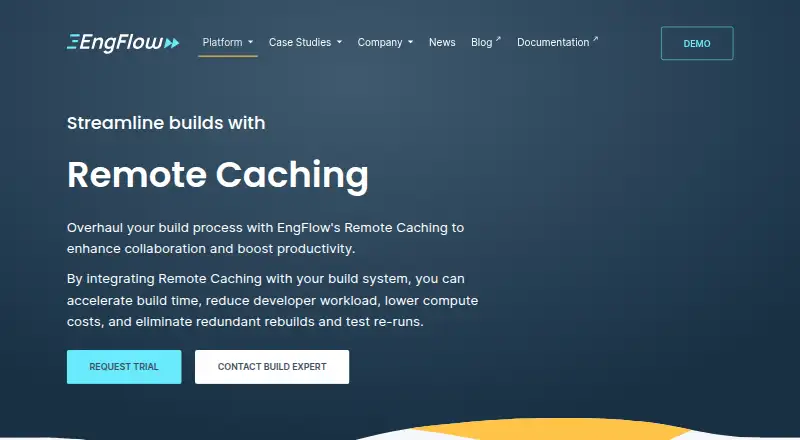
What EngFlow Remote Caching is
EngFlow Remote Caching is a remote build cache intended to cut redundant rebuilds and test reruns, developer workload, and compute costs. It uses gRPC, cache compression, and Build without the Bytes to limit latency and unnecessary data transfers. A layered cache keeps frequently accessed data ready, reducing repeated requests and network load. Its Build & Test UI displays cache hit rates, build time, and status in real time.
The Free tier works with Bazel and includes in-cluster caching on one Linux machine with 32 CPU cores. Enterprise supports Bazel, Goma for Chromium, and Soong for AOSP, with in-cluster or external cache storage such as S3 and GCS. The pricing comparison lists Free as self-hosted and Enterprise as self-hosted or managed; deployment options include bare metal, AWS, GCP, Kubernetes, and OpenStack for Free, with Azure, MacStadium, and Orka also available for Enterprise.
EngFlow says builds run in isolated environments with encryption and dedicated infrastructure by default. It also says its solutions receive regular third-party audits against the five SOC 2 principles. Free pricing is listed as free. Enterprise is available by custom quote, and a trial request form is offered without a stated trial duration.
Good
- Reduces redundant builds and test reruns.
- Real-time UI shows cache hit rates, build time, and status.
- Layered caching aims to reduce repeated requests and network load.
- Enterprise supports Bazel, Goma, and Soong.
- Self-hosted and managed Enterprise deployment options are listed.
Watch out
- Free tier is limited to one machine and 32 CPU cores.
- Free tier works with Bazel.
- Enterprise pricing requires a custom quote.
Who it suits
EngFlow Remote Caching suits development teams that want to reduce repeat build and test work, from small teams to enterprise-scale projects. The Free tier is for Bazel users able to work within one Linux machine and 32 CPU cores; Enterprise adds other listed build systems and broader storage and deployment options.
Verdict
Choose the Free tier for self-hosted Bazel caching within its one-machine, 32-core Linux limits. Enterprise is the option for additional build systems, external cache storage, or managed deployment.
Plans and prices
From EngFlow Remote Caching's own pricing page, checked 30 Sep 2026.
| Plan | Price | What it gives you |
|---|---|---|
| Free | Free | 1 machine · 32 CPU cores · in-cluster remote caching · Linux |
| Enterprise | Priced on request | Unlimited machines and CPU cores · in-cluster or external-storage caching · Linux, macOS, Windows · Custom quote |
The facts
Each one read from EngFlow Remote Caching's own pages, with the date it was checked.
What it does
- Analytics
- The Build & Test UI provides real-time information on cache hit rates, build time, and status.checked 30 Sep 2026
- Authentication
- The pricing comparison lists HTTP basic authentication and mTLS for Free, with GCP IAM, Google OAuth, SAML, and custom options added for Enterprise.checked 30 Sep 2026
- Cache architecture
- A layered caching strategy keeps frequently accessed data readily available to reduce redundant requests and network load.checked 30 Sep 2026
- Cache storage
- The Free tier includes in-cluster caching; Enterprise also supports cache storage in external services such as S3 and GCS.checked 30 Sep 2026
- Compliance
- EngFlow says its solutions receive regular third-party audits against the five SOC 2 principles.checked 30 Sep 2026
- Deployment
- The pricing page lists Free as self-hosted and Enterprise as self-hosted or managed, with deployment options that include bare metal, AWS, GCP, Kubernetes, and OpenStack for Free, plus Azure, MacStadium, and Orka for Enterprise.checked 30 Sep 2026
- Purpose
- Remote Caching is designed to speed builds, reduce developer workload and compute costs, and eliminate redundant rebuilds and test reruns.checked 30 Sep 2026
- Scalability
- The product is designed for projects ranging from small development teams to enterprise-scale software, with parallelism and cache loads distributed across multiple servers.checked 30 Sep 2026
- Security
- EngFlow says builds run in isolated environments with encryption and, by default, dedicated infrastructure.checked 30 Sep 2026
- Support
- The pricing page lists community support for Free and a dedicated engineer for Enterprise.checked 30 Sep 2026
- Supported build systems
- The Free tier works with Bazel; Enterprise lists Bazel, Goma (Chromium), and Soong (AOSP).checked 30 Sep 2026
- Transfers
- The service uses gRPC, cache compression, and Build without the Bytes to reduce latency and unnecessary data transfers.checked 30 Sep 2026
The company
- Headquarters
- Austin, Texas, United Stateschecked 23 Sep 2026
Money
- Trial
- The product page offers a trial request form but does not state a trial duration.checked 30 Sep 2026
The full review of EngFlow Remote Caching
EngFlow Remote Caching is a remote build cache aimed at teams that need fewer redundant compilations and test reruns. It is best suited to Bazel users who can operate a self-hosted service, while larger organizations can use broader build-system and deployment options. The central trade-off is clear: the free plan is useful but tightly bounded, and the expanded Enterprise tier requires a custom quote.
Overview
The service reuses build outputs remotely to reduce build time, developer workload, and compute spending. gRPC transport, cache compression, and Build without the Bytes are designed to reduce latency and avoid moving data that is not needed. A layered cache keeps frequently requested artifacts readily available, which can reduce repeated requests and network traffic when many builds share the same outputs.
The Build & Test UI shows cache hit rates, build time, and status in real time. That makes it possible to connect caching behavior with actual build performance instead of treating the cache as an invisible service. Remote execution is supported, and language coverage includes C/C++ with GCC, Clang, or MSVC and Java.
Key features
Transfer efficiency and cache insight
Compression and Build without the Bytes address the bandwidth and latency costs that can undermine a remote cache. Layering is intended to keep hot data close to the request path. These techniques are most valuable for build-heavy repositories and teams with repeated, shared workloads; they do not remove the need to choose an appropriate cache deployment or build-system integration.
Security and scale
EngFlow says builds run in isolated environments with encryption and, by default, dedicated infrastructure. It also says its solutions receive regular third-party audits against the five SOC 2 principles. The architecture is designed to distribute parallel work and cache load across multiple servers, covering small development teams through enterprise-scale projects. Those assurances and scaling goals will matter most to organizations with security review requirements or substantial concurrent builds.
Build-system coverage
Free supports Bazel. Enterprise adds Goma for Chromium and Soong for AOSP, making the paid tier materially more relevant to Android and Chromium engineering groups than the entry plan.
Pricing
Free
Free costs nothing and is self-hosted on Linux. It permits one machine and 32 CPU cores, with in-cluster remote caching, HTTP basic authentication, and mTLS. Community support is included. This is a sensible starting point for an individual or small Bazel team that can stay within one Linux host and does not need external cache storage, managed operation, or additional build systems. The one-machine and 32-core ceiling can become a hard constraint as parallel builds or team size increase.
Enterprise
Enterprise uses custom pricing and supports unlimited machines and CPU cores. It adds Linux, macOS, and Windows, in-cluster or external storage such as S3 and GCS, and self-hosted or managed deployment. Deployment choices include bare metal, AWS, GCP, Kubernetes, OpenStack, Azure, MacStadium, and Orka. GCP IAM, Google OAuth, SAML, and custom authentication options supplement the Free tier's HTTP basic authentication and mTLS. A dedicated engineer replaces community support. Choose it when infrastructure flexibility, multi-platform builds, higher concurrency, or operational assistance justify a negotiated contract.
A trial request form is offered, but no trial duration is stated. Free has no stated renewal charge because it is listed as free; Enterprise terms are handled through the custom quote.
Platforms
EngFlow lists API, Linux, macOS, self-hosted, web, and Windows platform coverage. In practice, the Free plan is Linux-only and self-hosted, while Enterprise provides the cross-platform and managed choices. CI integrations include GitHub Actions and Buildkite.
Who it's for
Choose EngFlow when a Bazel workflow benefits from a shared remote cache, cache-performance telemetry, and optional remote execution. Free fits a Linux-based team willing to run its own service within one machine and 32 cores. Enterprise is aimed at organizations running multiple build systems, requiring external object-storage caches, Windows or macOS support, managed deployment, or dedicated technical support.
It is a weaker fit for a single developer seeking a local compiler cache, or for teams that want a fully open-source server with no commercial tier decision. The Free plan also is not a practical match for workloads that quickly exceed its machine and core limits.
Pros and cons
- Pro: gRPC, compression, and Build without the Bytes target transfer overhead that can slow remote builds.
- Pro: Real-time cache-hit, build-time, and status metrics help teams verify whether caching is effective.
- Pro: Isolation, encryption, dedicated infrastructure by default, and stated SOC 2 audits address enterprise security reviews.
- Pro: Enterprise supports unlimited machines and cores, external S3 or GCS storage, and managed deployment.
- Con: Free is limited to Bazel, Linux, one machine, and 32 CPU cores, restricting larger or mixed-platform teams.
- Con: Enterprise pricing is custom, so budget comparison requires a sales conversation.
- Con: Free support is community-based, without the dedicated engineer available to Enterprise customers.
Alternatives
For a broader directory of options, see Build Cache Software.
Bitrise is the better choice when mobile CI is the priority and a free, single-person Hobby plan with occasional build credits is sufficient.
Pick Ccache for a free, local-style cache focused on single-file compilations across Linux, macOS, and Windows rather than a multi-server remote service.
cachepot suits teams wanting Apache-2.0 open-source software with no hosted plans stated.
Choose MozJPEG when the requirement is an open-source JPEG encoder library, not general build caching.
NativeLink is an alternative for self-hosted open-source distributed scheduling and remote caching across all build systems and major cloud providers.
FosterStack fits teams seeking a self-hosted MIT-licensed cache server with a $49 a month Team tier for multi-user controls.
bazel-remote is a straightforward Apache-2.0 self-hosted option with configurable cache size.
BuildFetch Cache is preferable when a metered open-source cache with 20GB storage, 50GB traffic, 100,000 requests, and 45-day LRU retention matches the workload.
Verdict
EngFlow Remote Caching is a strong choice for Bazel teams that want measurable remote-cache performance and a credible path from a small self-hosted Linux deployment to enterprise infrastructure. The main reason to look elsewhere is the Free plan's strict one-machine, 32-core boundary—or the need for an openly licensed, no-quote alternative.
Getting started
- Visit EngFlow's Remote Caching page.
- Request a trial using the product page form, if desired.
- Choose the Free or Enterprise deployment approach.
- For Free, deploy self-hosted on a listed option such as AWS, GCP, Kubernetes, OpenStack, or bare metal.
- Connect a supported build system; the Free tier works with Bazel.
Limits worth knowing
The Free plan is limited to one machine, 32 CPU cores, in-cluster caching, and Linux. Enterprise lists unlimited machines and CPU cores, external-storage caching, and Linux, macOS, and Windows; pricing is by custom quote.
Questions
Is EngFlow Remote Caching free?
Yes. The Free plan is listed as free and includes one machine, 32 CPU cores, in-cluster remote caching, and Linux.
What does Enterprise cost?
Enterprise is offered by custom quote; no fixed price is listed.
Which build systems are supported?
Free works with Bazel. Enterprise lists Bazel, Goma for Chromium, and Soong for AOSP.
Can EngFlow be self-hosted?
Yes. Free is self-hosted, while Enterprise can be self-hosted or managed.
What cache storage options are available?
Free includes in-cluster caching. Enterprise also supports external services such as S3 and GCS.
Is there a free trial?
A trial request form is available, but no trial duration is stated.