
NativeLink
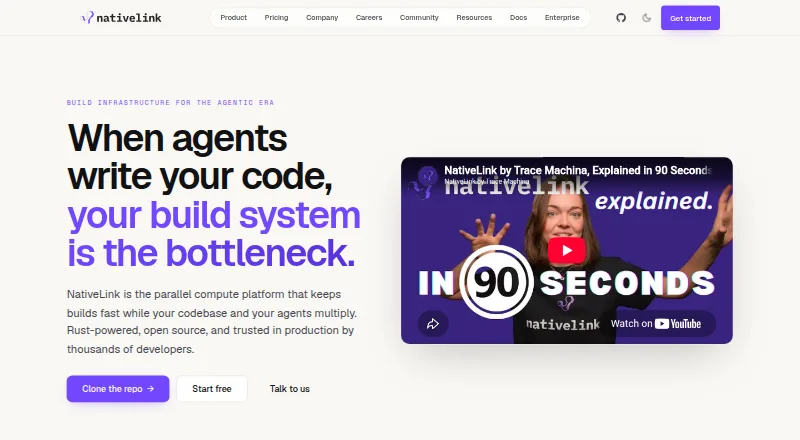
NativeLink combines remote build caching, remote execution, and observability in a Rust-native platform.
What NativeLink is
NativeLink combines remote build caching, remote execution, and observability in a Rust-native platform. Its content-addressed cache deduplicates build artifacts so teams, CI systems, and agents can reuse earlier results. Remote execution distributes compilation and tests across worker fleets on AWS, GCP, or bare metal, including GPU, ARM, and Apple Silicon support. Listed build systems include Bazel, Buck2, Siso, Soong, Pants, Goma, BuildStream, and CMake through recc. CI connections include GitHub Actions, GitLab, Buildkite, and Jenkins; integrations also include AWS, GCP, Azure, S3, GCS, and Redis. The product lists several AI coding platform integrations as well. The free Open Source tier is self-hosted and includes community Slack support. Most of the monorepo uses FSL-1.1-Apache-2.0, but metrics and remote persistent workers are Business Source License modules requiring Enterprise or a separate license for shared production use. Clients support Linux, macOS, and Windows; servers support Linux and macOS.
Good
- Free Open Source tier is self-hosted.
- Supports multiple build systems and CI platforms.
- Remote execution supports GPUs, ARM, and Apple Silicon.
- Security page states SOC 2 and ISO 27001 are complete.
Watch out
- Metrics and remote persistent workers have separate licensing limits.
- Servers support Linux and macOS, not Windows.
- Enterprise tiers are priced at $180,000 and $360,000 per year.
Who it suits
NativeLink suits software teams seeking shared build caching and distributed compilation or tests. Teams should review the licensing limits around metrics and remote persistent workers for shared production use.
Verdict
NativeLink offers caching and remote execution across a broad list of build systems and CI platforms. Its free tier is self-hosted, but some modules have separate licensing requirements for shared production use.
Plans and prices
From NativeLink's own pricing page, checked 29 Sep 2026.
| Plan | Price | What it gives you |
|---|---|---|
| Open Source | Free | Self-hosted · community Slack support · distributed scheduler and remote caching · all build systems · major cloud providers |
| Enterprise Tier 1 | — | Private companies under $100M valuation · self-hosted on Kubernetes · 6 support hours/month · 24-hour response SLA · billed monthly |
| Enterprise Tier 2 | — | Public companies or private companies valued at $100M+ · self-hosted on Kubernetes · 12 support hours/month · 4-hour response SLA · billed monthly |
The facts
Each one read from NativeLink's own pages, with the date it was checked.
What it does
- AI tools
- The product page lists Claude Code, Copilot Workspace, Devin, Cursor, and Windsurf as AI coding platform integrations.checked 29 Sep 2026
- Build systems
- The product lists Bazel, Buck2, Siso, Soong, Pants, Goma, and CMake via recc among its supported build systems.checked 29 Sep 2026
- Caching
- Its content-addressed cache deduplicates build artifacts so teams, CI, and agents can reuse prior results.checked 29 Sep 2026
- Deployment
- The documentation describes NativeLink as a single Rust binary that can act as the cache, scheduler, and worker with different configurations.checked 29 Sep 2026
- Integrations
- It lists GitHub Actions, GitLab, Buildkite, and Jenkins for CI, plus AWS, GCP, Azure, S3, GCS, and Redis integrations.checked 29 Sep 2026
- Licensing limit
- The product FAQ says most of the monorepo is FSL-1.1-Apache-2.0, while metrics and remote persistent workers are Business Source License modules requiring Enterprise or a separate license for shared production use.checked 29 Sep 2026
- Product
- NativeLink combines remote build caching, remote execution, and observability in a Rust-native platform.checked 29 Sep 2026
- Remote execution
- NativeLink distributes compilation and tests across worker fleets on AWS, GCP, or bare metal, with support for GPUs, ARM, and Apple Silicon.checked 29 Sep 2026
- Security
- The security page states SOC 2 and ISO 27001 are complete, and GDPR and CCPA/CPRA compliant.checked 29 Sep 2026
- Security controls
- The product page lists SSO/SAML, mutual TLS, signed inputs, content-addressed artifacts, hermetic builds, and queryable audit trails.checked 29 Sep 2026
- Server compatibility
- The product FAQ says clients support Linux, macOS, and Windows, while the server supports Linux and macOS.checked 29 Sep 2026
- Support
- The free Open Source tier provides community Slack support, while Enterprise includes dedicated engineering support.checked 29 Sep 2026
The company
- Company
- NativeLink is built by Trace Machina, whose company page describes work for industries including semiconductors, robotics, autonomous vehicles, AI research, life sciences, and financial services.checked 29 Sep 2026
The full review of NativeLink
Overview
NativeLink is a self-hosted build infrastructure platform for teams that need both remote caching and distributed execution. It is best suited to complex builds that can benefit from shared artifacts and worker fleets; its open-source tier lowers the entry cost, but production use of some modules requires a separate license or Enterprise.
Its content-addressed cache lets teams, CI jobs, and coding agents reuse build artifacts, while remote execution can distribute compilation and tests across workers on AWS, GCP, or bare metal. NativeLink is delivered as a Rust binary configurable to act as cache, scheduler, and worker, which offers deployment flexibility but leaves hosting to the customer.
Compare it with other options in Build Cache Software.
Key features
Shared caching and remote execution
Content-addressed caching deduplicates artifacts, making shared reuse across developers, CI, and agents a core strength. Remote execution supports GPUs, ARM, and Apple Silicon as well as general worker fleets, which can suit heterogeneous build workloads. The breadth comes with operational responsibility: NativeLink is self-hosted rather than a managed service.
Supported build systems include Bazel, Buck2, Siso, Soong, Pants, Goma, BuildStream, and CMake through recc. Listed compiler and language support spans C++, Rust, Python, Go, Java, Kotlin, and Swift. This range makes it relevant to mixed toolchains, though teams should match their own build setup to the supported systems.
Integrations and controls
CI integrations include GitHub Actions, GitLab, Buildkite, and Jenkins; cloud and service integrations include AWS, GCP, Azure, S3, GCS, and Redis. Listed AI coding integrations include Claude Code, Copilot Workspace, Devin, Cursor, and Windsurf, extending its potential reach beyond conventional CI.
Security controls include SSO/SAML, mutual TLS, signed inputs, hermetic builds, content-addressed artifacts, and queryable audit trails. NativeLink states that SOC 2 and ISO 27001 are complete and that it is GDPR and CCPA/CPRA compliant. Those credentials and controls matter for organizations with formal security needs, while their presence does not remove the work of operating a self-hosted system.
Pricing
The Open Source plan costs nothing. It is self-hosted and includes community Slack support, a distributed scheduler, remote caching, all build systems, and major cloud providers. It is the sensible starting point for teams able to run the infrastructure themselves, but the FAQ draws an important boundary: metrics and remote persistent workers are Business Source License modules that require Enterprise or a separate license for shared production use.
Enterprise Tier 1 costs $180,000 a year, billed monthly. It targets private companies under $100M valuation and includes self-hosting on Kubernetes, 6 support hours/month, and a 24-hour response SLA. Enterprise Tier 2 costs $360,000 a year, billed monthly, for public companies or private companies valued at $100M+; it includes Kubernetes self-hosting, 12 support hours/month, and a 4-hour response SLA. The higher tier adds support capacity and a faster response commitment, while both retain the burden of self-hosting.
Platforms
NativeLink clients support Linux, macOS, and Windows; its server supports Linux and macOS. The product is self-hosted, so Windows users can connect as clients but cannot host the server on Windows. Worker deployments can use AWS, GCP, or bare metal.
Who it's for
NativeLink fits engineering organizations with substantial or varied builds, compatible build systems, and the capacity to operate cache and execution infrastructure. Its worker support across GPUs, ARM, and Apple Silicon is useful where those architectures are part of the build fleet. The company behind it, Trace Machina, describes work across semiconductors, robotics, autonomous vehicles, AI research, life sciences, and financial services, indicating the range of industries it serves.
It is a weaker fit for a small project seeking a turnkey hosted cache, or for organizations that need Windows server hosting. Teams planning shared production use of metrics or remote persistent workers should account for the separate licensing requirement rather than assuming the free tier covers them.
Pros and cons
- Broad build-system and language coverage: support for multiple build systems and seven listed languages suits heterogeneous engineering environments.
- Cache and execution in one self-hosted platform: artifact reuse and distributed work can be configured through a Rust binary serving cache, scheduler, and worker roles.
- Flexible worker hardware: GPU, ARM, and Apple Silicon support broadens the kinds of builds that can run remotely.
- Meaningful free entry point: the Open Source plan includes distributed scheduling and remote caching, but is self-hosted and does not grant shared production rights for certain modules.
- High enterprise cost: the two annual plans cost 180000.00 USD and 360000.00 USD, with Kubernetes self-hosting still required.
- Server OS constraint: Windows is supported for clients, not servers.
Alternatives
Choose EngFlow Remote Caching if its free tier's 1 machine, 32 CPU cores, in-cluster remote caching, and Linux support fit a bounded deployment, or if you want to compare its custom-priced Enterprise plan.
Ccache is a free, GPL-licensed option for caching single-file compilations, a narrower fit than NativeLink's listed remote execution and multi-system scope.
Buildless has a free Individual / OSS offer marked coming soon with one project, one user, 3GB cache space, and 100GB transfer; its Team offer is free during public beta. Consider it when those stated project and cache limits suit your needs.
cachepot is another free, open-source choice for Linux, macOS, Windows, and self-hosting; choose it when that platform set and open-source model are the priority.
Bitrise offers a free-forever Hobby plan for a one-person team, with build credits for a small project a few times per month and community support. It is a fit for that limited solo workflow rather than the broad self-hosted infrastructure NativeLink provides.
Buildbarn is an open-source alternative for teams seeking a self-hosted option.
Cachely offers a free managed plan with 1 GiB storage, 500K requests/month, 3 workspaces, 5 API tokens, and a build insights dashboard. It may suit teams that prefer a web-based managed cache with explicit free-tier limits.
BuildFetch Cache is another alternative to consider.
Verdict
Choose NativeLink if your organization needs broad build-system coverage, shared remote caching, and distributed execution, and can run the infrastructure itself. Its main advantage is combining those capabilities with support for varied worker hardware; its main reason to look elsewhere is the operational commitment, compounded by Enterprise licensing for shared production use of some modules.