cachepot
Cachepot is an open-source compiler caching tool for Linux, macOS, Windows, and self-hosted environments.
What cachepot is
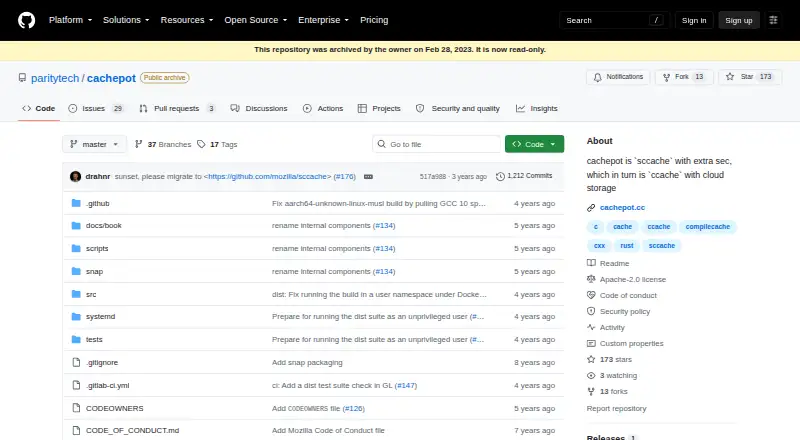
Cachepot is an open-source compiler caching tool for Linux, macOS, Windows, and self-hosted environments. It stores compilation results on local disk or cloud storage so builds can reuse results instead of recompiling when possible. The documented compiler list includes GCC, Clang, MSVC, rustc, NVCC, and Wind River Diab. Distributed compilation can package local toolchains automatically, and storage options include local disk, S3, Redis, Memcached, Google Cloud Storage, and Azure Blob Storage. Build integrations include Cargo, CMake, Jenkins, GitLab, and Concourse CI. Its distributed-compilation security design describes authentication, encrypted transport, and sandboxed compiler execution on build servers; bubblewrap is the preferred sandbox option over Docker. The default local cache limit is 10 gigabytes and can be changed with CACHEPOT_CACHE_SIZE. There are notable constraints: Rust crates that use the system linker and incrementally compiled crates cannot be cached, while cache hits require matching absolute paths. The repository was archived on February 28, 2023, in favor of upstream sccache. Cachepot is free under the Apache-2.0 license.
Good
- Free and Apache-2.0 licensed.
- Supports GCC, Clang, MSVC, rustc, NVCC, and Diab.
- Offers local and cloud storage backends.
- Distributed compilation packages local toolchains automatically.
- Includes documented sandboxing and transport encryption.
Watch out
- Repository was archived on February 28, 2023.
- Some Rust crates cannot be cached.
- Cache hits require matching absolute file paths.
- Server-side hash verification is listed as a TODO.
Who it suits
Cachepot may suit developers and build teams looking for a self-hosted or local compiler cache with distributed compilation. Its archived status and Rust and path limitations are important considerations.
Verdict
Cachepot documents broad compiler, storage, and build-system support, along with distributed compilation. The repository is archived, and its documented Rust and path constraints may affect whether it fits a build workflow.
Plans and prices
From cachepot's own pricing page, checked 2 Oct 2026.
| Plan | Price | What it gives you |
|---|---|---|
| Open-source software | Free | Apache-2.0 licensed; no hosted plans or pricing are stated |
The facts
Each one read from cachepot's own pages, with the date it was checked.
What it does
- Build integrations
- The README describes using Cachepot with Cargo, CMake, and Jenkins, and the official documentation also has GitLab and Concourse CI pages.checked 2 Oct 2026
- CI security caveat
- The GitLab guide warns that compilation output can leak data from the execution environment and says CI secrets should not be treated as secret from that output.checked 2 Oct 2026
- Default cache limit
- The README says the default local cache size is 10 gigabytes and can be changed with CACHEPOT_CACHE_SIZE.checked 2 Oct 2026
- Distributed compilation
- Cachepot supports icecream-style distributed compilation with automatic packaging of local toolchains.checked 2 Oct 2026
- Path limitation
- For a cache hit, the README says absolute file paths must match, including paths to third-party Rust crates in Cargo's default registry cache.checked 2 Oct 2026
- Project status
- The repository says Cachepot was archived on February 28, 2023 and superseded in favor of upstream sccache.checked 2 Oct 2026
- Purpose
- Cachepot is a compiler caching tool that avoids recompilation when possible and stores results on local disk or cloud storage.checked 2 Oct 2026
- Rust limitations
- The README says Rust crates that invoke the system linker and incrementally compiled crates cannot be cached.checked 2 Oct 2026
- Sandbox support
- The threat model documents built-in sandbox support using bubblewrap or Docker, with bubblewrap named as the preferred choice.checked 2 Oct 2026
- Security caveat
- The threat model lists server-side hash verification as a hardening goal and marks it TODO.checked 2 Oct 2026
- Security design
- The project describes authentication, transport encryption, and sandboxed compiler execution on build servers as security features of distributed compilation.checked 2 Oct 2026
- Storage backends
- The documented storage options include local disk, S3, Redis, Memcached, Google Cloud Storage, and Azure Blob Storage.checked 2 Oct 2026
- Supported compilers
- The README lists gcc, clang, MSVC, rustc, NVCC, and Wind River diab compiler.checked 2 Oct 2026
Where it runs
- Platforms
- The README says prebuilt x86-64 binaries are available for Windows, Linux, and macOS.checked 2 Oct 2026
The full review of cachepot
Cachepot is an open-source compiler cache for developers and build teams who want to reuse compilation results locally or through remote storage. Its broad compiler and backend support is compelling, but the archived repository makes it a difficult choice for a new long-term build pipeline.
Overview
Cachepot skips compilation when it can reuse an earlier result, with cache data kept on local disk or stored remotely. It also supports icecream-style distributed compilation and automatically packages local toolchains. That combination suits teams with varied build environments; it is less attractive when ongoing project maintenance is essential, since the repository was archived on February 28, 2023 and points to upstream sccache as its successor.
Key features
Compiler and build coverage
Supported compilers include GCC, Clang, MSVC, rustc, NVCC, and Wind River Diab. Cachepot documents integration with Cargo, CMake, GNU make, Jenkins, GitLab CI, and Concourse CI. This breadth can help teams apply caching across different toolchains and build environments rather than adopting a separate tool for each compiler.
There are meaningful Rust constraints: crates that invoke the system linker and crates compiled incrementally cannot be cached. Cache hits also require matching absolute file paths, including paths to third-party Rust crates in Cargo's default registry cache. Teams with inconsistent build paths or relying heavily on those Rust workflows may see less reuse than the feature list suggests.
Storage and distributed builds
Storage backends include local disk, S3, Redis, Memcached, Google Cloud Storage, and Azure Blob Storage. The default local cache is 10 gigabytes, adjustable with CACHEPOT_CACHE_SIZE. The range of backends offers flexibility, though it also leaves teams responsible for choosing and operating the storage that fits their setup.
For distributed compilation, the project describes authentication, transport encryption, and sandboxed compiler execution on build servers. Its threat model documents sandboxing with bubblewrap or Docker and prefers bubblewrap. However, server-side hash verification is marked as a hardening goal rather than an implemented safeguard. The GitLab guide also warns that compilation output can expose data from the execution environment, so CI secrets should not be considered secret from that output.
Pricing
Cachepot is free open-source software under the Apache-2.0 license, with a listed price of no cost. Self-hosting is supported, and there are no hosted plans or paid tiers described. This suits teams prepared to run their own cache infrastructure; it does not provide a hosted option for those seeking a managed service.
Platforms
Cachepot supports Linux, macOS, and Windows, as well as self-hosted deployment. That makes it relevant to mixed-platform teams, although the path-matching requirement still means build environments must align for cache hits.
Who it's for
Cachepot is best suited to teams with supported compilers and compatible build paths that can manage their own storage and accept an archived project. It is a weaker fit for new systems requiring active maintenance, Rust builds dependent on incremental compilation or system linking, or CI workflows that must keep secrets insulated from compilation output.
Pros and cons
- Pro: Supports six named compiler families and multiple build integrations, making it useful in heterogeneous build environments.
- Pro: Offers local and several remote storage backends, plus distributed compilation with automatic toolchain packaging.
- Pro: Free, Apache-2.0-licensed software with self-hosted deployment.
- Con: The repository is archived and identifies sccache as its successor, a substantial concern for new long-lived deployments.
- Con: Rust caching excludes system-linker and incremental builds, while cache hits depend on exact absolute-path matches.
- Con: Server-side hash verification remains a hardening goal, and GitLab CI compilation output can reveal environment data.
Alternatives
Build Cache Software is the category directory for comparing tools in this space.
Choose Ccache as another free compiler-cache option if a tool with the same listed Linux, macOS, self-hosted, and Windows platform coverage is a better fit. For a remote-caching setup with a defined small-scale free tier, EngFlow Remote Caching offers one machine and 32 CPU cores in-cluster on Linux, with custom-priced Enterprise. NativeLink is another free, self-hosted option, with a distributed scheduler and remote caching in its open-source plan.
If the priority is a hosted build platform with a free entry plan and trial, Bitrise offers a one-person Hobby plan with build credits for a small project a few times per month. FosterStack offers a free self-hosted cache server and a paid Team plan. bazel-remote is a free, self-hosted alternative with configurable cache size. BuildFetch Cache has a free open-source plan with stated storage, traffic, request, and retention limits. MozJPEG is a free open-source JPEG encoder library rather than a general compiler cache.
Verdict
Cachepot makes sense for teams that need its compiler breadth, storage choices, and distributed compilation, and can operate the infrastructure themselves. Its price and capabilities are appealing, but archival, Rust cache exclusions, path sensitivity, and the documented CI security caveat weigh against adopting it for a new critical pipeline. For most new deployments, look first at an actively maintained successor or another cache that better fits the workflow.
Getting started
- Open the Cachepot GitHub website
- Select Linux, macOS, Windows, or a self-hosted deployment
- Choose local disk or a documented remote storage backend
- Connect Cachepot to Cargo, CMake, GNU make, Jenkins, GitLab CI, or Concourse CI
- Configure distributed compilation and sandboxing when required
Limits worth knowing
The default local cache size is 10 gigabytes, adjustable with CACHEPOT_CACHE_SIZE. Rust crates that invoke the system linker and incrementally compiled crates cannot be cached, and cache hits require matching absolute paths.
Questions
Is Cachepot free?
Yes. It is open-source software under the Apache-2.0 license, with a listed price of no cost.
Which platforms does Cachepot support?
It supports Linux, macOS, Windows, and self-hosted environments.
Which storage backends are available?
Documented options include local disk, S3, Redis, Memcached, Google Cloud Storage, and Azure Blob Storage.
Does Cachepot support distributed compilation?
Yes. It supports icecream-style distributed compilation and automatic packaging of local toolchains.
What happened to the project repository?
The repository was archived on February 28, 2023, and points toward upstream sccache.