
eDB
eDB is an embedded multi-model database for EmbeddedOS devices, combining SQL, JSON document, key-value, graph, and full-text search capabilities.
What eDB is
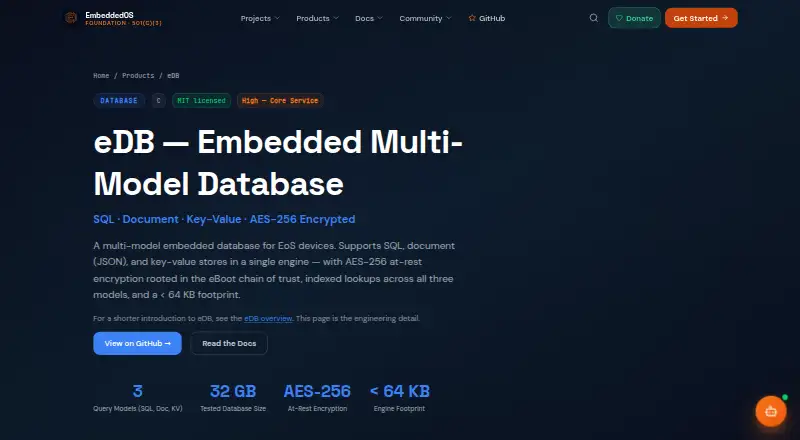
eDB is an embedded multi-model database for EmbeddedOS devices, combining SQL, JSON document, key-value, graph, and full-text search capabilities. Its SQLite-compatible SQL subset includes common table creation, data insertion, querying, updates, deletion, and joins. B-tree, hash, and inverted indexes serve the different data models. ACID transactions use write-ahead logging and are described as safe across power failures. AES-256-GCM protects data at rest, with keys derived from an eBoot TPM measurement. Storage options include NOR and NAND flash, eMMC, SD cards, and volatile RAM. The engine footprint is listed as under 64 KB of flash, while database size depends on the storage medium and has been tested to 32 GB. Wear leveling is intended to extend NOR and NAND storage life. eDB runs as an EoS service task, uses eBoot for encryption keys, and supports capability-secured inter-process queries through EIPC. It is MIT licensed, open source, self-hosted, and free forever.
Good
- Supports SQL, document, key-value, graph, and full-text data
- ACID transactions use write-ahead logging
- AES-256-GCM protects stored data
- Runs on several embedded storage types
- MIT licensed and free forever
Watch out
- Designed for EmbeddedOS devices
- Database size depends on storage medium
- Python implementation requires version 3.11 or later
Who it suits
eDB suits developers building EmbeddedOS applications that need persistent sensor logs, model metadata, configurations, device state, or health records. It fits teams seeking a compact, self-hosted database with several data models.
Verdict
eDB offers broad data-model support in a small embedded footprint, with transaction durability, encryption, and multiple storage choices. Its fit depends on using the EmbeddedOS environment and the stated implementation requirements.
The facts
Each one read from eDB's own pages, with the date it was checked.
What it does
- Durability
- Built-in flash wear leveling is described as extending storage lifetime on NOR and NAND flash.checked 5 Oct 2026
- Encryption
- The page specifies AES-256-GCM at-rest encryption with keys derived from the eBoot TPM measurement, and says data is device-bound.checked 5 Oct 2026
- Indexes
- The product page describes B-tree SQL indexes, hash indexes for key-value data, and inverted indexes for document full-text search.checked 5 Oct 2026
- Integrations
- The page says eDB depends on the EoS Kernel, eBoot, and EIPC, and powers eAI, eOffice, eHealth365, eFlow, and other EoS applications.checked 5 Oct 2026
- Intended users
- The product page presents eDB for EoS applications that need persistent storage, including sensor logs, AI model metadata, configurations, device state, and health records.checked 4 Oct 2026
- License
- The product is described as open source under the MIT license, with issues, discussions, and pull requests welcome.checked 5 Oct 2026
- Limits
- The engine footprint is listed as under 64 KB of flash, and the database size is limited by the storage medium but tested to 32 GB.checked 4 Oct 2026
- Product
- eDB is a multi-model embedded database for EoS devices, supporting SQL, JSON document, and key-value stores.checked 5 Oct 2026
- Purpose
- eDB is an embedded multi-model database for EoS devices with SQL, JSON document, and key-value stores.checked 4 Oct 2026
- Repository implementation
- The linked GitHub README describes a Python engine with a FastAPI HTTP API and a React/TypeScript database-manager UI; it requires Python 3.11 or later.checked 5 Oct 2026
- Security response
- The Foundation says it will respond to security reports within 48 hours and follows a 90-day responsible disclosure timeline.checked 4 Oct 2026
- Size
- The engine footprint is listed as under 64 KB of flash, and the tested database size is 32 GB.checked 5 Oct 2026
- SQL
- Its SQL interface supports a SQLite-compatible subset including CREATE TABLE, INSERT, SELECT, UPDATE, DELETE, and JOIN.checked 5 Oct 2026
- Storage
- Supported storage includes NOR flash, NAND flash, eMMC, SD card, and volatile RAM.checked 5 Oct 2026
- Support
- The Foundation lists technical support for build failures, board bring-up, toolchain setup, and documentation questions; other enquiries are answered in arrival order.checked 4 Oct 2026
- Transactions
- eDB provides ACID transactions with write-ahead logging and says they are safe across power failures.checked 5 Oct 2026
- Use cases
- The maker presents eDB for persistent device data such as sensor logs, AI model metadata, user configurations, device state, and health records, including medical, financial, and defense applications.checked 5 Oct 2026
The company
- Maker
- The product page identifies its publisher as EmbeddedOS Foundation, a 501(c)(3).checked 5 Oct 2026
Money
- Price
- The EmbeddedOS products page describes the ecosystem as open-source, MIT-licensed, and free forever.checked 4 Oct 2026
Alternatives to eDB
- 1
CrateDB
Free planOpen sourceWebAPILinuxmacOS8.4Free plan - 2

ArcadeDB
Free planOpen sourceWebAPILinuxmacOS8.3From $19.99 a month - 3
SingleStore Helios
Free planWebAPILinuxmacOS8.1Free plan - 4
Virtuoso Universal Server
Open sourceWebAPILinuxmacOS7.9From $99.99 a year - 5

Aerospike Database
Free planOpen sourceWebAPILinuxmacOS7.8Free plan - 6

Amazon DynamoDB
Free planAndroidiOSWebAPI7.8Free plan