DRBL
DRBL is free, open-source software for deploying GNU/Linux from one server to many client machines.
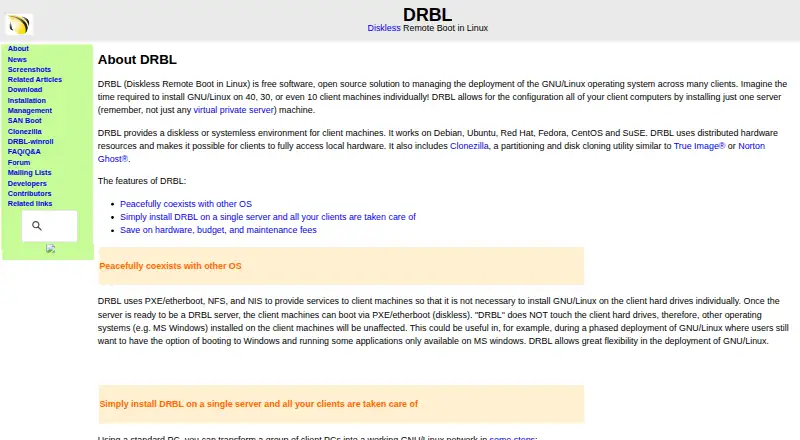
What DRBL is
DRBL is free, open-source software for deploying GNU/Linux from one server to many client machines. It can provide a diskless or systemless setup in which clients boot over PXE or etherboot without installing GNU/Linux on each client hard drive. DRBL says clients can use distributed hardware resources while retaining full access to local hardware, and that existing systems such as Windows are unaffected because client drives are not touched. The software includes Clonezilla for partitioning and disk cloning. Administrators can switch boot modes, copy files, manage user accounts, and send commands to all clients. DRBL uses PXE/etherboot, NFS, and NIS to provide network services, and supports network and multicast deployment. The installation guide lists Debian Bullseye and Buster, Ubuntu Jammy and Focal, CentOS 7, Scientific Linux 7.x, and RHEL 7.x as supported server distributions; it says other distributions or versions will not work. Setup is described as complicated for beginners. DRBL Live comes as an ISO for CD/DVD or a ZIP for USB flash drives or hard drives, with amd64, i686-pae, and i686 builds.
Good
- Boot clients without installing GNU/Linux on their drives
- Includes Clonezilla for disk cloning
- Commands manage accounts, files, and boot modes
- Supports network and multicast deployment
Watch out
- Other server distributions or versions will not work
- Setup can be complicated for beginners
- Windows SAN booting is experimental
Who it suits
DRBL suits administrators managing GNU/Linux deployment across multiple clients from a server. Its installation requirements make it a better fit for users comfortable with the listed Linux distributions and network setup.
Verdict
DRBL offers centralized deployment and management for compatible GNU/Linux environments, including diskless booting and Clonezilla. Check the supported server distributions and installation demands before adopting it.
Plans and prices
From DRBL's own pricing page, checked 8 Oct 2026.
| Plan | Price | What it gives you |
|---|---|---|
| DRBL | Free | Free software, open source solution |
The facts
Each one read from DRBL's own pages, with the date it was checked.
What it does
- Checksum availability
- The DRBL Live download pages provide MD5, SHA1, SHA256, and SHA512 checksums for listed images.checked 8 Oct 2026
- Client hardware
- DRBL says its clients use distributed hardware resources and can fully access local hardware.checked 8 Oct 2026
- Diskless clients
- DRBL provides a diskless or systemless environment in which clients can boot over PXE/etherboot without installing GNU/Linux on each client hard drive.checked 8 Oct 2026
- Experimental feature
- The SAN boot instructions describe Microsoft Windows SAN booting on DRBL as experimental.checked 8 Oct 2026
- Imaging
- DRBL includes Clonezilla, described as a partitioning and disk cloning utility.checked 8 Oct 2026
- Installation complexity
- The installation guide says setting up DRBL on GNU/Linux is a little complicated for a beginner.checked 8 Oct 2026
- Live architectures
- The download page lists amd64, i686-pae, and i686 architectures for DRBL Live.checked 8 Oct 2026
- Live formats
- DRBL Live is offered as an ISO for CD/DVD or a ZIP file for USB flash or hard drives.checked 8 Oct 2026
- Management commands
- DRBL commands can switch client boot modes, copy files to clients, manage user accounts, and issue commands to all clients.checked 8 Oct 2026
- Network services
- DRBL uses PXE/etherboot, NFS, and NIS to provide services to client machines.checked 8 Oct 2026
- Purpose
- DRBL manages deployment of the GNU/Linux operating system across many clients from one server.checked 8 Oct 2026
- Support
- The installation guide directs users to report bugs by generating a drbl-bug-report report and emailing the DRBL user mailing list or posting in the DRBL forum.checked 8 Oct 2026
- Supported server distributions
- The installation guide lists Debian Bullseye and Buster, Ubuntu Jammy and Focal, CentOS 7, Scientific Linux 7.x, and RHEL 7.x, and says other distributions or versions will not work.checked 8 Oct 2026
Where it runs
- Windows coexistence
- DRBL says it does not touch client hard drives, so other installed operating systems such as Windows are unaffected.checked 8 Oct 2026
Alternatives to DRBL
- 1

OPSI
Free planOpen sourceWebAPILinuxmacOS8.4From €4.99 a year - 2

Canonical MAAS
Free planOpen sourceWebAPILinuxSelf-hosted8.1From $30 a year - 3

FOG Project
Free planOpen sourceWebAPILinuxmacOS7.7Free plan - 4

Foreman
Free planWebAPILinuxSelf-hosted6.9Free plan - 5

Symantec IT Management Suite
WebAPILinuxmacOS6.8 - 6

Clonezilla
Free planLinuxmacOSSelf-hostedWindows6.7Free plan