
Clonezilla
Clonezilla is a partition and disk imaging program for system deployment, bare-metal backup, and recovery.
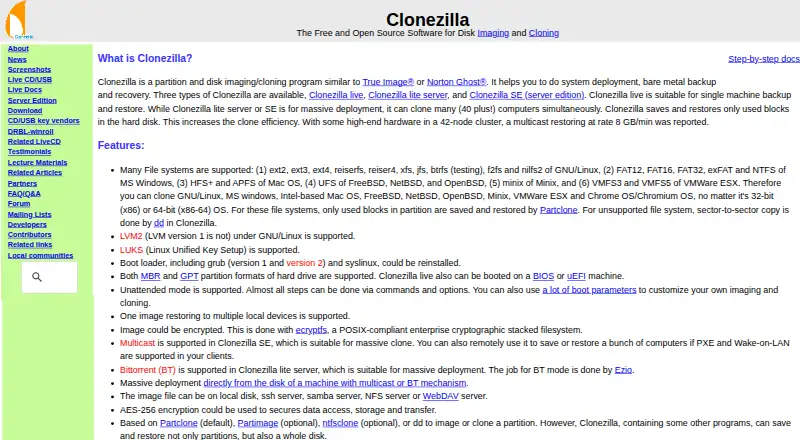
What Clonezilla is
Clonezilla is a partition and disk imaging program for system deployment, bare-metal backup, and recovery. Clonezilla live is designed for one machine, while its lite server and SE editions can clone many computers simultaneously; the site describes deployments of 40-plus computers. It saves and restores used blocks on supported file systems, and uses sector-to-sector copying for unsupported ones. Listed file systems include Linux, Windows, Mac, BSD, Minix, and VMware formats such as ext4, NTFS, APFS, and VMFS3/5. Images can be stored on a local disk or SSH, Samba, NFS, or WebDAV servers, and can be encrypted with AES-256. Clonezilla SE supports multicast, while lite server supports BitTorrent deployment. Clonezilla live boots on BIOS or UEFI machines and supports MBR and GPT. It requires an x86 or x86-64 processor, 196 MB RAM, and a boot device such as CD/DVD, USB, PXE, or hard drive. The destination partition must be at least as large as the source. Differential or incremental backups and online imaging are not implemented, and images cannot be mounted or explored for direct recovery of individual files. Clonezilla is free software under GPL version 2.
Good
- Free software under GPL version 2.
- Server editions support simultaneous cloning of many computers.
- Images can be encrypted with AES-256.
- Clonezilla live supports BIOS and UEFI booting.
Watch out
- Destination partition must be at least source size.
- Incremental and differential backups are not implemented.
- Online imaging is not implemented.
- Images cannot be mounted for direct file recovery.
Who it suits
Clonezilla suits people who need disk imaging for backup, recovery, or multi-computer deployment and can use a Linux-based boot environment. It may be a poor fit when online or incremental backups, or direct access to individual files in an image, are required.
Verdict
Clonezilla offers disk imaging options ranging from one-machine use to multi-computer deployment. Its limits around online and incremental backups, destination size, and individual-file recovery are important to weigh first.
Plans and prices
From Clonezilla's own pricing page, checked 29 Sep 2026.
| Plan | Price | What it gives you |
|---|---|---|
| Clonezilla | Free | Free and open source software · GPL version 2 |
The facts
Each one read from Clonezilla's own pages, with the date it was checked.
What it does
- Backup scope
- mixedchecked 23 Sep 2026
- Boot and partition support
- The site lists MBR and GPT support, and says Clonezilla live can boot on BIOS or UEFI machines.checked 29 Sep 2026
- Computer backup
- Yeschecked 23 Sep 2026
- Current release
- The downloads page lists stable Clonezilla live 3.3.3-37 as Debian-based and alternative stable 20260913-resolute as Ubuntu-based.checked 29 Sep 2026
- Deployment scale
- Clonezilla live is suitable for one machine; lite server and SE can clone many computers simultaneously, with the site describing 40-plus computers.checked 29 Sep 2026
- Download verification
- The downloads page says checksum files are GPG-signed by the DRBL project.checked 29 Sep 2026
- Editions
- The site lists Clonezilla live, Clonezilla lite server, and Clonezilla SE (server edition).checked 29 Sep 2026
- Encryption
- The site says images can be encrypted and that AES-256 encryption can secure data access, storage, and transfer.checked 29 Sep 2026
- File systems
- The site lists support for Linux, Windows, Mac, BSD, Minix, and VMware file systems, including ext4, NTFS, APFS, and VMFS3/5.checked 29 Sep 2026
- Image access limitation
- The site says Clonezilla images cannot be explored or mounted, so individual file recovery from an image is not directly supported.checked 29 Sep 2026
- Limitations
- The destination partition must be at least as large as the source; differential or incremental backups and online imaging are not implemented.checked 29 Sep 2026
- Mass deployment
- Clonezilla SE supports multicast; Clonezilla lite server supports BitTorrent for massive deployment.checked 29 Sep 2026
- Minimum requirements
- Clonezilla live requires an x86 or x86-64 processor, 196 MB RAM, and a boot device such as CD/DVD, USB, PXE, or hard drive.checked 29 Sep 2026
- Mobile backup
- Nochecked 23 Sep 2026
- Purpose
- Clonezilla is a partition and disk imaging and cloning program for system deployment, bare metal backup, and recovery.checked 29 Sep 2026
- Ransomware protection
- Nochecked 23 Sep 2026
- Restore modes
- mixedchecked 23 Sep 2026
- Server backup
- Yeschecked 23 Sep 2026
- Storage and transfer
- Image files can be stored on a local disk or on SSH, Samba, NFS, or WebDAV servers.checked 29 Sep 2026
- Used blocks
- Clonezilla saves and restores only used blocks on supported file systems; it uses sector-to-sector copying for unsupported file systems.checked 29 Sep 2026
Money
- Free plan
- Yeschecked 23 Sep 2026
Where it runs
- Supported platforms
- Linux-based bootable environment; can image supported file systems used by Linux,Windows,Mac,BSD,Minix,VMware ESX,and Chrome OS/Chromium OSchecked 23 Sep 2026
The full review of Clonezilla
Overview
Clonezilla is a free disk and partition imaging tool for cloning systems, deploying them, and recovering from bare-metal failures. It suits administrators and technically comfortable users who can work from a bootable environment; it is a poor fit for routine online or file-by-file backups.
Its three editions cover one-machine work and simultaneous multi-computer deployments, but the trade-offs matter: there are no incremental backups, and image contents cannot be browsed for individual files.
Key features
Imaging and file systems
On supported file systems, Clonezilla copies used blocks, which avoids copying empty space. Unsupported file systems instead require sector-to-sector copying. The supported range includes Linux, Windows, Mac, BSD, Minix, and VMware file systems, including ext4, NTFS, APFS, and VMFS3/5.
Images can be saved to local disks or SSH, Samba, NFS, and WebDAV servers. MBR and GPT are supported, and Clonezilla live can boot on BIOS and UEFI systems. The project also says images can be encrypted, with AES-256 available to secure access, storage, and transfer.
Deployment editions
Clonezilla live is aimed at a single machine. Clonezilla lite server and Clonezilla SE can clone many computers simultaneously; the project describes use with more than 40 computers. SE supports multicast, while lite server supports BitTorrent for large deployments. These options make Clonezilla more compelling for system rollout than for users seeking a polished everyday backup workflow.
Boot requirements and limits
Clonezilla live requires an x86 or x86-64 processor, at least 196 MB of RAM, and a boot device such as CD/DVD, USB, PXE, or a hard drive. The destination partition must be at least as large as the source. Online imaging and differential or incremental backups are not implemented, so backups require a boot workflow and repeated full imaging rather than ongoing change capture.
Images cannot be explored or mounted, which rules out direct recovery of a single file from an image. That is a significant drawback when the goal is retrieving one document rather than restoring or duplicating a disk.
Pricing
Clonezilla is free and open-source software under GPL version 2. Its Clonezilla plan costs nothing. The free plan includes the imaging and cloning program rather than a time-limited trial or paid tier; no paid plan is presented. The practical cost is the boot-based workflow and the limits on incremental, online, and individual-file recovery.
Platforms
Clonezilla runs from a Linux-based bootable environment, with Clonezilla live supporting x86 and x86-64 BIOS or UEFI machines. It can image supported file systems used by Linux, Windows, Mac, BSD, Minix, VMware ESX, and Chrome OS/Chromium OS. It supports computer and server backup, but not mobile backup. The downloads page lists stable Clonezilla live 3.3.3-37, based on Debian, and alternative stable 20260913-resolute, based on Ubuntu; download checksum files are GPG-signed by the DRBL project.
Who it's for
Choose Clonezilla when you need free disk-level recovery or repeatable deployment across machines and can boot systems into a dedicated environment. Its server editions make it especially relevant to administrators cloning fleets. Look elsewhere for continuous backups, imaging while a system is online, smaller destination partitions, or direct access to individual files inside an image.
Pros and cons
Pros
- Free and open source: the software costs nothing and is distributed under GPL version 2.
- Scales beyond one machine: lite server and SE can clone many computers at once, with multicast or BitTorrent options for mass deployment.
- Broad system coverage: supported file systems span several operating-system families, and live supports both BIOS and UEFI booting.
- Remote image storage and encryption: images can go to common network servers, with AES-256 encryption available.
Cons
- Boot-based operation: online imaging is not implemented, so it does not serve as a live, continuous backup tool.
- No incremental or differential backups: it cannot limit subsequent backups to changed data.
- No direct file recovery: images cannot be mounted or browsed to retrieve a single file.
- Destination size constraint: the destination partition must be at least as large as the source.
Alternatives
For a different free disk-cloning option, compare Redo Rescue, whose code can be audited, modified, and copied at no cost under GNU GPLv3. Rescuezilla is another free option that runs from a bootable USB or CD-ROM.
Pick HDClone if its free edition's private-use limit of up to 4 TB and 70 MB/s fits your needs, or if you need its paid Basic Edition for up to two PCs. Lazesoft Recovery Suite combines data recovery, Windows recovery, password recovery, disk imaging, and cloning for non-commercial home use.
AOMEI Backupper is a Windows-only alternative with a perpetually free Standard plan for PC backup. Casper is a Windows alternative with free and trial options. For personal, non-commercial Windows use on up to three PCs in one household, Lazesoft Disk Image & Clone has a free Home Edition. Mac users can consider SuperDuper!, which offers an unregistered erase-then-copy mode.
Browse Disk Cloning Software, OS Deployment Software, Bare Metal Provisioning Software, Disk Imaging Software, and Backup software for more options.
Verdict
Clonezilla is the right choice for cost-conscious users and administrators who need bootable disk imaging, bare-metal recovery, or large-scale cloning. Its free licensing, file-system coverage, and server deployment options are strong reasons to choose it. Look elsewhere if you need online or incremental backups, smaller-target restores, or convenient single-file recovery.
Getting started
- Open the Clonezilla website and choose Clonezilla live, lite server, or SE.
- For Clonezilla live, use an x86 or x86-64 computer with at least 196 MB RAM.
- Prepare a boot device such as USB, CD/DVD, PXE, or a hard drive.
- Boot Clonezilla live on a BIOS or UEFI machine, or use a server edition for multi-computer cloning.
Limits worth knowing
The destination partition must be at least as large as the source. Differential and incremental backups and online imaging are not implemented, and images cannot be explored or mounted for direct file recovery.
Questions
How much does Clonezilla cost?
Clonezilla is free and open-source software under GPL version 2.
Which editions are available?
The editions are Clonezilla live, Clonezilla lite server, and Clonezilla SE. Live is suitable for one machine; the server editions can clone many computers simultaneously.
Which file systems can it image?
Listed support includes Linux, Windows, Mac, BSD, Minix, and VMware file systems, including ext4, NTFS, APFS, and VMFS3/5.
Where can Clonezilla store images?
Images can be stored on a local disk or on SSH, Samba, NFS, or WebDAV servers.
Can I restore individual files from an image?
Images cannot be explored or mounted, so direct individual-file recovery from an image is not supported.
What does Clonezilla live require?
It requires an x86 or x86-64 processor, 196 MB RAM, and a boot device such as CD/DVD, USB, PXE, or a hard drive.
Alternatives to Clonezilla
- 1

FOG Project
Free planOpen sourceWebAPILinuxmacOS7.7Free plan - 2
Lazesoft Recovery Suite
Free planLinuxWindows7.0$27.95 one-time - 3

HDClone
Free planLinuxSelf-hostedWindows6.7€19.90 one-time - 4
Lazesoft Disk Image & Clone
Free planWindows6.6$17.95 one-time - 5
OpenSuperClone
Free planLinux6.5Free plan - 6
Redo Rescue
Free planLinuxmacOSWindows6.5Free plan