
Draup
Draup provides AI and data intelligence for enterprise sales and talent teams.
What Draup is
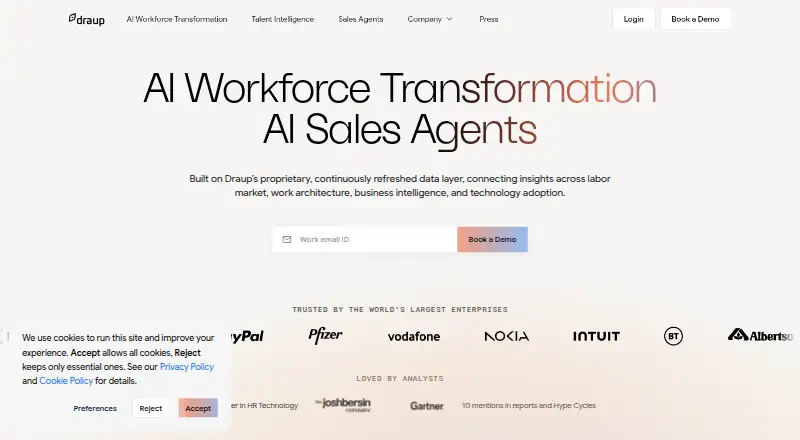
Draup provides AI and data intelligence for enterprise sales and talent teams. Its talent intelligence covers labor supply and demand, compensation, talent movement, work architecture, business priorities, and technology adoption. Workforce planning tools support benchmarking, location analysis, talent acquisition, skills planning, reskilling, and university hiring. Curie, an AI assistant for HR teams, can forecast talent needs, map skills to business needs, benchmark peers, design roles, and support reskilling. Etter models potential AI effects across business units and workflows, estimates ROI, and helps shape transformation plans. For sales teams, Draup delivers account, buyer, and industry intelligence into CRM and sales workflows, and describes more than 50 AI agents for business functions. Data access includes APIs, integrations, scheduled feeds, and marketplaces; named destinations include S3, BigQuery, Snowflake, and Databricks. Draup says data coverage varies by region and role, and distinguishes modeled from reported information. Pricing is available on request.
Good
- Curie supports HR talent forecasting and role design.
- Etter models AI effects and workforce scenarios.
- Sales intelligence can feed CRM and RevOps workflows.
- Data access includes APIs, integrations, feeds, and marketplaces.
Watch out
- Pricing is available only on request.
- Coverage varies by region and role.
- Compensation insights use blended directional inputs.
Who it suits
Draup is intended for enterprise Sales and Talent teams pursuing strategic initiatives. It may suit organizations planning workforce changes or bringing account and buyer intelligence into sales workflows.
Verdict
Draup combines talent and sales intelligence with planning tools and multiple data delivery options. Teams should consider its stated regional and role coverage variation, along with the distinction between modeled and reported data.
The facts
Each one read from Draup's own pages, with the date it was checked.
What it does
- AI assistant
- Curie is an AI assistant for HR teams that can forecast talent needs, map skills to business needs, benchmark peers, design roles, and support reskilling.checked 29 Sep 2026
- AI workforce transformation
- Etter models AI's impact across business units, functions, and workflows, estimates ROI, and builds a workforce transformation roadmap.checked 29 Sep 2026
- API
- The site describes REST endpoints for sales and talent data, including account intelligence, buyer contacts, technology stacks, market signals, roles, skills, and labor market benchmarks.checked 29 Sep 2026
- CRM integrations
- The sales integrations page names Salesforce, HubSpot, Microsoft Dynamics CRM, Zoho CRM, Pipedrive, and Freshsales.checked 30 Sep 2026
- Data access
- Draup offers MCP, Agent2Agent, REST APIs, native integrations, scheduled data feeds, and marketplace access.checked 30 Sep 2026
- Data coverage
- Draup says it analyzes more than 1 billion data points daily from over 100,000 sources, and notes that coverage varies by region and role.checked 30 Sep 2026
- Data delivery
- Draup offers access through MCP, A2A, APIs, native integrations, scheduled feeds, and data marketplaces; named destinations include S3, ADLS, BigQuery, SFTP, Snowflake, and Databricks.checked 29 Sep 2026
- Data feeds
- Scheduled feeds can go to S3, ADLS, BigQuery, or SFTP, with marketplace subscriptions through Snowflake or Databricks.checked 30 Sep 2026
- Data governance
- Draup says its governance combines automated evaluations and human reviews, with statistical checks, audits, and cross-source comparisons to reduce bias.checked 30 Sep 2026
- Data limitations
- Draup says compensation insights use blended directional inputs, distinguishes modeled from reported data, and applies guardrails against over-interpretation.checked 29 Sep 2026
- Etter analysis
- Etter scores tasks for AI automation or augmentation, helps plan reskilling, redeployment, and hiring, and models workforce scenarios.checked 29 Sep 2026
- HR integrations
- The talent integrations page says Draup integrates with 25+ ATS, HRIS, and HCM platforms and names Workday, SAP SuccessFactors, ADP Workforce Now, Oracle Cloud HCM, Rippling, Dayforce, Greenhouse, Oracle Taleo, and iCIMS.checked 30 Sep 2026
- HRIS integrations
- Draup describes native HRIS, HCM, and ATS connectors, including Workday, SAP SuccessFactors, and Oracle HCM.checked 29 Sep 2026
- Product
- Draup provides AI-powered talent intelligence and sales intelligence for enterprise teams.checked 30 Sep 2026
- Product scope
- Draup says it provides agentic AI and data intelligence for enterprise sales and talent teams.checked 29 Sep 2026
- Sales agents
- Draup describes 50+ AI agents for sales, partnerships, marketing, corporate strategy, and customer success workflows.checked 30 Sep 2026
- Sales intelligence
- Draup delivers account, buyer, and industry intelligence into CRM, sales engagement, and RevOps workflows.checked 30 Sep 2026
- Security and compliance
- Draup says it upholds SOC 2, GDPR, and ISO 27001 standards and audits for bias as an EAIGG member.checked 30 Sep 2026
- Support contact
- The site lists Draup, Inc. at 24 Waterway Ave, Suite 850, The Woodlands, Texas 77380, with phone +1 (855) 946-6681 and [email protected].checked 29 Sep 2026
- Talent intelligence
- Its talent intelligence covers labor market supply, demand, compensation, talent flow, work architecture, business priorities, and technology adoption.checked 29 Sep 2026
- Target users
- Draup says its AI-augmented workflows empower enterprise Sales and Talent teams to identify opportunities and execute strategic initiatives.checked 30 Sep 2026
- Workforce transformation
- Etter models AI’s impact across business units, functions, and workflows, estimates ROI, and builds a workforce transformation roadmap.checked 30 Sep 2026
The company
- Headquarters
- Draup, Inc lists its address as 24 Waterway Ave, Suite 850, The Woodlands, Texas 77380.checked 30 Sep 2026
Money
- Workforce planning
- Talent Intelligence supports workforce planning, peer intelligence, location analysis, talent acquisition, skills architecture, reskilling, and university hiring.checked 30 Sep 2026
The full review of Draup
Draup is an enterprise platform combining talent and sales intelligence with AI-assisted planning and data delivery. It best suits Sales and Talent teams that need intelligence in their existing systems or workflows. Its breadth is compelling, but buyers should weigh regional and role coverage variation and distinguish modeled estimates from reported data.
Overview
Draup brings together talent intelligence, workforce planning, sales intelligence, and AI-driven workforce transformation. Rather than serving as a narrow scoring tool, it spans labor-market and account insights, planning workflows, and delivery into business systems. Predictive account scoring is supported, drawing on inputs such as firmographics, geographic footprint, technology changes, executive movements, and buyer-organization coverage.
The platform describes a large, frequently refreshed data operation, while acknowledging that coverage differs by region and role. Compensation insights use blended directional inputs, and Draup distinguishes modeled data from reported data with guardrails against over-interpretation. That makes its intelligence useful for planning and prioritization, but not a substitute for treating every estimate as a verified measurement.
Key features
Talent and workforce planning
Talent intelligence spans labor supply and demand, compensation, talent flows, work architecture, business priorities, and technology adoption. Planning tools cover peer benchmarking, location analysis, talent acquisition, skills architecture, reskilling, and university hiring. This breadth suits organizations connecting hiring and workforce decisions to business priorities; teams seeking only a recruiting database may find the remit broader than they need.
AI assistants and transformation
Curie helps HR teams forecast talent needs, map skills to business needs, benchmark peers, design roles, and support reskilling. Etter models AI’s effects across business units, functions, and workflows, estimates ROI, and builds a workforce transformation roadmap. Its task-level scoring for automation or augmentation can inform reskilling, redeployment, and hiring scenarios. These tools target strategic planning rather than isolated task automation.
Sales intelligence and delivery
Draup describes more than 50 AI agents for sales, partnerships, marketing, corporate strategy, and customer success workflows. Its sales intelligence covers accounts, buyers, and industries, with CRM, sales engagement, and RevOps workflows as destinations. REST APIs expose sales and talent data such as account intelligence, buyer contacts, technology stacks, roles, skills, market signals, and labor benchmarks.
Delivery options include MCP, Agent2Agent, APIs, native integrations, scheduled feeds, and data marketplaces. Feeds can go to S3, ADLS, BigQuery, or SFTP, with marketplace subscriptions through Snowflake or Databricks. Named CRM integrations include Salesforce, HubSpot, Microsoft Dynamics CRM, Zoho CRM, Pipedrive, and Freshsales; HR integrations include Workday, SAP SuccessFactors, ADP Workforce Now, Oracle Cloud HCM, Rippling, Dayforce, Greenhouse, Oracle Taleo, and iCIMS. That range is useful for teams that need intelligence embedded in established systems, though buyers should assess fit with their own stack.
Governance
Draup says its governance combines automated evaluations with human reviews, statistical checks, audits, and cross-source comparisons to reduce bias. It states that it upholds SOC 2, GDPR, and ISO 27001 standards and is an EAIGG member that audits for bias. These practices matter for enterprise adoption, alongside careful interpretation of modeled and directional data.
Pricing
Draup uses a paid pricing model with custom pricing. Enterprise buyers should weigh the cost against their intended mix of intelligence, planning, integrations, and data delivery. No lower self-serve tier is described, so it is a less straightforward choice for individuals or small teams seeking a fixed-price entry point.
Platforms
Draup is available on web and through APIs. Its native integrations, scheduled feeds, and marketplace delivery extend data into connected systems and warehouses.
Who it's for
Draup is best suited to enterprise Sales and Talent teams coordinating strategic decisions across accounts, skills, hiring, and workforce transformation. It is particularly relevant where teams want predictive account scoring alongside labor-market intelligence and have a need to deliver data into CRM, HR systems, or data platforms. Organizations that need simple, directly comparable compensation figures or consistent coverage across every role and region should be cautious about relying on its directional and modeled outputs.
Pros and cons
- Pros: It joins sales and talent intelligence with workforce planning and AI transformation workflows, which can serve teams making linked commercial and staffing decisions.
- Pros: Multiple integration and delivery routes, including named CRM and HR platforms, warehouses, and APIs, give enterprise teams options for embedding data in existing workflows.
- Pros: The stated governance process includes automated and human review, audits, and cross-source checks, relevant to organizations evaluating data quality and bias.
- Cons: Pricing is custom, making cost comparison and budget planning less direct than with a published plan.
- Cons: Coverage varies by region and role, and compensation inputs are directional; users should validate whether the data is suitable for the decision at hand.
Alternatives
For a focused scoring comparison, browse Lead Scoring Software; for a talent-focused shortlist, see Talent Intelligence Software.
- UserMotion is worth considering when a free entry point matters: its Free plan is free, includes up to 1,000 accounts, ICP and intent scoring, real-time signals, and email and chat support; it also offers a free trial.
- 6sense is an alternative for teams seeking predictive AI, sales copilot capabilities, and company and contact data acquisition, with API access and no free plan.
- Common Room may suit teams seeking an API, extension, and web product with a defined annual Essential plan: $2,500 a month billed annually, including 5 seats, up to 100k contacts, 5k RoomieAI research credits, and 2.5k Prospector credits.
- Revic is another paid, web-based option with enterprise packaging scoped by account coverage, team access, and workflows.
- QuickOn is a freemium API and web option; its Free plan includes 100 leads per month, one lead source and JS widget, one project, and community support.
- LeadBoxer offers freemium API and web access, including a Free (App) plan with 25,000 credits per month, one user, one dataset, and one month of data retention.
- Demandbase is a paid, API-based alternative.
- HG Insights is a paid, API-based option with seat-, credit-, and lead-based packaging.
Verdict
Draup is a strong candidate for enterprise Sales and Talent teams that want intelligence, planning, and workforce transformation in one broad platform, especially when integration and data delivery options matter. Choose it for that breadth and strategic reach; look elsewhere if you need transparent fixed pricing or can’t accommodate variation in regional and role coverage or modeled, directional data.
Alternatives to Draup
- 1

IBM Planning Analytics
iOSWebAPIExtension7.9 - 2
Betterworks
AndroidiOSWebAPI7.3From $8 a month - 3

Findem
Free planWebAPI6.8Free plan - 4
Talentguide
Free planWeb6.7From €5 a month - 5

Reejig
WebAPI6.5From $250,000 a year - 6

TalentGuard
WebAPI6.5From $1.60 a year