DialMyCalls
DialMyCalls sends organizations text messages, recorded voice calls, and email notifications for alerts, reminders, schedule changes, and announcements.
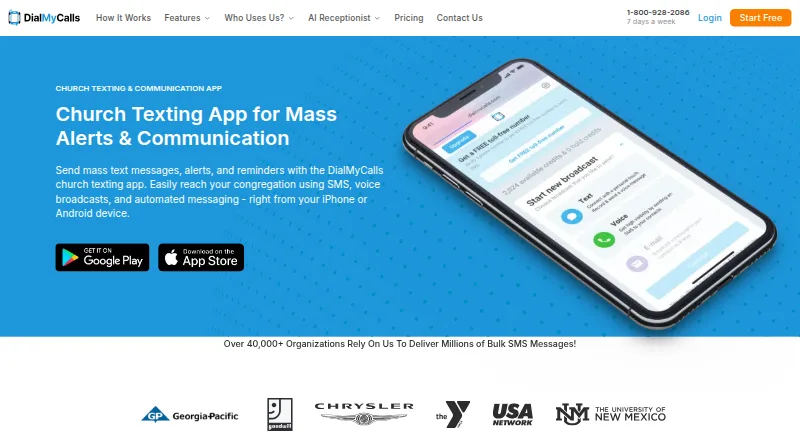
What DialMyCalls is
DialMyCalls sends organizations text messages, recorded voice calls, and email notifications for alerts, reminders, schedule changes, and announcements. Its church app lets congregations send mass texts, voice broadcasts, and automated messages from iPhone or Android devices. Text features include scheduled or immediate SMS, two-way replies, MMS, landline texting, templates, and polls. Voice broadcasts can use recorded audio or text-to-speech and include answering-machine detection, press-1 responses, opt-outs, and reports. The service lists integrations such as Google Calendar, HubSpot, Mailchimp, Salesforce, Slack, Zapier, and Zoho. Its API can sync contacts and add SMS or voice broadcasts to existing software. A free church account includes an automatic call to up to 25 members, with a 30-second message once per week. Monthly-plan church group texts are limited to 157 characters; extended texts are available for an additional monthly fee. The pricing note lists paid service from $9.99/mo and a 14-day trial, while several plan prices depend on the selected contact or credit amount.
Good
- Supports two-way replies, MMS, and text polling.
- Voice broadcasts can use recorded audio or text-to-speech.
- Messages can be scheduled or sent immediately.
- API can sync contacts and add messaging to existing software.
- Free church account includes a weekly call to 25 members.
Watch out
- No general free plan is listed.
- Church group texts on monthly plans cap at 157 characters.
- Extended church texts cost an additional monthly fee.
- Pay-as-you-go credit purchases require at least 200 credits.
Who it suits
DialMyCalls may suit churches and other organizations that need to reach members, customers, employees, or residents by text, voice, and email. Its app supports congregations sending messages from iPhone or Android devices.
Verdict
DialMyCalls covers text, voice, and email outreach, including church messaging from mobile devices. Consider the 157-character monthly church-text limit and plan-specific contact or credit pricing when selecting an option.
Plans and prices
From DialMyCalls's own pricing page, checked 28 Sep 2026.
| Plan | Price | What it gives you |
|---|---|---|
| Free church trial | Free | free account; free automatic call up to 25 church members; 30-second message; once per week |
| Contact Based | — | for recurring contact groups; messages go to a set group of contacts · Monthly or annual (save 10%); displayed price depends on selected contact amount |
| Credit Based | — | for changing contact lists; unused credits roll over; larger accounts contact sales · Monthly or annual (save 10%); displayed price depends on selected credit amount |
| Pay As You Go | — | 200–499 credits: 7.5¢ each · 500–999: 7.0¢ each · 1,000–2,499: 6.5¢ each · 2,500–9,999: 5.8¢ each · 10,000–24,999: 5.0¢ each · 25,000–49,999: 4.4¢ each · 50,000–99,999: 4.1¢ each · 100,000–250,000: 3.8¢ each · 250,000+: contact sales · One-time credit purchase; 200-credit minimum |
The facts
Each one read from DialMyCalls's own pages, with the date it was checked.
What it does
- API
- The API can sync contacts and add voice broadcasts and SMS sending to existing software.checked 28 Sep 2026
- Church message limit
- On monthly plans, church group texts can contain up to 157 characters, and extended texts are available for an additional monthly fee.checked 28 Sep 2026
- Church use
- Its church app lets congregations send mass texts, voice broadcasts, and automated messages from iPhone or Android devices.checked 28 Sep 2026
- Credit usage
- One credit covers one call to one number with a 30-second message or one text to one number with 157 characters.checked 28 Sep 2026
- Integrations
- Listed integrations include Acuity Scheduling, Calendly, Constant Contact, Eventbrite, Freshdesk, Google Calendar, HubSpot, Mailchimp, Salesforce, Slack, Zapier, and Zoho.checked 28 Sep 2026
- Privacy
- DialMyCalls says customer account information is the organization’s property and will not be sold, disclosed, or distributed.checked 28 Sep 2026
- Purpose
- DialMyCalls sends organizations text messages, recorded voice calls, and email notifications for alerts, reminders, schedule changes, and announcements.checked 28 Sep 2026
- Security
- The security page says the service uses 256-bit SSL encryption, routine PCI compliance scans, employee two-factor authentication, and SOC 2 Type II compliant data center facilities.checked 28 Sep 2026
- Support
- The company lists phone and live chat support seven days a week, email support, and 24-hour emergency support for eligible accounts.checked 28 Sep 2026
- Texting
- The service supports scheduled and immediate mass SMS, two-way replies, MMS, landline texting, templates, and text polling.checked 28 Sep 2026
- Voice broadcasts
- Voice broadcasts can use a recorded voice or text-to-speech, with answering-machine detection, press-1 responses, opt-outs, and reports.checked 28 Sep 2026
- Who it serves
- The company describes its audience as businesses and organizations reaching customers, employees, members, and residents.checked 28 Sep 2026
The company
- Founded
- 1999checked 28 Sep 2026
- Headquarters
- Jupiter, Florida, United Stateschecked 28 Sep 2026
Where it runs
- Platforms
- The mobile apps are available for iOS and Android, and the pricing page lists a Chrome browser extension and API access.checked 28 Sep 2026
The full review of DialMyCalls
Overview
DialMyCalls is a group-messaging service for organizations that need to send texts, recorded calls, or email notifications. It suits teams communicating with customers, employees, members, or residents, especially congregations that want to reach people from a phone. Its broad mix of channels and scheduling tools is useful, but the church plan’s short text limit and pricing that varies with contacts or credits deserve attention.
Founded in 1999 and headquartered in Jupiter, Florida, DialMyCalls combines mobile church messaging with tools for broader organizational outreach. The company describes its safeguards as 256-bit SSL encryption, routine PCI compliance scans, employee two-factor authentication, and SOC 2 Type II-compliant data center facilities. It says customer account information remains the organization’s property and will not be sold, disclosed, or distributed.
Key features
Text messaging
Teams can send mass SMS immediately or schedule it, with recurring messages, templates, MMS, landline texting, text polls, and two-way replies. That range supports both announcements and response-driven communication. Audience segmentation is also available, which can help organizations target messages to relevant groups rather than contact everyone at once.
Church group texts on monthly plans are limited to 157 characters; longer texts require an additional monthly fee. That cap can make concise alerts manageable, but organizations that routinely send detailed updates should account for the extra charge or consider whether another channel is a better fit. One credit covers one text to one number of up to 157 characters.
Voice and email
Voice broadcasts can use a recording or text-to-speech, with answering-machine detection, press-1 responses, opt-outs, and reports. These controls make voice a practical companion to SMS for announcements that need a response or may reach people who do not read texts promptly. DialMyCalls also sends email notifications, giving organizations another channel for alerts, reminders, schedule changes, and announcements.
Integrations and API
Integrations include Acuity Scheduling, Calendly, Constant Contact, Eventbrite, Freshdesk, Google Calendar, HubSpot, Mailchimp, Salesforce, Slack, Zapier, and Zoho. Its API can sync contacts and add SMS sending and voice broadcasts to existing software, making the service more relevant to organizations that want to connect outreach with their current systems.
Pricing
DialMyCalls uses a freemium model, advertises paid plans from $9.99/mo, and offers a 14-day trial. Its free church trial costs nothing and provides a free account with an automatic call to up to 25 church members, a 30-second message, and one call per week. That is a narrow way to try church calling, not a general free messaging plan.
Contact Based is billed monthly or annually, with annual billing saving 10%. Its displayed price depends on the chosen contact amount, and messages go to a set group. It is the better fit for recurring contact groups; the tradeoff is that a changing audience may not suit a fixed-contact approach.
Credit Based is also billed monthly or annually, with a 10% annual-billing saving. Price depends on the selected credit amount. Unused credits roll over, which favors organizations with variable outreach, while larger accounts must contact sales.
Pay As You Go uses a one-time credit purchase with a 200-credit minimum. Rates are 7.5¢ each for 200–499 credits, 7.0¢ for 500–999, 6.5¢ for 1,000–2,499, 5.8¢ for 2,500–9,999, 5.0¢ for 10,000–24,999, 4.4¢ for 25,000–49,999, 4.1¢ for 50,000–99,999, and 3.8¢ for 100,000–250,000; purchases of 250,000+ credits require contacting sales. The one-time structure may suit occasional campaigns, though the minimum purchase and per-credit cost require matching the purchase to expected use. One credit covers either one call to one number with a 30-second message or one text to one number with 157 characters.
The service includes 150 messages/mo, but organizations should distinguish that allowance from the credit-based terms and consider how their channel mix affects usage. Monthly and annual options, audience size, and credit selection all shape which paid approach makes sense.
Platforms
DialMyCalls supports Android, iOS, and web, alongside an API and extension. The church app’s mobile support is useful for staff or volunteers who need to send messages from a phone; the API and extension broaden its fit for organizations connecting outreach to other systems.
Who it's for
DialMyCalls is a strong fit for congregations and organizations that need scheduled or recurring group communication across text, voice, and email. Churches should especially weigh the 157-character monthly-plan limit and the extra fee for extended texts. Teams with changing audiences may prefer credit-based pricing, while stable recurring groups align more naturally with Contact Based. It is less compelling for organizations seeking a straightforward, unlimited free plan or predictable pricing independent of contact and credit volume.
Pros and cons
- Pros: Multiple channels—SMS, voice, and email—let organizations reach groups in different ways.
- Pros: Scheduled and recurring messages, two-way replies, polls, and segmentation support ongoing and targeted communication.
- Pros: The API and broad set of integrations can connect outreach with existing software.
- Cons: Church group texts on monthly plans stop at 157 characters unless the organization pays an additional monthly fee.
- Cons: Contact- and credit-based plan prices depend on selected volume, making the right cost harder to assess without choosing quantities.
- Cons: The free church trial is limited to one weekly automatic call to up to 25 members, rather than an ongoing free messaging plan.
Alternatives
For a wider comparison of voice outreach, see Voice Broadcasting Software; churches evaluating messaging options can compare Church Text Messaging Software, while organizations focused on broad alerts can browse Mass Notification Software.
Call Loop is worth considering if you want a month-to-month credit plan with unlimited contacts and users: its 250-credit plan is $15 a month and its 500-credit plan is $25 a month. Newfies-Dialer is an option for teams seeking API, web, or self-hosted deployment, with a free plan and paid port-based plans. Adoptiv Voice Broadcasting may suit a web-based voice-broadcasting need with per-seat plans and AI call analysis. EnableX Voice Broadcasting is a web and API option priced per contact, with domestic India calling rates billed by the minute per call leg.
CallMultiplier may suit small groups seeking an unlimited-usage plan: its $7.99 a month option covers up to 25 members, with standard texts and calls and voice messages up to two minutes. Hello Hunter Voice Broadcasting offers minute-based plans, including Basic at $100 a month for 4,000 minutes and Basic + at $200 a month for 8,000 minutes. VoxPro Voice Broadcasting is another web-based voice-broadcasting option. BBOX Voice Messaging is a web-based voice-messaging alternative.
Verdict
Choose DialMyCalls if your organization needs one service for group texts, voice broadcasts, and email, with mobile church messaging, scheduling, and integration options. Its strongest case is channel breadth paired with flexible contact- or credit-based approaches. Look elsewhere if your church depends on longer monthly-plan texts without an extra fee or needs pricing that does not hinge on audience and credit volume.
Alternatives to DialMyCalls
- 1
Text-Em-All (formerly Call-Em-All)
Free planAndroidiOSWebAPI8.1From $19 a month - 2
NetSupport Notify
AndroidiOSWebExtension7.6$2 one-time - 3
Open Paging Server
Free planOpen sourceWebLinuxSelf-hosted7.1Free plan - 4

OnPage
AndroidiOSWebAPI7.0From $13.99 a month - 5
PushPulse
AndroidiOSWebmacOS6.9From $540 a year - 6
SA-Announce
AndroidiOSAPImacOS6.8