Open Paging Server
Open Paging Server is a public address and mass notification system that runs on existing VoIP infrastructure.
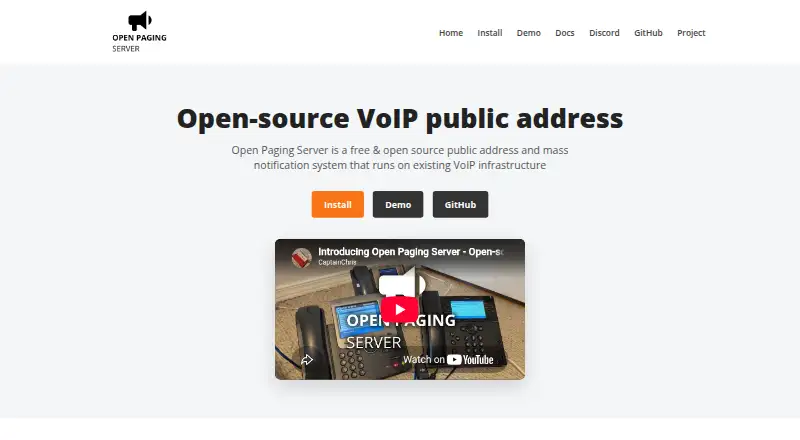
What Open Paging Server is
Open Paging Server is a public address and mass notification system that runs on existing VoIP infrastructure. It supports live paging, mass messaging, and bells through SIP connections to VoIP PBX or ITSP systems, as well as multicast broadcasts to IP phones or speakers. The project maintains first-party modules for several endpoint brands, including Cisco, Polycom, Yealink, and Snom, and supports third-party modules through its SDK. Its compatibility matrix lists Cisco Unified Communications Manager versions 11, 12, 14, and 15 as working as intended. It also lists Asterisk 18 through 23 and FreePBX 15 through 17 using chan_pjsip as working as intended. The software is self-hosted on Linux, with an automatic installer and Docker Compose instructions. The installer supports Debian 12 or later and Ubuntu 23.10 or later on x64 or ARM64. Open Paging Server is GPL 2.0 licensed and free for private, public, or commercial use. The maker says it is currently in beta and not ready for production use; support and community involvement are directed to Discord and GitHub.
Good
- Supports SIP and multicast connections to paging endpoints.
- Includes modules for Cisco, Polycom, Yealink, and Snom.
- Automatic installer supports Debian and Ubuntu on x64 or ARM64.
- Free for private, public, or commercial use.
Watch out
- The maker says it is not ready for production use.
- Automatic installer requires Debian 12+ or Ubuntu 23.10+.
Who it suits
Open Paging Server is aimed at small to medium enterprises familiar with system administration that want to run paging and notifications on existing VoIP infrastructure. It is not suited to production use while the maker says it remains in beta.
Verdict
Open Paging Server offers self-hosted paging and mass notification capabilities across listed VoIP systems and endpoints. Its beta status and stated lack of production readiness are important constraints for prospective users.
Plans and prices
From Open Paging Server's own pricing page, checked 14 Oct 2026.
| Plan | Price | What it gives you |
|---|---|---|
| Open Paging Server | Free | Private, public, or commercial use · self-hosted · GPL 2.0 |
The facts
Each one read from Open Paging Server's own pages, with the date it was checked.
What it does
- Bell scheduling
- The feature list includes bells for announcements or scheduled signals.checked 14 Oct 2026
- Beta status
- The maker says the software is currently in beta and not ready for production use.checked 4 Oct 2026
- Cisco integration
- Cisco Unified Communications Manager can synchronize phones through its AXL service and connect through a SIP trunk.checked 14 Oct 2026
- Compatibility
- The compatibility matrix reports working tests for Cisco UCM 11, 12, 14, and 15, Grandstream UCM6301/2/4/8, Asterisk 18–23, and FreePBX 15–17.checked 14 Oct 2026
- Database
- The documented deployments use MariaDB or MySQL for the application database.checked 14 Oct 2026
- Deployment
- The maker provides an automatic Linux installer and Docker Compose installation instructions.checked 4 Oct 2026
- Docker deployment
- Docker Compose installation is supported, although the documentation marks it beta.checked 14 Oct 2026
- Emergency notifications
- Cisco integration supports External Call Control Profiles that can trigger notifications for emergency-number calls.checked 14 Oct 2026
- Endpoint ecosystem
- The project supplies first-party endpoint modules and allows third-party modules through an SDK.checked 14 Oct 2026
- Example endpoints
- The project lists Cisco, Polycom, Yealink, and Snom among its official endpoint modules.checked 4 Oct 2026
- External API variable
- The `${api:URL}` variable fetches plain text from an external URL, while private and loopback addresses are blocked by default.checked 14 Oct 2026
- Features
- It supports live paging, mass messaging, and bells.checked 4 Oct 2026
- Independent adoption
- As of August 3, 2026, that account estimated more than 50 installations, about 50 Discord users, and over 500 GitHub commits.checked 14 Oct 2026
- Independent deployment
- A personal telecom site reports running Open Paging Server on an HP mini desktop alongside Cisco Unified Communications Manager and Asterisk.checked 14 Oct 2026
- Independent development
- The project evolved from PHP and Python scripts with Asterisk into database-backed modular endpoints and a custom SIP stack.checked 14 Oct 2026
- Independent endpoint support
- The independent development account describes added Polycom, Yealink, generic multicast, outbound SIP dialing, and manageable endpoint groups.checked 14 Oct 2026
- Independent history
- The same independent account says the project began in January 2026 and was publicly unveiled on May 15, 2026.checked 14 Oct 2026
- Intended users
- The maker describes it as designed for small to medium enterprises familiar with system administration and seeking cost savings.checked 4 Oct 2026
- Licence
- The project is released under GPL 2.0 and is free for private, public, and commercial use.checked 14 Oct 2026
- License and hosting
- The software is licensed under GPL 2.0 and can be self-hosted, allowing users to retain control of their data.checked 4 Oct 2026
- Limit: beta maturity
- The project warns that it is very early beta software, not tested or suitable for production, with incomplete documentation.checked 14 Oct 2026
- Limit: Cisco networking
- Cisco enterprise phones require HTTP reachability from the server and multicast or unicast RTP paths, which commonly prevents use across NAT.checked 14 Oct 2026
- Limit: demo privacy
- The public demo warns that users can receive messages sent by other users and should not remain connected long term.checked 14 Oct 2026
The company
- Company location
- The GitHub organization profile lists the organization location as United States of America.checked 14 Oct 2026
The full review of Open Paging Server
Open Paging Server adds paging and mass notification to organizations that already operate VoIP infrastructure. It suits small and midsize teams with Linux and systems-administration skills that want to self-host rather than buy a hosted service. The strongest case is cost-free control over data and endpoints; the decisive drawback is that the maker says it is still beta and not ready for production use.
Overview
This is a public-address and notification layer for an existing VoIP environment, not a replacement for a PBX or ITSP. It delivers live paging, mass messaging, and bells through infrastructure an organization already owns. The GPL 2.0 license permits private, public, or commercial use at no software charge, while self-hosting keeps operational data under the organization’s control.
That model favors administrators who can run Linux services, manage VoIP connectivity, and take responsibility for maintenance. Organizations wanting a vendor-operated service, or a system that works without an established voice platform, should consider a different category of product.
Key features
SIP connections reach VoIP PBX or ITSP systems, and multicast broadcasts can address IP phones or speakers. In practice, that gives compatible environments both telephony-based delivery and local network broadcast options. It is useful for announcements across offices, facilities, or connected speaker systems, but its usefulness depends on the quality and compatibility of the underlying voice deployment.
Official endpoint modules cover major brands such as Cisco, Polycom, Yealink, and Snom. An SDK allows third parties to add modules, which is valuable for mixed endpoint estates or equipment outside the first-party list. Administrators should still verify their exact devices and versions before making the software central to an alert workflow.
The compatibility matrix marks Cisco Unified Communications Manager 11, 12, 14, and 15 as working as intended. It also marks Asterisk 18 through 23 and FreePBX 15 through 17 with chan_pjsip as working as intended. Those entries provide a sensible starting point for teams on those releases, rather than a promise that every surrounding configuration will match.
Deployment guidance includes an automatic Linux installer and Docker Compose instructions. The installer supports Debian 12 or later and Ubuntu 23.10 or later on x64 or ARM64, giving teams a clear route on both conventional servers and ARM hardware. Community support is centered on Discord and GitHub, so organizations should be prepared to solve operational issues through community involvement rather than a commercial support desk.
Pricing
| Plan | Price | Best for |
|---|---|---|
| Open Paging Server | free | Private, public, or commercial self-hosting |
The free plan has no software subscription cost and is self-hosted. That makes it an attractive option for cost-conscious enterprises able to supply their own Linux, networking, VoIP administration, and support effort. The trade-off is not a reduced feature tier but the project’s beta status and lack of production readiness; organizations with safety-critical or business-critical notification requirements should not treat the zero price as a reason to waive operational review.
Platforms
Open Paging Server runs on Linux, is deployed as self-hosted software, and provides a web interface. The automatic installer targets Debian 12 or later and Ubuntu 23.10 or later on x64 or ARM64. Docker Compose is also supported for teams that prefer container-based deployment.
Who it's for
The intended audience is small to medium enterprises familiar with system administration and seeking savings on paging and notification software. It is a good fit when an organization already uses Cisco Unified Communications Manager, Asterisk, or FreePBX in the supported versions and wants to extend that investment to announcements and bells. It is a poor fit for teams that need production assurance, vendor-backed support, or a standalone cloud notification service.
Pros and cons
Pros
- No license charge: the plan is free for private, public, and commercial use.
- Self-hosted data control: GPL 2.0 licensing and local deployment keep the organization in charge of its data.
- VoIP-native delivery: SIP and multicast support can reach existing phones and speakers without introducing a separate paging network.
- Broad endpoint path: first-party modules for Cisco, Polycom, Yealink, and Snom are supplemented by an SDK for third-party modules.
- Clear deployment choices: an automatic installer and Docker Compose instructions cover conventional and containerized Linux setups.
Cons
- Not production-ready: the maker’s beta warning makes it unsuitable for deployments that require established production assurance.
- Administration burden: self-hosting leaves installation, VoIP integration, updates, and reliability work with the customer.
- Infrastructure dependency: the system adds capabilities to existing PBX, ITSP, and endpoint estates rather than replacing them.
- Community-led support: help is directed through Discord and GitHub instead of a commercial support channel.
Alternatives
For a broader category comparison, see Mass Notification Software.
- Text-Em-All (formerly Call-Em-All) is the better starting point for a hosted, freemium service on Android, iOS, API, and web; its free Starter tier includes 25 credits for voice-broadcast testing, while mass texting requires an upgrade.
- EMMA Notify is a paid option spanning Android, iOS, Linux, macOS, web, and Windows.
- Honeywell Forge is a paid, cross-platform suite with product-specific offerings and term-based licensing for Advanced Process Control.
- CrisisGo is a freemium, cross-platform choice; its Safety iResponse plan for independent schools costs $2,520 a year per school for up to 500 students.
- SA-Announce is a paid alternative with a free trial and self-hosted support.
- EmReach is a paid service for Android, API, and web.
- Everbridge Crisis Management is a paid, no-free-plan platform with a Professional offering sold through contact with sales.
- NetSupport Notify is a paid product with a free trial, available by perpetual or subscription licence on a custom quote.
Verdict
Choose Open Paging Server if your small or midsize organization already runs compatible VoIP systems, has Linux administration capability, and prioritizes free, self-hosted control over data and endpoints. Look elsewhere if notifications must be production-ready now, if you need vendor-backed support, or if you want a standalone hosted service without maintaining VoIP infrastructure.
Alternatives to Open Paging Server
- 1
Text-Em-All (formerly Call-Em-All)
Free planAndroidiOSWebAPI8.1From $19 a month - 2
NetSupport Notify
AndroidiOSWebExtension7.6$2 one-time - 3

OnPage
AndroidiOSWebAPI7.0From $13.99 a month - 4
PushPulse
AndroidiOSWebmacOS6.9From $540 a year - 5
SA-Announce
AndroidiOSAPImacOS6.8 - 6
TextSpeak NOTIFY!
AndroidiOSWebmacOS6.8$7,950 one-time