Hello Hunter Voice Broadcasting
Hello Hunter's PhoneCast is a web-based voice and call broadcasting service for small and medium-sized businesses.
What Hello Hunter Voice Broadcasting is
Hello Hunter's PhoneCast is a web-based voice and call broadcasting service for small and medium-sized businesses. Users upload recordings, manage calling lists, and control campaigns through a Flash-based interface. Its distributed calling system scales to over 100,000 calls per hour. Recipients can press keypad buttons to reach a live agent or SIP address, request do-not-call, or leave a message. Campaigns can run simple surveys and political polls with up to 12 answer options; managers can also set a separate voicemail message for detected voicemail boxes. Transferred calls can be routed to SIP addresses, PBX or Asterisk systems, and internet-based call centers. Campaign settings include before-and-after calling restrictions based on the destination time zone. The predictive dialer supports do-not-call filtering, configurable abandonment messages, and call outcome logging for FTC/FCC compliance. Exportable call-detail reports support usage tracking. The dialer requires a web browser and Adobe Flash. Listed plans start with Basic at $100 a month, with 4,000 minutes and a rate of $0.025 per minute. Support beyond the complimentary 30 minutes is billed at $30 per hour.
Good
- Campaigns can be scheduled by destination time zone
- Recipients can request do-not-call by keypad
- Call-detail reports are exportable
- Supports surveys with up to 12 answer options
Watch out
- Requires Adobe Flash and a web browser
- No free plan is listed
- Support beyond 30 complimentary minutes costs $30 per hour
Who it suits
PhoneCast may suit small and medium-sized businesses running prerecorded voice campaigns that need recipient keypad actions, surveys, or campaign scheduling. It also offers call-detail reports and API access through HTTP POST or XML SOAP calls.
Verdict
PhoneCast offers campaign controls, recipient keypad actions, and usage reports for voice broadcasting. Its Flash requirement and paid plans are important constraints to weigh before adopting it.
Plans and prices
From Hello Hunter Voice Broadcasting's own pricing page, checked 15 Oct 2026.
| Plan | Price | What it gives you |
|---|---|---|
| Basic | $100 a month | 4,000 minutes · $0.025 per minute · 4,000 minutes |
| Basic + | $200 a month | 8,000 minutes · $0.025 per minute · 8,000 minutes |
| Standard | $500 a month | 27,777 minutes · $0.018 per minute · 27,777 minutes |
| Pro | $1,000 a month | 62,500 minutes · $0.016 per minute · 62,500 minutes |
| Extreme | $2,000 a month | 153,846 minutes · $0.013 per minute · 153,846 minutes |
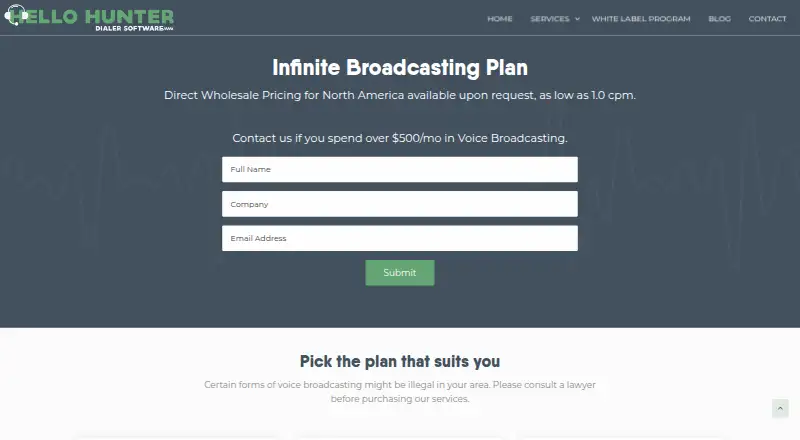
| Infinite | Priced on request | Unlimited minutes · $0.010 per minute · unlimited minutes · contact sales |
The facts
Each one read from Hello Hunter Voice Broadcasting's own pages, with the date it was checked.
What it does
- Action keys
- Recipients can press configurable keypad keys to transfer, request do-not-call handling or leave a message.checked 15 Oct 2026
- API
- The documented integration interface accepts HTTP POST or XML SOAP requests for telephony and CRM functions.checked 15 Oct 2026
- API examples
- Published integration examples include web lead posts, custom IVR forwarding, drip marketing, audio archiving, voice recognition, payment gateways and automated exports.checked 15 Oct 2026
- API integration
- Telephony and CRM functions are accessible through HTTP POST or XML SOAP calls, with custom integrations starting at $200.checked 1 Oct 2026
- Availability statement
- Hello Hunter says it performs daily backups, keeps at least two standby servers and customers typically experience under four hours of monthly downtime.checked 15 Oct 2026
- BYOC
- Customers may terminate traffic through their own SIP carrier; each new carrier setup requires a $100 deposit credited to usage.checked 15 Oct 2026
- Call-detail records
- Customers can export call-detail records and the vendor says unanswered calls are not billed.checked 15 Oct 2026
- Calling scale
- The distributed calling system scales to over 100,000 calls per hour.checked 1 Oct 2026
- Campaign control
- Users can upload recordings, manage lists, and start or stop campaigns through a Flash-based interface.checked 1 Oct 2026
- Campaign scale
- The maker says its distributed calling system can exceed 100,000 calls per hour.checked 15 Oct 2026
- Compliance controls
- The platform supports DNC filtering, call outcome logging and configurable abandon messages for stated FTC/FCC compliance workflows.checked 15 Oct 2026
- Documentation
- The public wiki covers setup, campaign creation, lead uploads, message uploads, real-time logs, exports, DNC lists, agent monitoring, administration and API FAQs.checked 15 Oct 2026
- FTC/FCC controls
- The predictive dialer supports do-not-call filtering, configurable abandonment messages, and call outcome logging for FTC/FCC compliance.checked 1 Oct 2026
- Funding
- GetLatka reports zero outside funding and labels its revenue and valuation figures as estimates.checked 15 Oct 2026
- Legal-use limitation
- The EULA places responsibility for TCPA, DNC, consent and prerecorded-message compliance on customers and allows suspension for suspected violations.checked 15 Oct 2026
- Licence
- The EULA grants a limited revocable license and states that all intellectual-property rights in the site and services remain with the company.checked 15 Oct 2026
- Limit: dynamic scripting
- A G2 reviewer said agent scripts are limited to one HTML page, creating problems for complicated call flows and a need for dynamic scripting.checked 15 Oct 2026
Where it runs
- Answering-machine detection
- The vendor claims 90% answering-machine detection accuracy and average usage savings of 30% when enabled.checked 15 Oct 2026
- Calling windows
- Campaigns provide never-call-before and never-call-after settings mapped to destination time zones.checked 15 Oct 2026
Money
- Billing records
- Customers receive fully exportable call-detail-record reports for usage tracking.checked 1 Oct 2026
The company
- Company identity
- Independent company profiles identify the maker as Predictive Dialer Limited, operating in IT, SaaS and telecommunications.checked 15 Oct 2026
- Company size
- BounceWatch and GetLatka each list approximately two employees.checked 15 Oct 2026
- Founded
- Independent company databases list Predictive Dialer Limited as founded in 2008.checked 15 Oct 2026
- Headquarters
- GetLatka lists the company headquarters as Chon Buri, Chon Buri, Thailand.checked 15 Oct 2026
The full review of Hello Hunter Voice Broadcasting
Hello Hunter Voice Broadcasting is a web-based PhoneCast service for sending prerecorded calls and managing campaigns. It best suits businesses that need large-scale voice outreach with keypad responses and telephony integrations. Its campaign controls are capable, but the Flash requirement and monthly usage commitments narrow its appeal.
Overview
PhoneCast combines broadcast management with recipient actions: listeners can transfer to an agent or SIP destination, opt out, or leave a message using their phone keypad. The stated capacity of more than 100,000 calls per hour is a substantial scale advantage for high-volume campaigns. That capacity matters less to smaller teams if monthly minute allowances and the legacy browser requirement are a poor fit.
Key features
- Campaign controls: Upload recordings, manage lists, and start or stop campaigns through a browser interface. Scheduling includes destination-time-zone rules that prevent calls before or after configured hours.
- Recipient actions and routing: Keypad responses can transfer callers to a live agent or SIP address, record a do-not-call request, or accept a message. Transfers can reach SIP addresses, PBX and Asterisk systems, or internet-connected call centers, making the service more useful when broadcasts need a path to human follow-up.
- Detection and voicemail: Hello Hunter states that answering-machine detection is 90% accurate and can cut usage fees by an average of 30% when used correctly. Managers can choose a separate custom voicemail recording or use the regular broadcast message when a mailbox is detected. Those savings are conditional, not a substitute for checking whether the plan's minute allowance fits campaign volume.
- Surveys and compliance controls: Simple surveys and political polling can offer up to 12 answer choices. The predictive dialer also supports do-not-call filtering, configurable abandonment messages, and call-outcome logging for FTC/FCC compliance; these controls support compliant operations but do not remove the need to configure campaigns appropriately.
- Reporting and integration: Exportable call-detail-record reports help track usage. Telephony and CRM functions are accessible through HTTP POST or XML SOAP, while custom integrations start at $200, an added cost for teams that need bespoke connectivity.
Pricing
The five priced plans charge a monthly fee and a per-minute rate. Their stated minute allowances align with those rates, so the practical choice is how much calling a team expects to do each month:
| Plan | Monthly price | Rate and allowance |
|---|---|---|
| Basic | $100 a month | $0.025 per minute; 4,000 minutes |
| Basic + | $200 a month | $0.025 per minute; 8,000 minutes |
| Standard | $500 a month | $0.018 per minute; 27,777 minutes |
| Pro | $1,000 a month | $0.016 per minute; 62,500 minutes |
| Extreme | $2,000 a month | $0.013 per minute; 153,846 minutes |
| Infinite | Custom pricing | $0.010 per minute; unlimited minutes; contact sales |
Basic and Basic + suit smaller or less frequent campaigns, but retain the higher $0.025 per-minute rate. Standard lowers the rate for a larger allowance; Pro and Extreme reduce it further for teams with substantial calling needs. Infinite is for buyers who need unlimited minutes and can work with sales on pricing. There is no free plan, and the entry plan starts at $100 a month, so occasional callers should compare usage-based alternatives before committing. Support includes 30 complimentary minutes; additional support is billed at $30 per hour.
Platforms
The dialer requires a web browser and Adobe Flash; it has been run on Windows, Mac OS, and Linux. That Flash dependency is the clearest practical drawback and makes this a poor fit for teams that cannot support it. The product is also identified for API use, but its browser dialer remains subject to the Flash requirement. Support tickets are typically answered within a few hours.
Who it's for
Hello Hunter is best for small and medium-sized businesses that need high-volume prerecorded calling, scheduled campaigns, keypad-driven responses, or SIP and CRM integration. The higher tiers make more sense when regular volume can use their larger allowances and lower per-minute rates. It is not a natural choice for occasional broadcasters, teams seeking a free starting tier, or organizations unable to use Flash.
Pros and cons
- Pro: Campaign capacity above 100,000 calls per hour supports unusually large outreach operations.
- Pro: Keypad transfers, opt-outs, voicemail capture, and SIP forwarding make broadcasts actionable rather than one-way announcements.
- Pro: Exportable call records and destination-time-zone scheduling help teams monitor usage and manage campaign timing.
- Con: The browser dialer requires Adobe Flash, which constrains compatibility.
- Con: There is no free plan, and the lowest priced tier costs $100 a month before considering campaign usage.
- Con: Custom integrations start at $200, and support beyond the complimentary 30 minutes costs $30 per hour.
Alternatives
- Voice Broadcasting Software is the category list to consult when comparing services across voice broadcasting tools.
- CallHub is worth considering for readers who want a free plan and free trial, or Android and iOS support alongside web and API access.
- Text-Em-All (formerly Call-Em-All) suits readers who want a freemium option with 25 credits for testing voice broadcasts and mobile apps.
- CallFire API is an API-only alternative with a pay-as-you-go option and no monthly fee.
- Newfies-Dialer is an alternative for readers seeking self-hosted and web access, with a free plan.
- VoiceShot may suit readers seeking a free trial and mobile apps.
- Call Loop offers month-to-month plans with stated credit allowances and unlimited contacts and users on its 250-credit plan.
- DialMyCalls is an alternative for readers who want a free trial, including a church account for up to 25 members and a 30-second weekly call.
- One Call Now is an alternative with a pay-as-you-go plan billed annually under contract.
Verdict
Choose Hello Hunter if your business needs large-scale prerecorded calling with recipient keypad actions, configurable routing, and usage reporting. Its scale and integration options are persuasive for regular, high-volume campaigns, but the Flash-dependent dialer and paid monthly plans are significant constraints. Teams with lighter needs, a requirement for mobile access, or no ability to use Flash should look elsewhere.
Alternatives to Hello Hunter Voice Broadcasting
- 1
CallHub
Free planAndroidiOSWebAPI8.2Free plan - 2
Text-Em-All (formerly Call-Em-All)
Free planAndroidiOSWebAPI8.1From $19 a month - 3
TmaxDialer Voice Broadcast
AndroidiOSWebAPI7.5$45 one-time - 4
One Call Now
AndroidiOSWebAPI7.4From $5 a year - 5

Newfies-Dialer
WebAPILinuxSelf-hosted7.2From $299 a month - 6
VoiceShot
AndroidiOSWebAPI6.8From $9 a month