
CallFire API
CallFire API v2 is a REST API for connecting applications to CallFire telephony services.
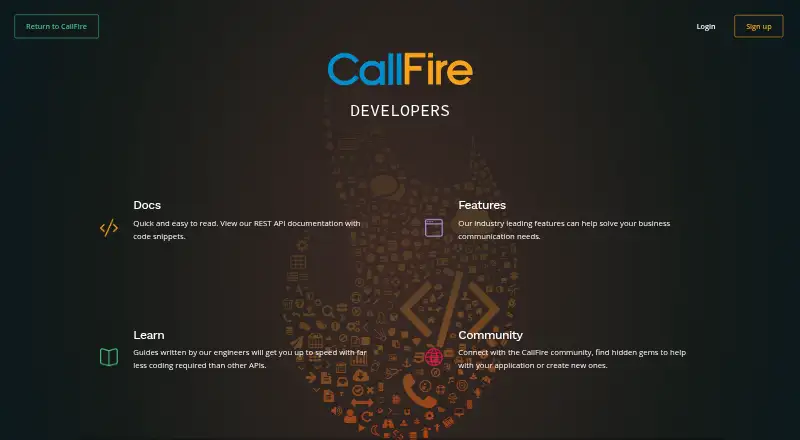
What CallFire API is
CallFire API v2 is a REST API for connecting applications to CallFire telephony services. It accepts requests from any HTTP client and returns JSON. Developers can use it for individual and broadcast text and voice messaging, inbound and outbound calling, number and keyword ordering, and call recording. Webhooks provide notifications for events such as campaign activity and incoming texts. The documentation also covers contacts, a sound library, short codes, and action states and results. Listed service features include campaign management, scheduling controls, real-time reporting, compliance solutions, and Do Not Call list management. CallFire says API traffic uses HTTPS with TLS and webhook calls use SSL certificates. Access uses separately generated HTTP Basic Authentication credentials; credentials for the standard CallFire interface do not work for API access. The developer site lists SDKs for Java, .NET, JavaScript, Python, and PHP, with the last three marked beta. CallFire advertises 99.95% uptime, 24/7 support, and messaging from one contact up to one million. Plans include Pay as you go at no cost, Lite at $99 a month, Startup at $199 a month, Grow at $299 a month, and Pro at $599 a month. Calls and texts stop when an account’s allowance reaches zero; extra credits cost 6¢ per credit. Plans include US and Canada calls, while international text messaging is not currently supported.
Good
- Supports individual and broadcast text and voice messaging.
- Offers webhooks for campaign and incoming-text events.
- SDKs are listed for Java, .NET, JavaScript, Python, and PHP.
- Includes call recording and real-time reporting.
Watch out
- No free plan is listed.
- Calls and texts stop when the account allowance reaches zero.
- International text messages are not supported.
- JavaScript, Python, and PHP SDKs are marked beta.
Who it suits
CallFire API suits developers integrating CallFire telephony into CRM platforms, mobile apps, or website backends. Teams should be comfortable generating separate API credentials and working within the listed geographic and allowance limits.
Verdict
CallFire API provides messaging, calling, and event hooks for applications using CallFire telephony services. Before choosing a plan, account for the usage allowance, extra-credit cost, and geographic messaging limits.
Plans and prices
From CallFire API's own pricing page, checked 8 Oct 2026.
| Plan | Price | What it gives you |
|---|---|---|
| Pay as you go | Free | Optional monthly rentals · $10.00 phone numbers · $25 keywords · no monthly fee |
| Lite | $99 a month | 2500 minutes/texts · Optional monthly rentals · $2.50 phone numbers · $20 keywords · $99/month |
| Startup | $199 a month | 5500 minutes/texts · Optional monthly rentals · $2.25 phone numbers · $15 keywords · $199/month |
| Grow | $299 a month | 10000 minutes/texts · Optional monthly rentals · $2.00 phone numbers · $13 keywords · $299/month |
| Pro | $599 a month | 20000 minutes/texts · Optional monthly rentals · $1.75 phone numbers · $10 keywords · $599/month |
The facts
Each one read from CallFire API's own pages, with the date it was checked.
What it does
- API type
- CallFire API v2 is a REST API that works with any HTTP client and returns JSON responses.checked 8 Oct 2026
- Authentication
- API v2 uses HTTP Basic Authentication with separately generated API credentials; standard CallFire UI credentials do not work as API credentials.checked 8 Oct 2026
- Compliance
- CallFire describes its developer software as including compliance solutions and lists Do Not Call list management among its features.checked 8 Oct 2026
- Geographic limits
- The pricing page says plans include calls to the US and Canada and that CallFire does not currently support international text messages.checked 8 Oct 2026
- Integrations
- The API can be used to integrate existing CRM platforms, mobile apps, or backend website architecture with CallFire telephony solutions.checked 8 Oct 2026
- Messaging and calling
- The API supports individual text and voice messaging as well as text and voice broadcast messaging.checked 8 Oct 2026
- Other capabilities
- The developer documentation includes contacts, number and keyword ordering, sound library, short codes, and action states and results.checked 8 Oct 2026
- Pricing allowance
- CallFire says calls and texts stop when an account's allowance reaches zero, and additional credits can be purchased at 6¢ per credit.checked 8 Oct 2026
- Scale and uptime
- The API features page advertises 99.95% uptime and messaging from one contact up to one million.checked 8 Oct 2026
- SDKs
- The developer site lists Java, .NET, JavaScript (beta), Python (beta), and PHP (beta) SDKs for API v2.checked 8 Oct 2026
- Security
- CallFire says communications between its endpoints and customer applications use HTTPS with TLS, and webhook calls use SSL certificates.checked 8 Oct 2026
- Service features
- CallFire lists campaign management, scheduling controls, free call recording, real-time reporting, and webhooks among its API features.checked 8 Oct 2026
- Support
- The API features page says support is available 24/7 through its support page.checked 8 Oct 2026
- Webhooks
- The API supports webhooks for event notifications, including campaign events and incoming texts.checked 8 Oct 2026
The company
- Headquarters
- Los Angeles, California, United Stateschecked 28 Sep 2026
The full review of CallFire API
Overview
CallFire API connects software to CallFire’s text and voice telephony services through a REST interface. It suits teams adding communications to an existing CRM, app, or website backend. Its breadth of messaging and campaign tools is useful, but monthly allowances, extra-credit costs, and North American messaging limits make volume and geography central to the choice.
Key features
API v2 accepts requests from any HTTP client and returns JSON, so developers can work with their existing stack. CallFire lists SDKs for Java, .NET, JavaScript, Python, and PHP; the JavaScript, Python, and PHP SDKs are beta, which matters for teams that want a language-specific starting point for a production integration.
The API supports individual text and voice messages and broadcasts in both formats. Campaign management, scheduling controls, real-time reporting, and free call recording support workflows that need more than message delivery. Contacts, number and keyword ordering, short codes, a sound library, and action states and results add campaign setup and follow-through tools. Webhooks report campaign events and incoming texts, letting an application react to activity as it happens.
API v2 uses HTTP Basic Authentication with separately generated API credentials; ordinary CallFire interface credentials will not authenticate API requests. CallFire says communications with customer applications use HTTPS with TLS and webhook calls use SSL certificates. Its developer features include compliance solutions and Do Not Call list management. CallFire advertises 99.95% uptime and messaging from one contact to one million, while also offering 24/7 support through its support page.
Pricing
CallFire’s plans pair a monthly allowance of minutes and texts with optional monthly rentals. The free Pay as you go tier has no monthly fee and no included usage quota is stated. Phone numbers cost $10.00 and keywords $25.00 on this tier, so it is a way to avoid a subscription rather than a predictable allowance for regular campaigns.
Lite costs $99 a month and includes 2500 minutes/texts; phone numbers are $2.50 and keywords $20.00. It is the lowest paid tier and fits modest recurring use, but its allowance can be exhausted quickly by frequent or larger campaigns. Startup costs $199 a month for 5500 minutes/texts, with phone numbers at $2.25 and keywords at $15.00. Grow is $299 a month for 10000 minutes/texts, with phone numbers at $2.00 and keywords at $13.00. Pro costs $599 a month for 20000 minutes/texts, with phone numbers at $1.75 and keywords at $10.00. These larger tiers make more sense as usage rises, and reduce the stated number and keyword costs.
When an account’s allowance reaches zero, calls and texts stop. Additional credits cost 6¢ per credit, so budget for overages if service interruption is unacceptable. Plans include calls to the US and Canada; international text messages are not supported. CallFire’s pricing note starts at $1/mo, but the listed monthly plans above show the allowances and costs relevant to choosing a tier.
Platforms
The API is the listed platform. Its HTTP client and JSON interface is intended for integration into existing software, including CRM platforms, mobile apps, and website backends; it is not presented as a standalone desktop or mobile application.
Who it's for
CallFire API is a fit for developers and organizations that already use CallFire telephony and need to embed messaging, voice campaigns, scheduling, or event notifications in their own systems. Teams that value language flexibility can use the REST interface directly, while those using Java, .NET, or the beta SDKs have language-specific options. Its advertised scale may appeal to high-volume senders, provided they choose an allowance that matches demand and can work within US-and-Canada calling coverage and the absence of international texting.
Pros and cons
- Broad communication coverage: Individual and broadcast text and voice messaging, inbound and outbound calling, and free call recording support several workflows through one API.
- Useful event handling: Webhooks cover campaign events and incoming texts, reducing the need for an application to depend only on polling.
- Flexible integration: Any HTTP client can use the JSON REST API, with SDKs listed for five languages; three are beta.
- Allowance can halt service: Calls and texts stop at zero balance, and extra credits cost 6¢ each, creating a real budgeting and continuity concern for busy campaigns.
- Geographic restriction: Calls cover the US and Canada, but international text messaging is unsupported.
- Credentials require setup: API access needs separately generated credentials rather than standard CallFire interface login details.
Alternatives
Choose CallHub if a free plan and trial or its listed Android, iOS, web, and desktop platforms better match your needs. Text-Em-All is worth considering for a freemium option with a free starting tier that includes 25 credits for testing voice broadcasts and test texting to your own number; mass texting requires an upgrade.
Newfies-Dialer may suit teams that want a self-hosted option, with its 25-port plan priced at $299 a month and including 5 agents, 1 tenant, and 10,000 daily calls and SMS. For a per-minute voice broadcasting plan, Hello Hunter Voice Broadcasting offers a Basic tier at $100 a month, billed at $0.025 per minute for 4,000 minutes. VoiceShot is another paid option with a free trial and an urgent-alert plan at $9 a month for 0–50 recipients, with no activation fee or contract.
Vasudev Voice Broadcasting is a paid, web-based alternative. Call Loop may fit readers seeking a month-to-month credit plan with unlimited contacts and users; its 250-credit tier costs $15 a month. DialMyCalls offers a free church trial for automatic calls to up to 25 church members, with a 30-second message once per week. Browse the voice broadcasting software category for more options.
Verdict
Choose CallFire API when you need to build CallFire texting and calling into an existing system and want broadcasts, campaign controls, and webhooks under one API. Its flexible REST interface and broad feature set are compelling for integrations with predictable North American usage. Look elsewhere if international texting is essential or if an allowance running out could interrupt critical communications.
Getting started
- Visit the CallFire developer site.
- Choose an available plan, including Pay as you go at no cost.
- Generate separate API credentials for HTTP Basic Authentication.
- Connect through an HTTP client or a listed SDK.
- Use webhooks for event notifications such as campaign events or incoming texts.
Limits worth knowing
Pay as you go has no monthly fee, while the listed monthly plans include specified minutes/texts: 2,500 on Lite, 5,500 on Startup, 10,000 on Grow, and 20,000 on Pro. Calls and texts stop when the account allowance reaches zero; additional credits can be purchased at 6¢ per credit. CallFire's pricing page says plans include calls to the US and Canada and that international text messages are not currently supported.
Questions
How much does CallFire API cost?
The listed plans are Pay as you go at no cost, Lite at $99 a month, Startup at $199 a month, Grow at $299 a month, and Pro at $599 a month. Additional credits can be purchased at 6¢ per credit.
Is there a free plan?
No free plan is listed. Pay as you go is billed with no monthly fee and is listed as free.
Which platforms and SDKs are available?
The platform is API. The developer site lists Java, .NET, JavaScript, Python, and PHP SDKs; JavaScript, Python, and PHP are marked beta.
What does the API support?
It supports individual and broadcast text and voice messaging, inbound and outbound calling, webhooks, campaign management, scheduling, call recording, and real-time reporting.
How does API authentication work?
API v2 uses HTTP Basic Authentication with separately generated API credentials. Standard CallFire UI credentials do not work as API credentials.
Can it send international text messages?
CallFire says international text messages are not currently supported. Its pricing page says plans include calls to the US and Canada.
Alternatives to CallFire API
- 1

Telnyx SIP Trunking
Free planAndroidiOSWebAPI8.0Free plan - 2

Callr
AndroidiOSWebAPI7.6From €599 a month - 3
D7 Networks
Free planWebAPI7.5$0.01 one-time - 4

Wazo Platform
Free planAndroidiOSWebAPI7.5Free plan - 5

46elks
Free planWebAPI7.0From €3 a month - 6

Amazon Chime SDK PSTN Audio
Free planAndroidiOSWebAPI6.9Free plan